Sunday, 5 July 2026

Bangarra’s Sheltering is a Powerful Showcase of First Nations Dance and Creativity, Opening at the Sydney Opera House

Dancer Donta Whitham is part of the triple bill 'Sheltering'. Photograph (above) by Daniel Boud. Cover picture of Hermes AW26 collection in Los Angeles by Max Farago.

By Erin Brannigan

Frances Rings’ artistic directorship of Bangarra Dance Theatre’s shines through the company’s new triple-bill production, Sheltering. She demonstrates a commitment to uplifting company members and First Nations creatives, with a coherent curatorial vision that shows care for diverse audiences.

This triple-bill is a beautiful sampler of what this important company has to offer to the cultural, political and creative facets of our nation.

A nurturing home for First Nations creatives

Sheltering comprises three individual choreographic works: Keeping Grounded, Brown Boys, and Sheoak.

Sheoak is a 2015 work by Rings herself, commissioned by then Artistic Director Stephen Page.

Keeping Grounded (2023) is choreographed by Indjalandji-Dhidhanu and Alyawarre woman Glory Tuohy-Daniell, with a cast of eight company dancers.

Keeping Grounded is performed by eight company dancers. Daniel Boud

The most recent work is a short dance film called Brown Boys (2024). It was directed by Cass Mortimer Eipper and Daniel Mateo, a Bangarra company member and Gomeroi and Mari Ma’ufanga, Tongatapu (Tonga) man.

Both Brown Boys and Keeping Grounded were first presented in Bangarra’s emerging artist showcase, Dance Clan, and supported from there onto the mainstage program. Creators Tuohy-Daniell and Mateo trained at NAISDA, Australia’s National Indigenous Dance College, and joined Bangarra through its Russell Page Graduate Program, which provides training and mentorship for new company dancers.

Keeping Grounded

Keeping Grounded opens onto an enormous and heavy rope net designed by Dyarubbin woman, Shana O’Brien. Under it, figures twitch and roll like a catch of fish.
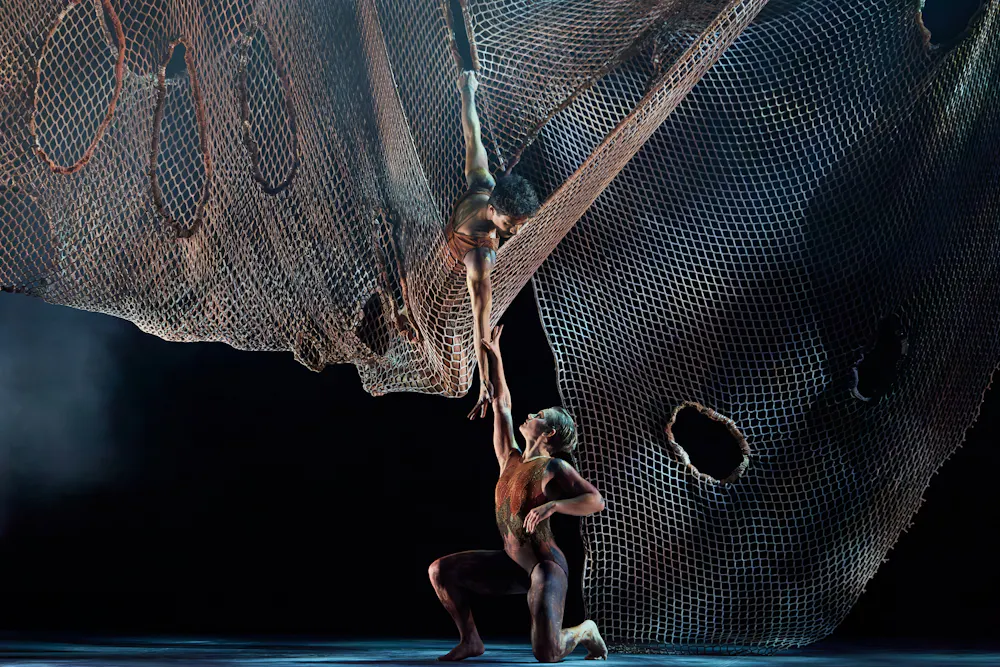
The set features a large heavy rope net designed by Dyarubbin woman Shana O’Brien. Daniel Boud

Karen Norris’ textured lighting supports the impression of a coastal setting, and “sets the scene” across the work as it shifts from an evocation of Country to a more technologically-mediated aesthetic.

In an interview with Glory Tuohy-Daniell, the choreographer describes how the work invites viewers “to consider how small, almost forgotten actions keep us grounded […] a step barefoot, a moment of stillness, a return”.

Tuohy-Daniell’s movement vocabulary is striking for its literal groundedness, reflecting the central theme highlighted in the work’s title.

The first sections see the dancers bound to the floor with a variation on the typical angular, rolling, swooping and sharply delineated shapes of Bangarra’s Indigenous contemporary style – here purposefully fractured.

Set to a score by Brendon Boney, the movement in this section is broken into one movement per beat, a staccato rhythm that suggests a disconnect from the flow of nature. This “pixellated” quality makes familiar forms new in an exciting way.

Brown Boys

Six-minute dance film Brown Boys is a meditation on the experience of young First Nations men. Daniel Mateo, the writer, choreographer and performer, has a cultural background spanning northern New South Wales and Tonga.

The program notes describe Brown Boys as a total work of art involving poetry, choreography, cinematography, sound and dramaturgy.

Adding to this is the central role of sculpture. Set and costume designer Elizabeth Gadsby has worked with traditional forms to establish a culturally informed aesthetic. This includes a fale (pronouned “fah-lay”), which is a traditional Tongan shelter made of grass matting. This structure frames Mateo’s body inside the film frame.

A fale is a kind of traditional Tongan shelter. Cass Eipper

Ochres, minerals and soils are other material elements featured in the design and choreography. The striking final image shows Mateo literally grounded by a soil mound that takes the silhouette of a 19th century crinoline skirt.

Mateo’s text and performance are extraordinary. His direct and settled gaze to camera, gentle unfolding movements, and spoken word poem, give visibility, dignity and complexity to the figure of the young Indigenous man. That he has “always been beautiful” could not be more persuasively portrayed.

Sheoak

Rings’ mastery of group choreography was recently showcased in her commissioned work for the Australian Ballet, Flora. Having delivered another major work for Vivid 2025, this was likely the right time to revive one of her classics.

The opening image of Sheoak showcases both Rings’ choreographic skill and Jennifer Irwin’s amazing legacy as a costume designer. The dancers wear shirts with black on white streaks – skeletal puzzle pieces that join together to form larger human sculptures.

Sheoak gives palpable form to the exhaustion and frustration experienced by First Nations peoples. Daniel Boud

The theme of this work is cultural strength, resilience and adaptability, with the sheoak tree as the central metaphor. Dancer Chantelle Lee Lockhart is captivating in the role of this “Grandmother tree”, as it’s known to the Dharawal people.

The choreography weaves around Jacob Nash’s set design, featuring seven two-metre-long branches. The passing of branches signals the struggle to pass on cultural responsibility and knowledge from generation to generation.

The company of technically virtuosic dancers seems right at home in each of the three diverse works of Sheltering. The program particularly underscores Tuohy-Daniell’s potential as a new leading light in Australian choreography

Sheltering as a whole is dedicated to the late David “Dubboo” Page, brother of former Artistic Director Stephen Page. David’s work as composer, singer and musician was central to establishing the Bangarra aesthetic. His music also features in Rings’ Sheoak.

Sheltering will now show at the Queensland Performing Arts Centre from July 9 to 18.The Conversation

Erin Brannigan, Associate Professor, Theatre and Performance, UNSW Sydney

Subscribe to support our independent and original journalism, photography, artwork and film.

Review: New Documentary Traces Kylie Minogue’s Career, From Harsh Early Critics to Pop Stardom

Portrait of Australian singer and actress Kylie Minogue by Steve Schofield. Her new documentary shows how the media has changed during the pop superstar's career, especially how women and their audiences are treated. 


By Liz Giuffre

Kylie's career is remarkably
enduring and successful.
Netflix’s three-part documentary about Kylie Minogue, Kylie, covers her nearly 40-year career. We go from the release of Minogue’s first self-titled album and time as an actor on Neighbours to the present day with a new single Light Up and preparations for an anniversary tour next year.

Minogue is well represented in this documentary. Her commentary shows her depth of character, understanding and connection as a music professional.

Minogue frames the documentary, sitting in what looks like her archive room, going through boxes of slides and mementos, including a glorious moment with a 1980s boombox which she says “started it all”.

As Adrian Renzo and I found in our book, Kylie, an exploration of her first album, there were different standards applied to Minogue than to her male contemporaries when she began in the industry

‘How would you feel if that was your daughter?’

Minogue and her sister, Dannii, started as children in the Australian music and media industries.Dannii was the first in the family to be a musician via Young Talent Time.

Kylie Minogue appeared as a child actor in shows like The Sullivans and The Henderson Kids. But her star truly arose with her role as Charlene Robinson in soap opera Neighbours. Her ascension in music and television collided in 1987 with her single Locomotion, and the famous wedding of Charlene and Scott (Jason Donovan).

Neighbours still: Charlene and Scott sit on a couch.
Kylie’s ascension in music and television collided in 1987 with her single Locomotion, and the famous wedding of Charlene and Scott. Netflix

As a musician and actor Minogue received huge commercial success, fuelled by young fans, many who were young girls and queer people. In the documentary she expresses great gratitude for her gay audience, and a shared sense of feeling out of place but still having pride in yourself.

Minogue also received harsh criticism from music industry “experts” who claimed she was too young or too “soapie” to deserve the success she achieved. One radio station launched an active “no Kylie” campaign.

Music industry figures dehumanised her by calling her a “singing budgie”. We found one critic at a major Sydney newspaper who wrote Minogue should get herself “in the path of a descending jumbo”.

The Netflix documentary explores the duality of this period. We see headlines saying “I Hate Her” and “She is Nothing”, edited with archival footage of happy crowds and Minogue on stage. Television archive footage of an unnamed male commentator says of Minogue “you no longer need to be interesting to get to number one, you can just be a sort of human, crocheted scarf”.

“Being 19 years old and having to cop that, that was unpleasant,” Minogue says, reflecting back on that time.

Later in the documentary, Minogue is more direct:

One of the terms used to describe me, the singing budgie, had the human part missing – who decides this is cool? […] What would happen if I met with them and sat face to face with them, and said ‘How would you feel if that was your daughter?’.

The reaction to Minogue at the time was damaging to her as an individual. It served as a reminder to those that loved Minogue – young girls like I was at the time, and young queer people like Adrian was at the time – that were not valued by those in positions of power.

Missing stories

Minogue’s triumph over the subsequent decades has shown those in power have changed.

It is no longer acceptable to target a young woman with suggestions of violence in the press. Those that would dismiss the value of an audience of young women or queer people now clearly would do so at their own cultural and financial risk.

The documentary does still fall into the trap of using Minogue’s male colleagues and relationships as a way of validating her.

Minogue’s influence in the United Kingdom and beyond is underpinned by international songwriter Peter Waterman. As one of the iconic songwriters and producers Stock, Aiken and Waterman (SAW), Waterman shows how Minogue was created as a global pop brand.

Kylie poses for a photo, wearing headphones.
Kylie was crafted into a global pop brand. Netflix

Nick Cave tells a large part of the story – worthy, but perhaps a bit uneven given it really was only one single they made together.

Donovan appears early on to discuss the early years, swearing about being overshadowed by her at the time but with no real malice.

It would have been great to hear more from Minogue’s female contemporaries and friends. Dannii Minogue is a regular feature, but others in more prominent spots would have been great.

Another key feature missing from the documentary is the Australian story, and the support provided to her by pioneering Australian record label Mushroom. While its founder Michael Gudinski has since passed away, Amanda Pelman, who signed Minogue to Mushroom, and released her memoir earlier this year, would have been a great addition.

As a documentary, Kylie tracks how the media has changed over the last few decades, especially when it comes to how women and their audiences are treated.

Minogue’s connection to her fans, her family and her work ethic is inspiring, as is her unapologetic celebration of the role pop music plays in making life worth living.

Kylie is now streaming on Netflix.The Conversation

Liz Giuffre, Associate Professor in Media, University of Technology Sydney


Subscribe to support our independent and original journalism, photography, artwork and film.

Monday, 29 June 2026

Paris Fashion Week: Bamboo, Balance and Beauty Define Issey Miyake's Vision of Modern Menswear

Issey Miyake presented an elegant and poetic SS27 collection in Paris for their label IM Men. Photograph (above) and cover picture by Jay Zoo for DAM.
Fashion designers often look to nature for inspiration, but few interpret it with the innovation and precision of Issey Miyake's IM Men Spring/Summer 2027 collection. Created by Sen Kawahara, Yuki Itakura and Nobutaka Kobayashi and shown at Paris Fashion Week, the Japanese label transformed the quiet poetry of bamboo into an elegant exploration of craftsmanship, movement and textile experimentation, delivering one of the season’s most thoughtful and technically accomplished collections. Story by Jeanne-Marie Cilento. Photography by Jay Zoo

The atmospheric, pale tones of the Paris runway
was contrasted with tall, black bamboo poles.
INSIDE the serene white space at Césure, the former university campus on Paris's Left Bank, Issey Miyake unveiled In Praise of Bamboo Shadows, a collection that transformed one of nature's most familiar forms into a sophisticated study of construction and material invention.

"The collection explores the perceptive intensity and sensorial flux evoked by the delicate presence of bamboo shadows, expressing them through clothing," the designers Sen Kawahara, Yuki Itakura and Nobutaka Kobayashi explained. That deceptively simple statement became the intellectual foundation for one of the week's most considered collections, where craftsmanship and experimentation unfolded with remarkable clarity.

Before the first look appeared, the audience was immersed in an abstract landscape of ethereal white with black bamboo and translucent screens. Shadowy figures drifted behind the semi-transparent installation, their outlines slowly sharpening as they stepped forward. The staging immediately established the collection's central dialogue between concealment and revelation, a recurring theme that continued throughout the show.

"The collection explores the perceptive intensity and sensorial flux evoked by the delicate presence of bamboo shadows, expressing them through clothing"

Bamboo shadows, a range inspired by 
East Asian ink paintings and intricate,
paper stencils used in katazome dyeing. 
Drawing inspiration from bamboo imagery found in East Asian ink paintings and the intricate paper stencils used in traditional katazome textile dyeing, the designers resisted the temptation to create literal interpretations. Instead, they distilled centuries of artistic tradition into garments that felt unmistakably contemporary.

The opening sequence introduced immaculate tailoring in black and white, where finely printed bamboo shadows drifted across sharply cut coats and relaxed suits. Produced using the Japanese ironaki dyeing technique on bamboo fibre blended with organic cotton, the prints possessed an extraordinary softness that blurred the boundary between textile and artwork.

As the collection evolved, silhouette became increasingly expressive. Oversized outerwear enveloped the body with effortless ease, while generous dolman sleeves and sculptural collars created garments that floated rather than imposed themselves. One particularly memorable series referenced the layered ceremonial robes associated with Princess Kaguya from The Tale of the Bamboo Cutter, translating historical dress into striking contemporary volumes without resorting to costume.

Lightweight denim carried subtle hand-finished bleaching that recreated the tonal gradients of bamboo depicted in ink landscapes

Denim in tonal gradients was created in a 
lightweight version with subtle bleaching. 
Textile development has always been fundamental to the Miyake philosophy, and here it remained the collection's greatest strength.

Lightweight denim carried subtle hand-finished bleaching that recreated the tonal gradients of bamboo depicted in ink landscapes, while jacquard fabrics reproduced the woven geometry of traditional bamboo basketry with astonishing three-dimensional precision. Blousons engineered from single rectangular pattern pieces revealed the studio's continuing fascination with reducing construction to its purest form.

Pleating, an enduring signature within the Miyake canon, was approached with fresh purpose. Instead of functioning merely as decoration, rhythmic hand-worked folds echoed the segmented structure of bamboo stems, giving garments an architectural rhythm that constantly shifted as the wearer moved. The result was clothing that appeared simultaneously sculptural and remarkably weightless.

Carefully removed pocket structures exposed underlying layers, allowing absence itself to become an active design element

Cut-outs were a feature, making
negative space part of the design. 
Perhaps the collection's most intellectually engaging proposition emerged through garments exploring negative space.

Carefully removed pocket structures exposed underlying layers, allowing absence itself to become an active design element. It was an elegant reminder that innovation often comes through restraint rather than addition.

Accessories extended the narrative with equal intelligence. Soft leather bags borrowed their form from chimaki, the traditional bamboo leaf-wrapped delicacy, while woven hats and sculptural headpieces subtly reinforced the show's botanical inspiration. Completing the looks was the latest evolution of Issey Miyake footwear, developed alongside ASICS, where the shoe's technical framework disappeared beneath a seamless textile skin, elegantly dissolving the distinction between sportswear and design object.

 Every colour felt connected to the changing light within a bamboo grove rather than the dictates of seasonal fashion.

The black and white part of the collection,
was enlivened with deep blues and pinks.
The restrained monochrome palette gradually gave way to earthy browns, sage greens, vivid royal blue and flashes of vibrant pink, introducing moments of optimism without disturbing the collection's meditative rhythm. Every colour felt connected to the changing light within a bamboo grove rather than the dictates of seasonal fashion.

While many collections this season have relied on spectacle to generate conversation, IM Men demonstrated that genuine innovation speaks with  greater authority. In Praise of Bamboo Shadows was not simply another exercise in technical excellence from the Miyake Design Studio. It was a reminder that fashion's future may lie not in making more noise, but in looking more closely, finding subtle possibilities in nature, tradition and the quiet precision of exceptional design.

See more highlights from the Issey Miyake IM Men Spring/Summer 2027 collection in Paris


Subscribe to support our independent and original journalism, photography, artwork and film.