Tuesday, 25 November 2025

To Understand the History of European Culture Start with the Minoans, Not the Ancient Greeks

Ruins of the ancient Minoan settlement in Gournia, Crete.  Photograph: Georgios Tschilis/Shutterstock
By Ellen Adams, King's College London

The Minoan culture was the first highly complex society on modern European soil, with palaces, writing, stunning art – and even flushing toilets. The Minoans lived in the bronze age (circa 3000-1200BC) on the Mediterranean island of Crete, which served as a stepping stone between Europe, Africa and Asia.

My new book, The Minoans, presents key features of their archaeology, including architecture, art, religion, writing, bureaucracy and the economy. It explores how this pioneering European civilisation has influenced western culture – and how Minoan culture has been reconstructed, re-imagined and represented in museum displays.

Traditionally, the ancient Greeks have been viewed as the fountainhead of European civilisation, but Minoan culture was flourishing many hundreds of years earlier. Despite this expanse of time, there was a loose dialogue between them: the Minoans influenced the Mycenaeans, who themselves were early Greeks, and the later classical Greeks indicate some “memory” of the Minoans, as filtered down through their myths.

For example, in the later Greek stories (from the first millennium BC), Crete is closely associated with bulls. Zeus took the form of a bull when he seized the Phoenician princess Europa and forced her to the island to initiate the Minoan bloodline. She bore Minos whose wife, Pasiphae, submitted to her passion for Poseidon’s bull, producing the minotaur.

In Minoan art, bulls are everywhere. Archaeologists have found bronze age ritual libation vessels – used for pouring liquid sacrifices to the gods – crafted into the shape of a bull’s head, and large gold rings depicting people leaping over bulls. The echoes of history, myth and ritual seem to have rippled through the generations, to later be reproduced and re-imagined by the ancient Greeks.
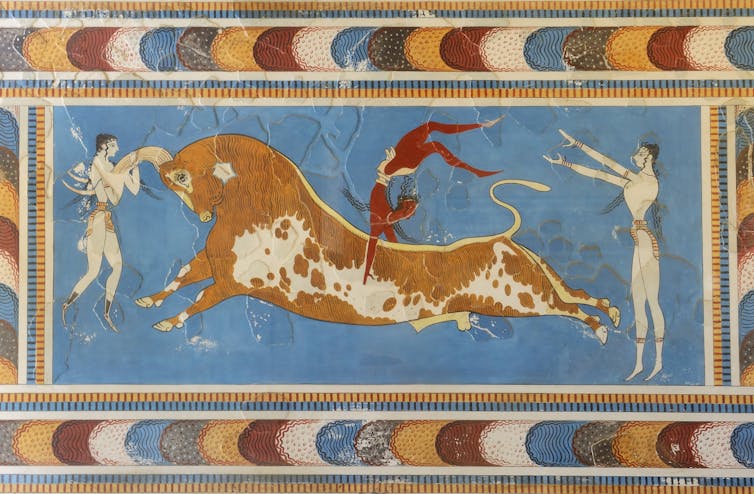
Fresco showing two people and a bull
A bull fresco from Knossos Palace in Crete. Pecold/Shutterstock

It is therefore essential for people who want to understand the history of Europe to study the influence the Minoans have had on the ancient Greeks and modern Europeans – in particular, the evidence coming from the great digs conducted on the island in the early 20th century. These include the excavations by the British archaeologist Arthur Evans at Knossos, Crete, a vast site with complexity that may lend itself to the Greek labyrinth myth.

While the image of the bull is particularly widespread here, there is little association between this creature and women, as later appears in the myths. Women are linked with other animals, though, such as serpents, as shown by the snake goddess figurines that Evans found in the Palace of Knossos in 1903.

Snakes in Minoan art

These snake goddesses were found hidden in large stone-lined pits, in a very fragmentary state. Numerous riches were in this deposit: hundreds of shells, clay and stone vessels, clay seal impressions (used for documentation), Linear A inscriptions (a writing script) and animal bones.

The remains of five or six female figurines were found, but only two have been reconstructed. They have become icons of Minoan culture and poster girls for Crete, standing out due to their eye-catching costumes. These are tight, corseted jackets that leave the breasts bare, with floor-length full skirts – their heaviness serving to emphasise the exposed breasts even more.

Sepia photo of figurines.
The remains of the figurines found in the Palace of Knossos in 1903. Wiki Commons

The slightly larger one is a matronly figure with a tall, conical hat. Her snake-entwined arms are held at around 45 degrees, palms up and set approximately in line with her navel. Snakes drape over her as she stares straight ahead.

The second figure raises her bright white arms, bent at the elbow, up and out to her sides, flexed slightly forward. She clutches snakes, and a feline creature balances on her hat.

These figurines offer food for thought about the reconstruction processes that archaeologists undertake. First, Evans gave the title “goddess” to the larger figurine, and “votary” (meaning a worshipper who has taken vows) to the smaller one. This is arbitrary: we cannot know who these figurines represented, whether they were human, as a dignitary or priestess, or divine – we just sense they were VIPs.

Furthermore, when viewing these extraordinary objects in the Heraklion Museum in Crete today, the visitor may be unaware of the extent to which they have been reconstructed, and how much is an early 20th-century creation.

For example, the votary’s head, with its distinctive, wide-eyed stare, is entirely modern, as is her left arm, added soon after she was excavated. The object held in her right hand was broken off – only a very small piece of the original remained in her clenched fist. The reconstruction of snakes as the objects she holds is not so absurd – her sister has them running all over her as a comparison – but recent research has cast some doubt on what she originally held.

In addition to reconstructing the originals, people have also re-imagined these striking figurines in numerous ways – in replicas as souvenirs, as Barbie dolls, in graffiti (particularly in Heraklion) and in advertisements. They have appeared as book covers and inspired modern literature as well as visual and performative art.

Adaptations of them have come to life in poetry, opera, dance and music. A performer led the historical procession as the snake goddess in the opening ceremony for the 2004 Olympic Games in Athens. The Many Lives of a Snake Goddess project, which I am part of, seeks to understand the cultural biographies of these objects. It shows their legacy has been great partly because we have recreated them in such varied ways.

Minoan Crete is important not only because of any claims made for its place as the fountainhead of European civilisation, but also because its art and archaeology have done so much to shape modern culture.

Ellen Adams, Professor in Classical Archaeology and Museum Access, King's College London


Subscribe to support our independent and original journalism, photography, artwork and film.

Monday, 24 November 2025

The Romance of Ruin: How Designers Use Grime, Decay, and Upcycling to Redefine Fashion

Iamisigo, hand-woven raffia cotton blend look dyed with coffee and mud, Shadows, Spring/Summer 2024.  Photograph by Fred Odede. Courtesy of Iamisigo. 

In a world where fashion often dazzles with perfection, the Barbican’s latest exhibition takes a deliberate step into the mire. Dirty Looks: Desire and Decay in Fashion unearths the beauty of what is usually hidden, unwanted, or discarded. From rust-stained gowns to mud-soaked textiles and upcycled couture, the show reveals how designers across decades have embraced imperfection not as flaw but as force, challenging ideals of luxury, exploring our ties to the earth, and imagining fashion’s future in an age of crisis. Story by Antonio Visconti

Yuima Nakazato, Couture
Spring/Summer 2023.
Photograph: Morgan O'Donovan
WHAT happens when silk meets soil, or satin is left to rust? The Barbican’s exhibition Dirty Looks: Desire and Decay in Fashion invites us to linger in that space where beauty collides with entropy. Here, clothing becomes both relic and rebellion, carrying traces of time, memory, and the earth itself.

Few exhibitions capture that tension as vividly as this exhibition at the Barbican Art Gallery. The show casts its gaze on fashion’s fascination with all things sullied, frayed, and imperfect: an embrace of dirt and decay that is as much about culture, politics and the environment as it is about aesthetics.

This is no simple celebration of ripped jeans or distressed leather. Instead, the show positions “the dirty” as an idea with a surprisingly long and layered history. 

Across more than a hundred works, the exhibition tracks how grime, rust, stains, and even microbial erosion have been reimagined as symbols of rebellion, spirituality, and renewal. In doing so, the show challenges the long-standing myth that fashion’s ultimate aim is flawless beauty. 

"This exhibition brings together a remarkable breadth of global designers who are radically reshaping what fashion can mean and do today. With its focus on decay, renewal and the aesthetics of imperfection, Dirty Looks invites us to reconsider beauty, value and the regenerative power of making in a world in flux," explains Shanay Jhaveri, head of visual arts at the Barbican. 

More than a hundred works tracks how grime, rust, stains, and even microbial erosion are symbols of rebellion, spirituality, and renewal

Maison Margiela, Artisanal
Spring/Summer 2024
©Catwalkpictures

For centuries, luxury has been synonymous with polish. The shimmer of silk, the gleam of polished shoes, the perfection of a couture gown, these were signals of wealth and refinement, markers of distance from the messy business of everyday life. Dirt was, to borrow anthropologist Mary Douglas’s phrase, “matter out of place.” To carry a stain was to carry shame.

But beginning in the late 20th century, designers began to turn that assumption on its head. Punk’s ragged safety-pinned uniforms, the raw hems of Japanese avant-garde tailoring, and the oxidised garments of Hussein Chalayan all suggested that imperfection could be a radical aesthetic choice. 

It was not simply about shock value; it was about dismantling hierarchies of taste and class. What had once been described as low or unworthy elements of creative power.

The exhibition's curators, Karen Van Godtsenhoven and Jon Astbury, situate this trajectory within broader cultural currents. Dirt in fashion, they argue, is not only visual but metaphorical: it speaks to environmental decline, colonial legacies, and the tension between our digital lives and our yearning for the natural world. In their view, to look at dirty clothes is also to look at the dirty truths of the industry itself.

The line-up of designers featured is as ambitious as it is eclectic. Established titans such as Alexander McQueen, Vivienne Westwood, Maison Margiela, are shown alongside a new generation of experimental voices such as Yuima Nakazato, Solitude Studios, and IAMISIGO. The juxtapositions make clear that “dirty fashion” is not a passing trend but a recurring impulse that reinvents itself across decades and continents.

Japanese couturier Yuima Nakazato vision of decay is not an end point but the raw material for something startlingly new

Hussian Chalayan,
Temporary Interference
Spring/Summer 1995
Courtesy of Niall McInerney
Highlights include Chalayan’s legendary Tangent Flows collection, where dresses were literally buried in a London backyard until they rusted into fragile relics. Robert Wun’s sculptural gowns, stained with wine and scorched by fire, reinterpret decay as grandeur. Meanwhile, Nigerian designer Bubu Ogisi and her label Iamisigo use natural fibres and indigenous craft to symbolically restore connections severed by colonialism.

Japanese couturier Yuima Nakazato offers one of the exhibition’s most poignant contributions. His work, born from encounters with mountains of textile waste in Nairobi, transforms discarded clothing into luminous new fabrics through advanced recycling technologies. In Nakazato’s vision, decay is not an end point but the raw material for something startlingly new.

One of the exhibition’s more surprising threads is what curators call the “nostalgia of mud.” It suggests that our fascination with dirt is not only about disruption but also about longing. Displays such as Queen Elizabeth II’s worn wellington boots and Kate Moss’s festival-soaked footwear illustrate how muddy encounters, whether on a royal estate or in the chaos of Glastonbury, carry a cultural cachet of authenticity.

Elsewhere, the show looks further back, drawing connections to ancient rituals in which soil and bogs were linked to fertility, sacrifice, and spiritual transformation. Solitude Studios, for example, submerges cloth in Danish bogs, letting microorganisms partially consume the fabric before presenting it as couture. What emerges is less about fashion as surface decoration and more about clothing as a living, breathing participant in the cycles of nature.

The show reminds us of fashion’s environmental toll as one of the world’s most polluting industries, producing waste on an extraordinary scale

Comme des Garcon,
Autumn/Winter 2005
'Broken Bride'
 ©Catwalkpictures
The physical staging of the exhibition itself part of the narrative. Studio Dennis Vanderbroeck, known for pushing the boundaries of theatrical design, has transformed the Barbican’s galleries into a series of uneasy contrasts: pristine white walls interrupted by surfaces that appear corroded, worn, or broken down. The installation insists that visitors confront both glamour and grit at once, collapsing the divide between the gallery and the garment.

Beyond spectacle, the show is a pointed reminder of fashion’s environmental toll. The industry remains among the world’s most polluting, producing waste at an extraordinary scale. By showcasing garments that revel in imperfection, upcycling, and decomposition, the exhibition suggests that alternative approaches, whether folkloric, technological, or spiritual, might offer blueprints for a more responsible future.

Yet this is not a didactic climate change show. Its power lies in its refusal to separate aesthetics from politics, beauty from decay. It insists that the act of getting dirty, whether through mud, rust, or creative reuse, is as much about desire as it is about critique. To stain a dress is not only to mark time but to open up possibilities of transformation.

It has been eight years since the Barbican last staged a major fashion exhibition, and this one arrives with a sense of occasion. Building on past successes with Viktor & Rolf, Jean Paul Gaultier, and Japanese avant-garde fashion, Dirty Looks: Desire and Decay in Fashion signals a renewed commitment to exploring fashion as a vital strand of contemporary culture.

By the time visitors leave the show, they may find themselves looking differently at their own wardrobes, the frayed cuffs, the grass-stained shoes, the jumper that has outlasted seasons of wear. Far from being discarded, these imperfections might be recast as part of a much larger narrative: one in which dirt is not an enemy to beauty, but its most honest companion.

Dirty Looks: Desire and Decay in Fashion is at the Barbican Art Gallery, London from 25th of September to January 25th, 2026. Visit: Barbican

Subscribe to support our independent and original journalism, photography, artwork and film.

Sunday, 9 November 2025

In Full Stride: Equestrian Energy Meets Bohemian Rebellion in Shiatzy Chen’s SS26 Paris Collection

Long, swinging hair and natural make-up added to the feeling of a Seventies ethos of liberation in Shiatzy Chen's new collection in Paris. Photograph (above) by Jay Zoo for DAM.  

Shiatzy Chen’s Spring/Summer 2026 collection at Paris Fashion Week, captured the untamed energy of the horse and the free-spirited ethos of 1970s bohemian style. Blending flowing fabrics, intricate embroidery, and equestrian-inspired details, the designs merged Eastern craftsmanship with Western silhouettes. Through a palette that ranged from earthy neutrals to vibrant neons, and playful combinations of structured tailoring and relaxed layering, the Taiwanese designer celebrated movement, individuality, and cultural dialogue, delivering a collection that was at once romantic, bold, and contemporary. Story by Jeanne-Marie Cilento. Photographs by Jay Zoo 

Leather straps and belts
gave the collection an
equestrian theme. 
CALLED Unstill, Shiatzy Chen's new collection was designed to suggest the energy of a horse in full stride. Drawing on equestrian symbolism to inspire her work, Chen’s vision merged the romantic rebellion of the 1970s with modern tailoring, creating an East-meets-West aesthetic that felt both liberated and finely crafted.

From the first look, the collection exuded movement and freedom. Textiles such as chiffon, lace, and lightweight cotton-linen moved with each step, punctuated by the structured curves of saddle-inspired pockets and tailored flares. 

The designer's signature embroidery appeared throughout, not as ornamentation, but as storytelling, adding a certain vitality to each garment. Multi-directional patterns and ribbon detailing recalled the handcraft of folk art, while maintaining a sophistication suitable for Paris’ discerning fashion audience.

Color played a central role in the collection’s narrative. Tobacco browns and coffee tones suggested the earthy landscape of a sun-drenched horizon, while blues, fuchsias, and cobalt punctuated the neutrals like bursts of bright sunlight on a wild meadow. Black and white served as grounding elements, echoing the elegance and discipline inherent in Chen’s tailoring. Together, the palette reflected the duality of the collection: daydreaming wanderers and nocturnal revelers, pastoral calm and disco vibrancy coexisting in balance.

There was a freedom to mix and match, with unexpected pairings such as crochet tops with suiting or pajamas as outerwear, a playful nod to the era of bohemian experimentation.

Silk scarves and softly
flowing, floral designs
enhanced the 70's style.
Flared pants paired with cropped vests, flowing lace blouses over soft skirts, and layered long-on-long looks created a sense of casual sophistication. 

Menswear-inspired pieces were equally dynamic: cropped jackets, leather trousers, cargo-style curves, and bell-bottoms fused utilitarian strength with poetic grace. The freedom to mix and match was emphasized, allowing for unexpected pairings such as crochet tops with suiting or pajamas as outerwear, a playful nod to the era of bohemian experimentation.

Accessories reinforced the equestrian and hippie motifs. Triangular silk scarves became headbands or neckerchiefs; saddle-shaped bags with dimensional clasps offered a subtle nod to the horse motif; while jewellery repurposed bits and horseshoes into necklaces, brooches, and belts. Footwear included reimagined Mary Janes, platform sandals, and brogues, some with metallic accents, merging functionality with exuberant style.

What set this collection apart was Chen's ability to channel her horse-inspired themes into designs that evoked a sense of liberation. Balancing her feel for ethereal romance and bold physicality, the designer was able to fuse Eastern sensibilities with a Western bohemian spirit. In Unstill, Shiatzy Chen once again demonstrated why she is one of the few designers who can continually reinvent the dialogue between heritage and modernity and East and West, in new and interesting ways.   

Scroll down to see more highlights from the Shiatzy Chen SS26 show at the Palais de Tokyo in Paris


Backstage at Shiatzy Chen before the Spring/Summer 2026 show at the Palais de Tokyo in Paris


Subscribe to support our independent and original journalism, photography, artwork and film.