Tuesday, 7 July 2026

Paris Haute Couture: Ronald van der Kemp's Art of Reinvention in an Age of Excess

A highlight of RVDK's Paris AW26/27 haute couture show was this sleek jacket beautifully tailored and created from woven silk and metallic lurex, worn with a bejewelled belt. Cover picture and photograph (above) by Brittany Scott for DAM


At a time when fashion is being forced to confront its own excesses, Ronald van der Kemp continues to chart a singular course through the world of haute couture. Unbound by convention yet respectful of fine craftsmanship, the Dutch designer transforms forgotten luxury materials into creations that blur the boundaries between fashion, art and innovation. Presented during Paris Haute Couture Week, his new Autumn/Winter 2026-2027 collection was a reminder that some of fashion's most exciting frontiers lie not in endless newness, but in the creative reinvention of what already exists. Story by Jeanne-Marie Cilento. Photographs by Brittany Scott 

The look that opened the 
RVDK show in Paris.
RONALD Van der Kemp has built a couture house around a radically different definition of luxury since founding RVDK in 2014. For his new collection, Vive L'Art, those ideas are once more the foundation of work celebrating creativity, intuition and transformation. 

As the designer says in his show notes: "Make. Break. Transform." It is an approach that embraces experimentation, allowing materials to evolve through craftsmanship, imagination and discovery rather than convention.

Rather than embracing fashion's relentless cycle of production, he creates limited-edition pieces from existing resources, working with luxury surplus, rescued textiles, forgotten treasures and innovative techniques to give discarded materials an extraordinary second life.

The philosophy was brought vividly to life with his new designs that are created like wearable works of art. The opening coat immediately established the collection's direction with a dramatic, sinuous silhouette of curving panels in brilliant hues of red, blue and green made from fragments of exotic skins, antique jacquards and metallic brocades. Finished with handcrafted three-dimensional decorative elements, the richly textured design demonstrated how reclaimed luxury materials could be transformed into something entirely original.

In a fashion industry increasingly driven by speed and consumption, RVDK remains refreshingly committed to a slower, more thoughtful form of luxury

A vibrant blue wrap jacket 
 designed cleverly like a stole, 
shows the designer's skill. 
Tailoring is one of Van der Kemp's great strengths. An electric-blue wool bouclé wrap jacket had a striking avant-garde form, like a stole, and was combined with jeans and a crêpe de chine top (see at right). Another sharply tailored black satin jacket featured velvet lapels and an asymmetric peplum combined with a silk organza pencil skirt overlaid with lace, balancing sculptural precision with delicacy.

An engaging mini dress was created from tweed and left with deliberately raw edges that flowed into a dramatic silk taffeta-lined train. A floral lace gown concealed colourful lining fragments beneath its surface, while sculptural details and a floriate corsage added unexpected depth and dimension. 

Softer moments arrived, where blush plissé drapery cascaded from sculptural shoulders in a blouse before meeting a fluid silver pleated skirt, offering an elegant counterpoint to the collection's more architectural looks.

Elsewhere, Van der Kemp continued to dissolve the boundaries between couture, art and innovation. A beautifully tailored jacket woven in silk and metallic lurex with an elegant peplum shape, complete by a jewelled belt and silver lambskin trousers (see main image). Futuristic glamour was encapsulated with a broad-shouldered jacket with appliqués over a black mini skirt while other designs had oversized silhouettes, mohair, exaggerated hardware and unexpected decoration, elevating the designs into conceptual fashion statements. 

Ronald van der Kemp shows how couture's greatest power lies not only in creating beautiful clothes, but in transforming forgotten materials, preserving cultural memory and challenging our perceptions

The hand-embroidered textile
originally created for a 
Josephine Baker costume.
One of the collection's most poignant moments came with a look created with a hand-embroidered textile originally created for a costume intended for Josephine Baker's cancelled 1968 revue at the Olympia in Paris, designed by André Levasseur, Christian Dior's former assistant and Baker's longtime costume designer (see at left).

Conserved for decades before finding its way to RVDK, the historic embroidery was finally realised as couture, a tribute to Baker's enduring legacy as an artist, humanitarian and resistance hero. It embodies Van der Kemp's belief that fashion can conserve history while simultaneously creating something entirely new.

Art has always been central to Ronald Van der Kemp's work, and this collection expanded that vision beyond clothing. Jewellery, brooches, hair pieces, moving sculptures and wearable artworks, all fashioned from recycled materials, overstock components and found objects, became integral parts of the narrative. Rather than accessories, they reinforced the idea that couture can exist as a complete artistic expression, where every object contributes to the story.

This collection demonstrated that sustainability need not come at the expense of glamour or imagination. Instead, Van der Kemp proposes a future where responsibility enhances creativity, proving that innovation often begins with rediscovering what already exists.

In a fashion landscape increasingly driven by speed and consumption, RVDK remains refreshingly committed to a slower, more thoughtful form of luxury.  Ronald van der Kemp once again shows that haute couture's greatest power lies not simply in creating beautiful clothes, but in transforming forgotten materials, preserving cultural memory and challenging our perceptions.

    See the rest of the RVDK Haute Couture Autumn/Winter 2026-2027 Collection in Paris


Subscribe to support our independent and original journalism, photography, artwork and film.

Monday, 6 July 2026

Paris Haute Couture: Imane Ayissi and the New Geography of Luxury, Where Cultures Come Together

One of the soigne, jewel-coloured gowns that were a highlight of Imane Ayissi's AW26/27 haute couture collection in Paris. Photographs and cover picture by Andrea Heinsohn for DAM

Haute couture is at its most engaging when fine craftsmanship is matched by a powerful point of view. At Paris Haute Couture Week, Imane Ayissi once again demonstrated why he occupies such a distinctive place on the official calendar. Presenting his new Autumn/Winter 2026-2027 collection, the couturier unveiled a collection that fused sculptural elegance, artisanal mastery and cultural storytelling into a personal vision of contemporary couture. Story by Jeanne-Marie Cilento. Photography by Andrea Heinsohn

The couturier Iman Ayissi with his new collection at the
finale of his joyous show in at the Aero Club de France.
AMID the gilded salons of the Aero Club de France in Paris, Imane Ayissi prepared to present Ozouandam Ollat, the Ewondo expression for haute couture, a collection that reaffirmed his voice within the international couture landscape. The show culminated in an impromptu and joyous dance on the runway. 

For the new season, the Cameroonian-born, Paris-based designer explored the relationship between movement, memory and craftsmanship, creating a refined vision of couture where once more he melds the precision of Parisian savoir-faire and the richness of African artisanal traditions.

Presented as part of the official Paris Haute Couture Week calendar, where Ayissi appears as a guest member of the Fédération de la Haute Couture et de la Mode, the collection demonstrated his continued commitment to expanding the language of couture beyond geographical boundaries. His work has always existed at the intersection of cultures: not as a contrast between African heritage and European technique, but as a sophisticated dialogue between two creative worlds.

The Autumn/Winter 2026-2027 show began with the atmosphere of departure and flight, setting the tone for a collection built around transformation and freedom. An announcement inviting guests to prepare for takeoff introduced a theatrical sense of movement, while also carrying an emotional resonance for Ayissi, paying tribute to his late mother, a former Miss Cameroon and flight attendant whose elegance and presence remained an important influence throughout his life.

Imane Ayissi's work is at the intersection of cultures: not as a contrast between African heritage and European technique, but as a sophisticated dialogue between two creative worlds

One of Ayissi's vividly hued new designs that
explore fine, beadwork and floriate patterns.
This emotional connection was expressed through garments that appeared to defy stillness. Ayissi’s silhouettes moved between structure and fluidity, balancing architectural precision with dramatic gestures of fabric. 

Sculptural dresses unfolded into sweeping capes and extended trains, while carefully constructed volumes created a sense of power without sacrificing elegance. Each look revealed the designer’s understanding that couture is not simply observed, it is experienced through the movement of the body.

That sensitivity to motion is deeply connected to Ayissi’s own artistic history. Before becoming one of the most recognised couturiers of African heritage, he trained as a dancer with the Ballet National du Cameroun, an experience that continues to influence his approach to form, proportion and rhythm. His early career as a model in Paris, working with renowned maisons including Dior, Yves Saint Laurent and Givenchy, further immersed him in the traditions of French luxury before he established his own couture house.

Born into a family surrounded by creativity, Ayissi grew up with a fine appreciation for performance and craftsmanship. His mother’s achievement as Miss Cameroon 1960, his father’s career as a champion boxer and the artistic pursuits of his siblings created an environment where discipline and expression were intertwined. These influences continue to shape a designer whose collections are as much about identity and storytelling as they are about design.

By bringing together personal history, global craftsmanship and an unmistakable creative identity, the designer is helping shape a more expansive future for couture

This sleek, brilliant red suit is beautifully cut and 
has a dash of romance with its swathe of raffia. 
For this collection, Ayissi once again placed materials at the centre of his creative vision. Luxurious silks, raffia, handwoven textiles and intricate embroidery demonstrated his ability to elevate traditional techniques into contemporary couture. 

Rather than using heritage as a decorative reference, he treats craftsmanship as a living practice, giving African textile traditions a place within the highest levels of international fashion.

The collection’s colour palette intensified its emotional impact, moving through vibrant blues, rich oranges, luminous jewel tones and softer shades that highlighted the complexity of the textiles. Beaded surfaces, floral-inspired embellishment and handcrafted details created garments that felt both modern and timeless.

Sustainability remained an essential part of Ayissi’s couture philosophy, with an emphasis on natural materials, artisanal production and techniques that celebrate longevity. In a fashion environment increasingly focused on speed and volume, his work offers a substantive alternative: luxury defined by skill, cultural knowledge and the human touch.

With Ozouandam Ollat, Imane Ayissi continues to demonstrate that haute couture is not a fixed tradition but an evolving art form. By bringing together personal history, global craftsmanship and an unmistakable creative identity, he is helping to shape a more expansive and inclusive future for couture, one where history becomes a source of innovation and beauty.

See more highlights from the Imane Ayissi Autumn/Winter 2026-27 Collection in Paris


Subscribe to support our independent and original journalism, photography, artwork and film.

Sunday, 5 July 2026

Bangarra’s Sheltering is a Powerful Showcase of First Nations Dance and Creativity, Opening at the Sydney Opera House

Dancer Donta Whitham is part of the triple bill 'Sheltering'. Photograph (above) by Daniel Boud. Cover picture of Hermes AW26 collection in Los Angeles by Max Farago.

By Erin Brannigan

Frances Rings’ artistic directorship of Bangarra Dance Theatre’s shines through the company’s new triple-bill production, Sheltering. She demonstrates a commitment to uplifting company members and First Nations creatives, with a coherent curatorial vision that shows care for diverse audiences.

This triple-bill is a beautiful sampler of what this important company has to offer to the cultural, political and creative facets of our nation.

A nurturing home for First Nations creatives

Sheltering comprises three individual choreographic works: Keeping Grounded, Brown Boys, and Sheoak.

Sheoak is a 2015 work by Rings herself, commissioned by then Artistic Director Stephen Page.

Keeping Grounded (2023) is choreographed by Indjalandji-Dhidhanu and Alyawarre woman Glory Tuohy-Daniell, with a cast of eight company dancers.

Keeping Grounded is performed by eight company dancers. Daniel Boud

The most recent work is a short dance film called Brown Boys (2024). It was directed by Cass Mortimer Eipper and Daniel Mateo, a Bangarra company member and Gomeroi and Mari Ma’ufanga, Tongatapu (Tonga) man.

Both Brown Boys and Keeping Grounded were first presented in Bangarra’s emerging artist showcase, Dance Clan, and supported from there onto the mainstage program. Creators Tuohy-Daniell and Mateo trained at NAISDA, Australia’s National Indigenous Dance College, and joined Bangarra through its Russell Page Graduate Program, which provides training and mentorship for new company dancers.

Keeping Grounded

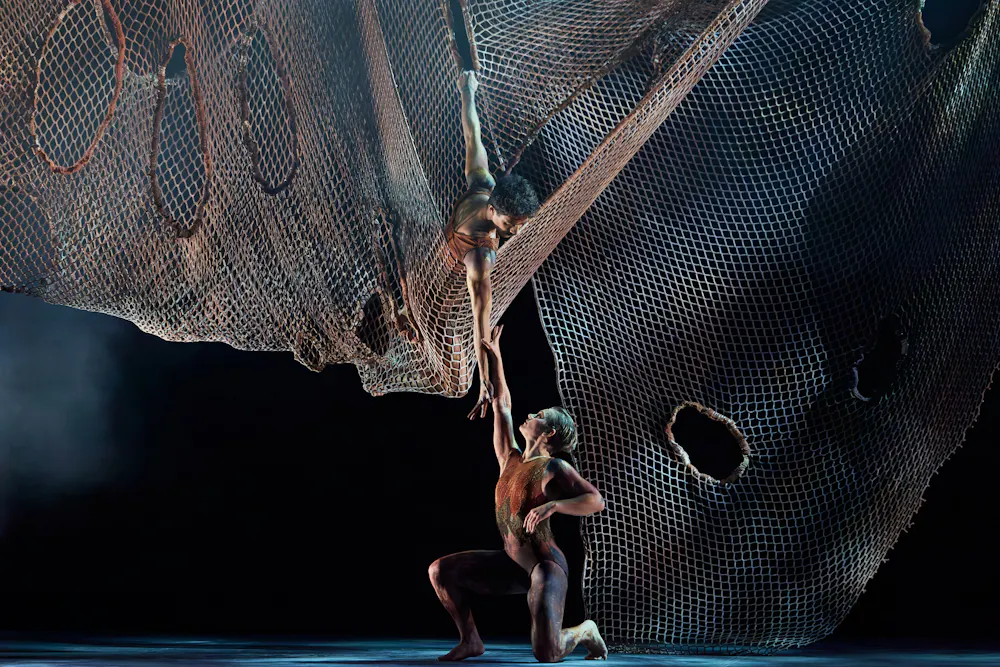
Keeping Grounded opens onto an enormous and heavy rope net designed by Dyarubbin woman, Shana O’Brien. Under it, figures twitch and roll like a catch of fish.

The set features a large heavy rope net designed by Dyarubbin woman Shana O’Brien. Daniel Boud

Karen Norris’ textured lighting supports the impression of a coastal setting, and “sets the scene” across the work as it shifts from an evocation of Country to a more technologically-mediated aesthetic.

In an interview with Glory Tuohy-Daniell, the choreographer describes how the work invites viewers “to consider how small, almost forgotten actions keep us grounded […] a step barefoot, a moment of stillness, a return”.

Tuohy-Daniell’s movement vocabulary is striking for its literal groundedness, reflecting the central theme highlighted in the work’s title.

The first sections see the dancers bound to the floor with a variation on the typical angular, rolling, swooping and sharply delineated shapes of Bangarra’s Indigenous contemporary style – here purposefully fractured.

Set to a score by Brendon Boney, the movement in this section is broken into one movement per beat, a staccato rhythm that suggests a disconnect from the flow of nature. This “pixellated” quality makes familiar forms new in an exciting way.

Brown Boys

Six-minute dance film Brown Boys is a meditation on the experience of young First Nations men. Daniel Mateo, the writer, choreographer and performer, has a cultural background spanning northern New South Wales and Tonga.

The program notes describe Brown Boys as a total work of art involving poetry, choreography, cinematography, sound and dramaturgy.

Adding to this is the central role of sculpture. Set and costume designer Elizabeth Gadsby has worked with traditional forms to establish a culturally informed aesthetic. This includes a fale (pronouned “fah-lay”), which is a traditional Tongan shelter made of grass matting. This structure frames Mateo’s body inside the film frame.

A fale is a kind of traditional Tongan shelter. Cass Eipper

Ochres, minerals and soils are other material elements featured in the design and choreography. The striking final image shows Mateo literally grounded by a soil mound that takes the silhouette of a 19th century crinoline skirt.

Mateo’s text and performance are extraordinary. His direct and settled gaze to camera, gentle unfolding movements, and spoken word poem, give visibility, dignity and complexity to the figure of the young Indigenous man. That he has “always been beautiful” could not be more persuasively portrayed.

Sheoak

Rings’ mastery of group choreography was recently showcased in her commissioned work for the Australian Ballet, Flora. Having delivered another major work for Vivid 2025, this was likely the right time to revive one of her classics.

The opening image of Sheoak showcases both Rings’ choreographic skill and Jennifer Irwin’s amazing legacy as a costume designer. The dancers wear shirts with black on white streaks – skeletal puzzle pieces that join together to form larger human sculptures.

Sheoak gives palpable form to the exhaustion and frustration experienced by First Nations peoples. Daniel Boud

The theme of this work is cultural strength, resilience and adaptability, with the sheoak tree as the central metaphor. Dancer Chantelle Lee Lockhart is captivating in the role of this “Grandmother tree”, as it’s known to the Dharawal people.

The choreography weaves around Jacob Nash’s set design, featuring seven two-metre-long branches. The passing of branches signals the struggle to pass on cultural responsibility and knowledge from generation to generation.

The company of technically virtuosic dancers seems right at home in each of the three diverse works of Sheltering. The program particularly underscores Tuohy-Daniell’s potential as a new leading light in Australian choreography

Sheltering as a whole is dedicated to the late David “Dubboo” Page, brother of former Artistic Director Stephen Page. David’s work as composer, singer and musician was central to establishing the Bangarra aesthetic. His music also features in Rings’ Sheoak.

Sheltering will now show at the Queensland Performing Arts Centre from July 9 to 18.The Conversation

Erin Brannigan, Associate Professor, Theatre and Performance, UNSW Sydney

Subscribe to support our independent and original journalism, photography, artwork and film.