Monday, 6 July 2026

Review: Cartier, ‘the Jeweller of Kings’, has Come to the National Gallery of Victoria in a Dazzling New Exhibition

Cartier's legendary 'Tutti Frutti' necklace, a riot of carved emeralds, rubies and sapphires, that captured the French house's bold interwar imagination in 1936  and a new modern elegance. Cartier Collection. Photograph: Vincet Wulveryck. Cover picture of Hermes AW26 by Max Farago,
By Sasha Grishin

Harper's Bazaar editor and Parisian
socialite, Daisy Fellowes, wearing
the 'Tutti Frutti' Hindou necklace
in its original form, in 1937.
Photograph: Cecil Beaton
Founded in Paris 179 years ago, Cartier has fostered a legendary reputation as the creator of luxury goods for royalty, the aristocracy, film stars, and the generally wealthy. The English king Edward VII famously referred to Cartier as “the jeweller of kings and the king of jewellers”.

The glittering magnificence of the Cartier style through the ages has been brought together in a major exhibition by London’s Victoria and Albert Museum, now being presented at the National Gallery of Victoria.

An Instant Hit 

Curated over almost a decade by the Victoria and Albert Museum’s Helen Molesworth, the Cartier show opened in London last year for a seven-month season and promptly sold out.

With almost 350 items on display, it was celebrated by many as one of the best shows of 2025. However, one criticism was the exhibition was too cramped, and the inevitable small scale of most of the objects resulted in a crowd crush within darkened spaces.

King Edward VII famously referred to Cartier as “the jeweller of kings and the king of jewellers”

Director of the Cartier Collection, 
Pascale Lepeu, at the new exhibition
Melbourne, at the NGV International.
The NGV iteration of the exhibition, with almost 400 items, presents a number of alterations to the checklist of exhibits, such as the inclusion of necklaces and bodice ornaments owned by Australian opera singer Dame Nellie Melba. Melba was an early client of the brand, with Pierre Cartier among her fans.

More significantly, the NGV has collaborated with internationally renowned designers to reimagine the exhibition, following in a tradition it has established for itself over several years.

The gallery has collaborated with Studio Sabine Marcelis and CLOUD, two multidisciplinary design practices based in Rotterdam, in The Netherlands.

Marcelis evokes the Cartier colour palette in her design, while CLOUD has built on the Cartier geometric forms to create light-filled architectural structures that are involved in a creative dialogue with the jewellery.

It was Alfred’s three sons who made Cartier into a powerhouse of fashion design, with offices in Paris, London, New York and St Petersburg

Alfred Cartier (second from right) with his three sons
Pierre, Louis and Jacques, 1922. Cartier Collection
Photograph: Vincent Wulveryck.
A Thumbnail Sketch of the Cartier Style

The thumbnail sketch of the development of the Cartier style is mandatory for understanding the exhibition. 

Louis-François Cartier founded the firm in Paris in 1847, and in 1874 passed it to his son Alfred. 

It was Alfred’s three sons – Louis, Pierre and Jacques – who internationalised the brand and made it into a powerhouse of fashion design, with offices in Paris, London, New York and St Petersburg.

Louis embraced orientalist Art Deco designs and colourful “Tutti Frutti” jewel combinations. 

He also pioneered wristwatch designs and exploited platinum as a structural base for elaborate diamond and gemstone settings in the jewellery.

Cartier continues to resonate with its audiences by tapping into ancient cultures and traditions, making them modern and relevant

Splendid Cartier Paris necklace from 1947.
Cartier Collection. Photograph: Nils Hermann.
Pierre extended operations to New York, while Jacques developed operations in New Bond Street in London.

It is difficult to define the Cartier design, yet relatively simple to recognise it when you encounter it.

Writing in the NGV Cartier catalogue, Vivienne Becker, a prolific London-based jewellery historian, arrives at a convincing characterisation. She writes that the style:

is underpinned by culture, by an ever-evolving quest to infuse jewellery design with originality, artistic integrity and cultural richness.

As one makes their way around the exhibition, there is constant encounter with styles from the past – including Egyptian, Chinese, Japanese, Iranian and Islamic elements – informing the use of diamonds and other precious materials. 

The tiaras have been worn by celebrities, from Clementine Churchill at the coronation of Queen Elizabeth II to the singer Rihanna

A scintillating tiara, made by Cartier 
Londonin 1937. Cartier Collection.
Photograph: Vincent Wulveryck
A Who's-Who List of Clients

Cartier also has its repertoire of signature motifs, such as the iconic Panthère, which may appear as a panther clip brooch, or snakes and crocodiles that can take the forms of necklaces and bracelets.

As jewellers and watchmakers, Cartier was known as the “watchmaker of shapes” – exploiting squares, rectangles and octagons, rather than the traditional circle.

While celebrating a supreme elegance, most of the items on display have the power to surprise, such as a spectacular scarab brooch, or a 1933 brooch with a giant floating amethyst set against sapphires, diamonds and platinum.

A highlight of the exhibition is the display of more than 20 stunning tiaras. These are symbols of royalty and glamour, with connotations of celestial halos, laurel wreaths and garlands.

These tiaras have been worn by a who’s who of celebrities. For instance, one scroll tiara (1902) was worn by Clementine Churchill at the coronation of Queen Elizabeth II in 1953, and again in 2016 by the singer Rihanna, on the cover of W magazine.

Household names who have worn the Cartier jewellery in this exhibition include Elizabeth Taylor, Grace Kelly and Dame Nellie Melba

Wallis Simpson, the Duchess of Windsor,
in Cartier jewels, 1939. Conde Nast
Photograph: Cecil Beaton Archive
There is also the Sun tiara of 1907, with a 32-carat cognac-yellow diamond at its core, and the Art Deco diamond and platinum Halo tiara of 1934, which was inspired by ancient Egypt and owned by Begum Aga Khan III.

Household names who have worn the Cartier jewellery present in this exhibition include Elizabeth Taylor, Grace Kelly, Rihanna, Princess Margaret, The Duchess of Windsor, Dame Nellie Melba, the Maharaja of Patiala, Begum Aga Khan III and American heiress Barbara Hutton. These will prove a selfie magnet for many visitors.

While this is not the first major Cartier exhibition in Australia (there was a big show in Canberra in 2018), it is the largest, containing almost 300 items never previously seen in Australia. It is also the most innovative in its display.

Cartier continues to resonate with its audiences by going beyond mere displays of ostentatious wealth; it taps into ancient cultures and traditions, making them modern and relevant to contemporary audiences.

Cartier is showing at the National Gallery of Victoria until October 4th 2026.

Subscribe to support our independent and original journalism, photography, artwork and film.

Paris Haute Couture: Imane Ayissi and the New Geography of Luxury, Where Cultures Come Together

One of the soigne, jewel-coloured gowns that were a highlight of Imane Ayissi's AW26/27 haute couture collection in Paris. Photographs and cover picture by Andrea Heinsohn for DAM

Haute couture is at its most engaging when fine craftsmanship is matched by a powerful point of view. At Paris Haute Couture Week, Imane Ayissi once again demonstrated why he occupies such a distinctive place on the official calendar. Presenting his new Autumn/Winter 2026-2027 collection, the couturier unveiled a collection that fused sculptural elegance, artisanal mastery and cultural storytelling into a personal vision of contemporary couture. Story by Jeanne-Marie Cilento. Photography by Andrea Heinsohn

The couturier Iman Ayissi with his new collection at the
finale of his joyous show in at the Aero Club de France.
AMID the gilded salons of the Aero Club de France in Paris, Imane Ayissi prepared to present Ozouandam Ollat, the Ewondo expression for haute couture, a collection that reaffirmed his voice within the international couture landscape. The show culminated in an impromptu and joyous dance on the runway. 

For the new season, the Cameroonian-born, Paris-based designer explored the relationship between movement, memory and craftsmanship, creating a refined vision of couture where once more he melds the precision of Parisian savoir-faire and the richness of African artisanal traditions.

Presented as part of the official Paris Haute Couture Week calendar, where Ayissi appears as a guest member of the Fédération de la Haute Couture et de la Mode, the collection demonstrated his continued commitment to expanding the language of couture beyond geographical boundaries. His work has always existed at the intersection of cultures: not as a contrast between African heritage and European technique, but as a sophisticated dialogue between two creative worlds.

The Autumn/Winter 2026-2027 show began with the atmosphere of departure and flight, setting the tone for a collection built around transformation and freedom. An announcement inviting guests to prepare for takeoff introduced a theatrical sense of movement, while also carrying an emotional resonance for Ayissi, paying tribute to his late mother, a former Miss Cameroon and flight attendant whose elegance and presence remained an important influence throughout his life.

Imane Ayissi's work is at the intersection of cultures: not as a contrast between African heritage and European technique, but as a sophisticated dialogue between two creative worlds

One of Ayissi's vividly hued new designs that
explore fine, beadwork and floriate patterns.
This emotional connection was expressed through garments that appeared to defy stillness. Ayissi’s silhouettes moved between structure and fluidity, balancing architectural precision with dramatic gestures of fabric. 

Sculptural dresses unfolded into sweeping capes and extended trains, while carefully constructed volumes created a sense of power without sacrificing elegance. Each look revealed the designer’s understanding that couture is not simply observed, it is experienced through the movement of the body.

That sensitivity to motion is deeply connected to Ayissi’s own artistic history. Before becoming one of the most recognised couturiers of African heritage, he trained as a dancer with the Ballet National du Cameroun, an experience that continues to influence his approach to form, proportion and rhythm. His early career as a model in Paris, working with renowned maisons including Dior, Yves Saint Laurent and Givenchy, further immersed him in the traditions of French luxury before he established his own couture house.

Born into a family surrounded by creativity, Ayissi grew up with a fine appreciation for performance and craftsmanship. His mother’s achievement as Miss Cameroon 1960, his father’s career as a champion boxer and the artistic pursuits of his siblings created an environment where discipline and expression were intertwined. These influences continue to shape a designer whose collections are as much about identity and storytelling as they are about design.

By bringing together personal history, global craftsmanship and an unmistakable creative identity, the designer is helping shape a more expansive future for couture

This sleek, brilliant red suit is beautifully cut and 
has a dash of romance with its swathe of raffia. 
For this collection, Ayissi once again placed materials at the centre of his creative vision. Luxurious silks, raffia, handwoven textiles and intricate embroidery demonstrated his ability to elevate traditional techniques into contemporary couture. 

Rather than using heritage as a decorative reference, he treats craftsmanship as a living practice, giving African textile traditions a place within the highest levels of international fashion.

The collection’s colour palette intensified its emotional impact, moving through vibrant blues, rich oranges, luminous jewel tones and softer shades that highlighted the complexity of the textiles. Beaded surfaces, floral-inspired embellishment and handcrafted details created garments that felt both modern and timeless.

Sustainability remained an essential part of Ayissi’s couture philosophy, with an emphasis on natural materials, artisanal production and techniques that celebrate longevity. In a fashion environment increasingly focused on speed and volume, his work offers a substantive alternative: luxury defined by skill, cultural knowledge and the human touch.

With Ozouandam Ollat, Imane Ayissi continues to demonstrate that haute couture is not a fixed tradition but an evolving art form. By bringing together personal history, global craftsmanship and an unmistakable creative identity, he is helping to shape a more expansive and inclusive future for couture, one where history becomes a source of innovation and beauty.

See more highlights from the Imane Ayissi Autumn/Winter 2026-27 Collection in Paris


Subscribe to support our independent and original journalism, photography, artwork and film.

Sunday, 5 July 2026

Bangarra’s Sheltering is a Powerful Showcase of First Nations Dance and Creativity, Opening at the Sydney Opera House

Dancer Donta Whitham is part of the triple bill 'Sheltering'. Photograph (above) by Daniel Boud. Cover picture of Hermes AW26 collection in Los Angeles by Max Farago.

By Erin Brannigan

Frances Rings’ artistic directorship of Bangarra Dance Theatre’s shines through the company’s new triple-bill production, Sheltering. She demonstrates a commitment to uplifting company members and First Nations creatives, with a coherent curatorial vision that shows care for diverse audiences.

This triple-bill is a beautiful sampler of what this important company has to offer to the cultural, political and creative facets of our nation.

A nurturing home for First Nations creatives

Sheltering comprises three individual choreographic works: Keeping Grounded, Brown Boys, and Sheoak.

Sheoak is a 2015 work by Rings herself, commissioned by then Artistic Director Stephen Page.

Keeping Grounded (2023) is choreographed by Indjalandji-Dhidhanu and Alyawarre woman Glory Tuohy-Daniell, with a cast of eight company dancers.

Keeping Grounded is performed by eight company dancers. Daniel Boud

The most recent work is a short dance film called Brown Boys (2024). It was directed by Cass Mortimer Eipper and Daniel Mateo, a Bangarra company member and Gomeroi and Mari Ma’ufanga, Tongatapu (Tonga) man.

Both Brown Boys and Keeping Grounded were first presented in Bangarra’s emerging artist showcase, Dance Clan, and supported from there onto the mainstage program. Creators Tuohy-Daniell and Mateo trained at NAISDA, Australia’s National Indigenous Dance College, and joined Bangarra through its Russell Page Graduate Program, which provides training and mentorship for new company dancers.

Keeping Grounded

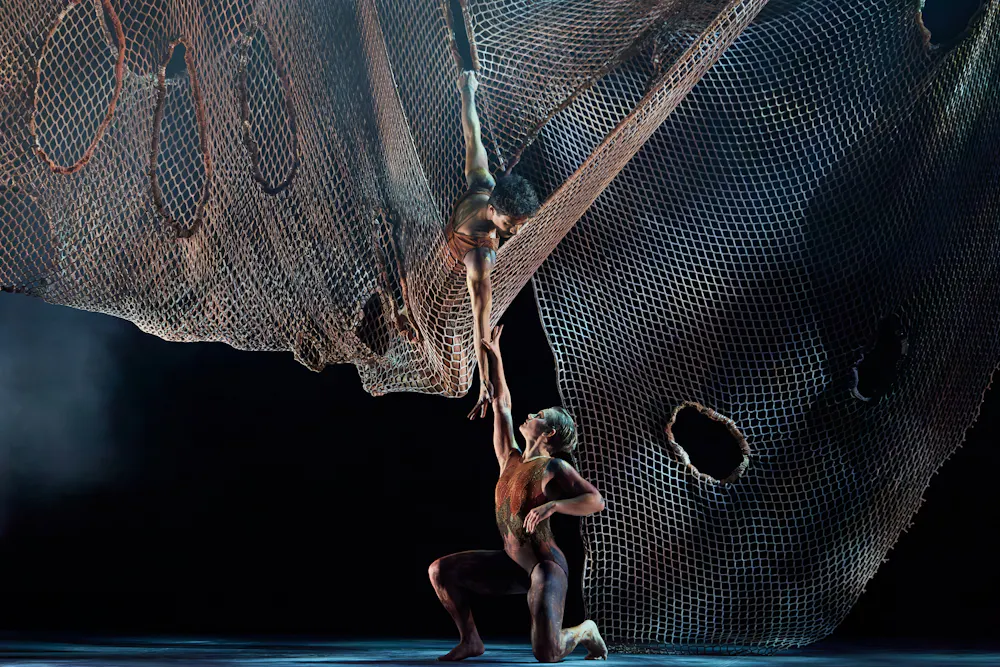
Keeping Grounded opens onto an enormous and heavy rope net designed by Dyarubbin woman, Shana O’Brien. Under it, figures twitch and roll like a catch of fish.

The set features a large heavy rope net designed by Dyarubbin woman Shana O’Brien. Daniel Boud

Karen Norris’ textured lighting supports the impression of a coastal setting, and “sets the scene” across the work as it shifts from an evocation of Country to a more technologically-mediated aesthetic.

In an interview with Glory Tuohy-Daniell, the choreographer describes how the work invites viewers “to consider how small, almost forgotten actions keep us grounded […] a step barefoot, a moment of stillness, a return”.

Tuohy-Daniell’s movement vocabulary is striking for its literal groundedness, reflecting the central theme highlighted in the work’s title.

The first sections see the dancers bound to the floor with a variation on the typical angular, rolling, swooping and sharply delineated shapes of Bangarra’s Indigenous contemporary style – here purposefully fractured.

Set to a score by Brendon Boney, the movement in this section is broken into one movement per beat, a staccato rhythm that suggests a disconnect from the flow of nature. This “pixellated” quality makes familiar forms new in an exciting way.

Brown Boys

Six-minute dance film Brown Boys is a meditation on the experience of young First Nations men. Daniel Mateo, the writer, choreographer and performer, has a cultural background spanning northern New South Wales and Tonga.

The program notes describe Brown Boys as a total work of art involving poetry, choreography, cinematography, sound and dramaturgy.

Adding to this is the central role of sculpture. Set and costume designer Elizabeth Gadsby has worked with traditional forms to establish a culturally informed aesthetic. This includes a fale (pronouned “fah-lay”), which is a traditional Tongan shelter made of grass matting. This structure frames Mateo’s body inside the film frame.

A fale is a kind of traditional Tongan shelter. Cass Eipper

Ochres, minerals and soils are other material elements featured in the design and choreography. The striking final image shows Mateo literally grounded by a soil mound that takes the silhouette of a 19th century crinoline skirt.

Mateo’s text and performance are extraordinary. His direct and settled gaze to camera, gentle unfolding movements, and spoken word poem, give visibility, dignity and complexity to the figure of the young Indigenous man. That he has “always been beautiful” could not be more persuasively portrayed.

Sheoak

Rings’ mastery of group choreography was recently showcased in her commissioned work for the Australian Ballet, Flora. Having delivered another major work for Vivid 2025, this was likely the right time to revive one of her classics.

The opening image of Sheoak showcases both Rings’ choreographic skill and Jennifer Irwin’s amazing legacy as a costume designer. The dancers wear shirts with black on white streaks – skeletal puzzle pieces that join together to form larger human sculptures.

Sheoak gives palpable form to the exhaustion and frustration experienced by First Nations peoples. Daniel Boud

The theme of this work is cultural strength, resilience and adaptability, with the sheoak tree as the central metaphor. Dancer Chantelle Lee Lockhart is captivating in the role of this “Grandmother tree”, as it’s known to the Dharawal people.

The choreography weaves around Jacob Nash’s set design, featuring seven two-metre-long branches. The passing of branches signals the struggle to pass on cultural responsibility and knowledge from generation to generation.

The company of technically virtuosic dancers seems right at home in each of the three diverse works of Sheltering. The program particularly underscores Tuohy-Daniell’s potential as a new leading light in Australian choreography

Sheltering as a whole is dedicated to the late David “Dubboo” Page, brother of former Artistic Director Stephen Page. David’s work as composer, singer and musician was central to establishing the Bangarra aesthetic. His music also features in Rings’ Sheoak.

Sheltering will now show at the Queensland Performing Arts Centre from July 9 to 18.The Conversation

Erin Brannigan, Associate Professor, Theatre and Performance, UNSW Sydney

Subscribe to support our independent and original journalism, photography, artwork and film.

Review: New Documentary Traces Kylie Minogue’s Career, From Harsh Early Critics to Pop Stardom

Portrait of Australian singer and actress Kylie Minogue by Steve Schofield. Her new documentary shows how the media has changed during the pop superstar's career, especially how women and their audiences are treated. 


By Liz Giuffre

Kylie's career is remarkably
enduring and successful.
Netflix’s three-part documentary about Kylie Minogue, Kylie, covers her nearly 40-year career. We go from the release of Minogue’s first self-titled album and time as an actor on Neighbours to the present day with a new single Light Up and preparations for an anniversary tour next year.

Minogue is well represented in this documentary. Her commentary shows her depth of character, understanding and connection as a music professional.

Minogue frames the documentary, sitting in what looks like her archive room, going through boxes of slides and mementos, including a glorious moment with a 1980s boombox which she says “started it all”.

As Adrian Renzo and I found in our book, Kylie, an exploration of her first album, there were different standards applied to Minogue than to her male contemporaries when she began in the industry

‘How would you feel if that was your daughter?’

Minogue and her sister, Dannii, started as children in the Australian music and media industries.Dannii was the first in the family to be a musician via Young Talent Time.

Kylie Minogue appeared as a child actor in shows like The Sullivans and The Henderson Kids. But her star truly arose with her role as Charlene Robinson in soap opera Neighbours. Her ascension in music and television collided in 1987 with her single Locomotion, and the famous wedding of Charlene and Scott (Jason Donovan).

Neighbours still: Charlene and Scott sit on a couch.
Kylie’s ascension in music and television collided in 1987 with her single Locomotion, and the famous wedding of Charlene and Scott. Netflix

As a musician and actor Minogue received huge commercial success, fuelled by young fans, many who were young girls and queer people. In the documentary she expresses great gratitude for her gay audience, and a shared sense of feeling out of place but still having pride in yourself.

Minogue also received harsh criticism from music industry “experts” who claimed she was too young or too “soapie” to deserve the success she achieved. One radio station launched an active “no Kylie” campaign.

Music industry figures dehumanised her by calling her a “singing budgie”. We found one critic at a major Sydney newspaper who wrote Minogue should get herself “in the path of a descending jumbo”.

The Netflix documentary explores the duality of this period. We see headlines saying “I Hate Her” and “She is Nothing”, edited with archival footage of happy crowds and Minogue on stage. Television archive footage of an unnamed male commentator says of Minogue “you no longer need to be interesting to get to number one, you can just be a sort of human, crocheted scarf”.

“Being 19 years old and having to cop that, that was unpleasant,” Minogue says, reflecting back on that time.

Later in the documentary, Minogue is more direct:

One of the terms used to describe me, the singing budgie, had the human part missing – who decides this is cool? […] What would happen if I met with them and sat face to face with them, and said ‘How would you feel if that was your daughter?’.

The reaction to Minogue at the time was damaging to her as an individual. It served as a reminder to those that loved Minogue – young girls like I was at the time, and young queer people like Adrian was at the time – that were not valued by those in positions of power.

Missing stories

Minogue’s triumph over the subsequent decades has shown those in power have changed.

It is no longer acceptable to target a young woman with suggestions of violence in the press. Those that would dismiss the value of an audience of young women or queer people now clearly would do so at their own cultural and financial risk.

The documentary does still fall into the trap of using Minogue’s male colleagues and relationships as a way of validating her.

Minogue’s influence in the United Kingdom and beyond is underpinned by international songwriter Peter Waterman. As one of the iconic songwriters and producers Stock, Aiken and Waterman (SAW), Waterman shows how Minogue was created as a global pop brand.

Kylie poses for a photo, wearing headphones.
Kylie was crafted into a global pop brand. Netflix

Nick Cave tells a large part of the story – worthy, but perhaps a bit uneven given it really was only one single they made together.

Donovan appears early on to discuss the early years, swearing about being overshadowed by her at the time but with no real malice.

It would have been great to hear more from Minogue’s female contemporaries and friends. Dannii Minogue is a regular feature, but others in more prominent spots would have been great.

Another key feature missing from the documentary is the Australian story, and the support provided to her by pioneering Australian record label Mushroom. While its founder Michael Gudinski has since passed away, Amanda Pelman, who signed Minogue to Mushroom, and released her memoir earlier this year, would have been a great addition.

As a documentary, Kylie tracks how the media has changed over the last few decades, especially when it comes to how women and their audiences are treated.

Minogue’s connection to her fans, her family and her work ethic is inspiring, as is her unapologetic celebration of the role pop music plays in making life worth living.

Kylie is now streaming on Netflix.


Subscribe to support our independent and original journalism, photography, artwork and film.