Sunday, 11 October 2026

To Understand the History of European Culture Start with the Minoans, Not the Ancient Greeks

Ruins of the ancient Minoan settlement in Gournia, Crete.  Photograph: Georgios Tschilis/Shutterstock
By Ellen Adams, King's College London

The Minoan culture was the first highly complex society on modern European soil, with palaces, writing, stunning art – and even flushing toilets. The Minoans lived in the bronze age (circa 3000-1200BC) on the Mediterranean island of Crete, which served as a stepping stone between Europe, Africa and Asia.

My new book, The Minoans, presents key features of their archaeology, including architecture, art, religion, writing, bureaucracy and the economy. It explores how this pioneering European civilisation has influenced western culture – and how Minoan culture has been reconstructed, re-imagined and represented in museum displays.

Traditionally, the ancient Greeks have been viewed as the fountainhead of European civilisation, but Minoan culture was flourishing many hundreds of years earlier. Despite this expanse of time, there was a loose dialogue between them: the Minoans influenced the Mycenaeans, who themselves were early Greeks, and the later classical Greeks indicate some “memory” of the Minoans, as filtered down through their myths.

For example, in the later Greek stories (from the first millennium BC), Crete is closely associated with bulls. Zeus took the form of a bull when he seized the Phoenician princess Europa and forced her to the island to initiate the Minoan bloodline. She bore Minos whose wife, Pasiphae, submitted to her passion for Poseidon’s bull, producing the minotaur.

In Minoan art, bulls are everywhere. Archaeologists have found bronze age ritual libation vessels – used for pouring liquid sacrifices to the gods – crafted into the shape of a bull’s head, and large gold rings depicting people leaping over bulls. The echoes of history, myth and ritual seem to have rippled through the generations, to later be reproduced and re-imagined by the ancient Greeks.
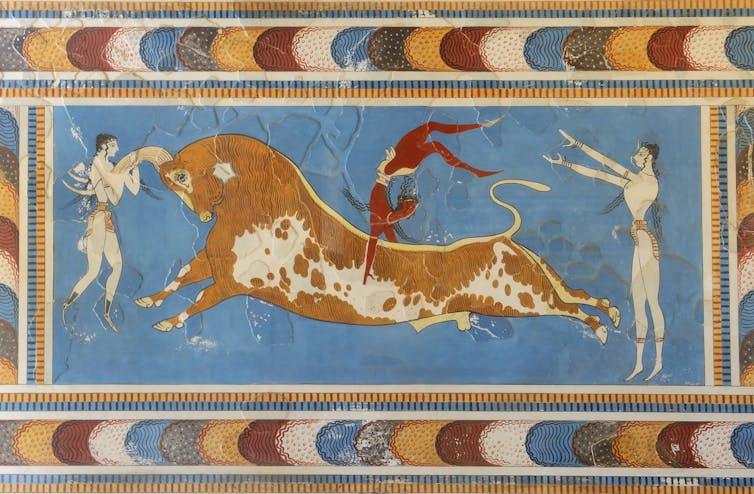
Fresco showing two people and a bull
A bull fresco from Knossos Palace in Crete. Pecold/Shutterstock

It is therefore essential for people who want to understand the history of Europe to study the influence the Minoans have had on the ancient Greeks and modern Europeans – in particular, the evidence coming from the great digs conducted on the island in the early 20th century. These include the excavations by the British archaeologist Arthur Evans at Knossos, Crete, a vast site with complexity that may lend itself to the Greek labyrinth myth.

While the image of the bull is particularly widespread here, there is little association between this creature and women, as later appears in the myths. Women are linked with other animals, though, such as serpents, as shown by the snake goddess figurines that Evans found in the Palace of Knossos in 1903.

Snakes in Minoan art

These snake goddesses were found hidden in large stone-lined pits, in a very fragmentary state. Numerous riches were in this deposit: hundreds of shells, clay and stone vessels, clay seal impressions (used for documentation), Linear A inscriptions (a writing script) and animal bones.

The remains of five or six female figurines were found, but only two have been reconstructed. They have become icons of Minoan culture and poster girls for Crete, standing out due to their eye-catching costumes. These are tight, corseted jackets that leave the breasts bare, with floor-length full skirts – their heaviness serving to emphasise the exposed breasts even more.

Sepia photo of figurines.
The remains of the figurines found in the Palace of Knossos in 1903. Wiki Commons

The slightly larger one is a matronly figure with a tall, conical hat. Her snake-entwined arms are held at around 45 degrees, palms up and set approximately in line with her navel. Snakes drape over her as she stares straight ahead.

The second figure raises her bright white arms, bent at the elbow, up and out to her sides, flexed slightly forward. She clutches snakes, and a feline creature balances on her hat.

These figurines offer food for thought about the reconstruction processes that archaeologists undertake. First, Evans gave the title “goddess” to the larger figurine, and “votary” (meaning a worshipper who has taken vows) to the smaller one. This is arbitrary: we cannot know who these figurines represented, whether they were human, as a dignitary or priestess, or divine – we just sense they were VIPs.

Furthermore, when viewing these extraordinary objects in the Heraklion Museum in Crete today, the visitor may be unaware of the extent to which they have been reconstructed, and how much is an early 20th-century creation.

For example, the votary’s head, with its distinctive, wide-eyed stare, is entirely modern, as is her left arm, added soon after she was excavated. The object held in her right hand was broken off – only a very small piece of the original remained in her clenched fist. The reconstruction of snakes as the objects she holds is not so absurd – her sister has them running all over her as a comparison – but recent research has cast some doubt on what she originally held.

In addition to reconstructing the originals, people have also re-imagined these striking figurines in numerous ways – in replicas as souvenirs, as Barbie dolls, in graffiti (particularly in Heraklion) and in advertisements. They have appeared as book covers and inspired modern literature as well as visual and performative art.

Adaptations of them have come to life in poetry, opera, dance and music. A performer led the historical procession as the snake goddess in the opening ceremony for the 2004 Olympic Games in Athens. The Many Lives of a Snake Goddess project, which I am part of, seeks to understand the cultural biographies of these objects. It shows their legacy has been great partly because we have recreated them in such varied ways.

Minoan Crete is important not only because of any claims made for its place as the fountainhead of European civilisation, but also because its art and archaeology have done so much to shape modern culture.

Ellen Adams, Professor in Classical Archaeology and Museum Access, King's College London


Subscribe to support our independent and original journalism, photography, artwork and film.

Saturday, 10 October 2026

The Margaret Preston Retrospective at the National Gallery of Victoria is a Revelation

Self-portrait of Margaret Preston from 1930. Art Gallery of NSW, Sydney. © Margaret Preston/Licensed by Copyright Agency Australia. Image © Art Gallery of New South Wales. Cover picture of Issey Miyake SS27 in Paris. 


By Sasha Grishin

The National Gallery of Victoria’s Margaret Preston is a breathtaking exhibition. It is Preston as we have never seen her before, and challenges many earlier preconceptions.We see her work in the context of her students/lovers, Bessie Gibson and Gladys Reynell, and her obsession with First Nations art – her adaptations, her collections, and, now, commentaries on her adaptations by Trevor Nickolls and Gordon Bennett, among others.

A much more complex and nuanced image of Preston emerges than in previous exhibitions.

The show is a mixture of a chronological survey with her early still life paintings from the opening decade of the 20th century, then her decorative flower pieces moving to the magnificence of her hand-coloured woodcuts.

There is a desire to bring her art to life: we see her iconic Wheelflower print of 1929, next to the actual woodblock from which it was printed. Her First Nations pieces are shown together with their actual sources of inspiration.

The exhibition is full of these little detective pieces that save the exhibition from being just another Margaret Preston show to make it into the Margaret Preston show for our generation.

The vivid 'Coastal Gums' 
by Matgaret Preston, 1929. 
Private Collection
© Margaret Preston
Licensed by Copyright 
Agency, Australia

A spectacular makeover

Born Margaret Rose McPherson in Adelaide in 1875, she initially trained in Sydney, then at the National Gallery School in Melbourne. She spent many years travelling in Europe, mainly in Germany, France and England.

She first travelled with Betty Davidson and then Gladys Reynell, with both of whom, the NGV catalogue asserts, she had a romantic bond.

She exhibited to limited acclaim, first under the name of Rose McPherson and by 1912 as Margaret McPherson.

Her personal and artistic makeover was as spectacular as it was sudden.

On the last day of 1919, the 44-year-old McPherson falsified her age by eight years and married Lieutenant William George Preston, subsequently a successful businessman. This made her, at least on the marriage certificate, a socially respectable two years younger than her husband, rather than the embarrassing six years older.

She changed her exhibiting name to Margaret Preston and, armed with her husband’s wealth, launched her new career with a massive publicity blitz that was to last until her death in 1963.

Following her marriage, she settled with her husband in the bayside Sydney suburb of Mosman and moved rapidly up the social ladder to become a friend of the publisher Sydney Ure Smith.

Preston was the most articulate and outspoken female artist of her generation, writing frequent articles and giving lectures and interviews.

While always a committed traveller, after her marriage Preston embarked on numerous journeys throughout Asia and the Pacific, the Middle East and Europe.

At the height of the Depression, the Prestons moved from Mosman to a 14-acre block in rural Berowra, before returning to the Mosman neighbourhood in 1939, where they remained until her death.

Thea Proctor's Tea Party, 1924 by Margaret
Preston. Art Gallery of NSW, Sydney
Purchased in 1942.© Margaret Preston 
A revelation

For me, a revelation of this exhibition is her late stencil pieces, including Christ turning the water into wine (1951) and White gum (1953) where Preston in her mature years is grappling with a host of conceptual problems and exhibits a brilliant technical inventiveness.

While many of the pieces have been seen before, here they gain a new poignancy through their new context.

With over 200 works on display, there is enough to present a comprehensive overview to gain a good understanding of her work and her contribution to Australian art and not an overkill requiring a packed lunch for viewing every print she ever made.

On ‘primative’ art

Although a strong advocate for First Nations art, I feel that Preston’s attitude still sat within the framework of cultural imperialism.

That is, it came from one who had not the slightest doubt in the superiority of her own culture that could absorb “primitive” elements from Indigenous cultures.

She illustrated how a sacred Kimberley dancing board could give you a suggestion for a curtain. In 1924 she boasted,

I have barely altered the design […] The Australian aboriginal has followed the usual abstract designs that are characteristic of the savage […] I have suggested a cushion cover that could be adapted from the design.

Aboriginal Still Life 1940, by Margaret Preston.
Queensland Art Gallery, Brisbane. Gift of the
Godfrey Rivers Trust through Miss Daphne 
Mayo, 1940. © Margaret Preston
In 1925 Preston wrote,

In wishing to rid myself of the mannerisms of a country other than my own, I have gone to the art of a people who have never seen or known anything different from themselves, and were accustomed to always use the same symbols to express themselves.

[…]

It is on the primitive natural forms that we must depend. In returning to primitive art it should be remembered that it is to be used as a starting point only for a renewal of growth, and a gradual selection must take place to arrive at the culmination.

Over the decades, Preston’s attitude to First Nations art matured as she travelled thousands of kilometres to view rock art and art in various communities. But the art remained a quarry from which a “civilized” artist could plunder elements from which to create an “authentic” Australian national art.

Preston’s ideas on a national art were naïve, but, as shown by this exhibition, she did create a powerful and memorable oeuvre.

Margaret Preston is at The Ian Potter Centre: NGV Australia until January 31 2027.The Conversation

Sasha Grishin, Adjunct Professor of Art History, Australian National University

Subscribe to support our independent and original journalism, photography, artwork and film.

The Mediterranean Diet is all the Rage Because it Represents a Way of Life We’ve Lost

The Mediterranean diet has been included on UNESCO’s Intangible Cultural Heritage list since 2010. Cover picture of Issey Miyake SS27 in Paris.


By Marco Romagnoli, Université du Québec à Montréal (UQAM) 

The promise of a long, healthy, happy existence living an active, community-based lifestyle under warm, sunny skies may be within reach. In fact, it could be on your table.

The Mediterranean diet has been included on UNESCO’s Intangible Cultural Heritage list since 2010. Not only does the diet have guaranteed cultural value, it is also a powerful strategic tool for promoting food products such as olive oil.

Often cited for its health benefits, the Mediterranean diet was first described in a 1953 book about Crete. At the time, people were amazed at the low incidence of cardiovascular disease among the inhabitants of this Greek island, compared with northern Europeans.

Among other things, this olive oil-based diet encourages the consumption of fresh foods, seasonal fruit and vegetables and whole grains. It embodies the essence of the Mediterranean lifestyle, according to the UNESCO definition:

The Mediterranean diet involves a set of skills, knowledge, rituals, symbols and traditions concerning crops, harvesting, fishing, animal husbandry, conservation, processing, cooking, and particularly the sharing and consumption of food. Eating together is the foundation of the cultural identity and continuity of communities throughout the Mediterranean Basin. It is a moment of social exchange and communication, an affirmation and renewal of family, group or community identity. 

A bottle of olive oil and healthy food on a table, with the sea in the background
Olive oil is at the heart of the Mediterranean diet. (Shutterstock)

But beyond its impact on our health, what does the Mediterranean diet say about us as a society? Could it be the symptom of something?

As a postdoctoral researcher at UQAM’s École des sciences de la gestion, my research lies at the intersection of heritage and tourism studies, food and mental health.

In 2021, I carried out field research in Cilento (Italy), Soria (Spain) and Marseille (France), where I looked at the inhabitants’ attachment to the Mediterranean diet. I listened to their stories and tried to understand the local and social dynamics at play in the Mediterranean diet concept.

Mirroring a deep societal crisis

The concept of the Mediterranean diet refers to a lifestyle that strengthens social relationships and is good for your health. It sounds simple and coherent.

However, the society in which we live turns the work of meeting these basic needs into something more complex. The health and social dimensions of the Mediterranean diet are seen as extremely desirable because they represent a balance that is lacking in globalized societies.

Claude Fischler, a sociologist of human nutrition, describes the multidimensional crisis of the food system in modern societies.

In his view, there is a psychopathology of daily eating underway. This is characterized by “appetite disturbances, bulimic attacks, anxious or compulsive snacking, etc.” Just think of the consumption of ultra-processed foods or ready-made and frozen meals, eaten on their own in front of the TV in the evening or in front of the computer during lunch break.

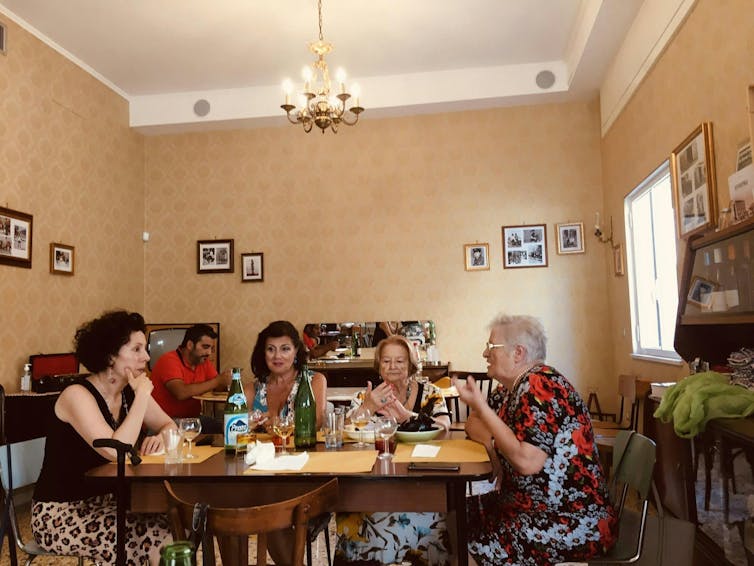
A group of women eating, at a family table
A meal at the O Vicolo ‘E L'Alleria, in Battipaglia, Italy. Eating together is the foundation of the cultural identity and continuity of communities in the Mediterranean basin. (Author provided)

In this psychopathological perspective on food, which also mirrors a societal crisis, mechanisms for cultural (and in this case, food) reactivation are appearing. The rush to the Mediterranean diet is a reflection of this societal crisis, because it is the opposite of our way of life.

With its inclusion on the UNESCO list, the Mediterranean diet has thus become a prestigious “monument” of Mediterranean culinary art.

This food culture has been mythologized and made a part of our heritage after undergoing an irreversible process of erosion of food production and consumption systems in the Mediterranean area.

‘Gastronativism’: Politics on the plate

The food arena is one of the best places to express the anxieties and fears of contemporary life.

Fabio Parasecoli, a researcher in food studies, describes the anxieties caused by globalization as gastronativism, “the ideological use of food in politics to advance ideas about who belongs to a community (however defined) and who doesn’t.”

So gastronativism represents a political tool that provides “a sense of rootedness, comfort and security” in the face of perceived collapse (climate change, wars, pandemics, globalization).

The Mediterranean diet is part of this gastronativist approach, standing for a lifestyle that can be adopted.

Different meanings of the Mediterranean diet

We often hear about the Mediterranean diet from institutions and academics. What we don’t hear much about are the views of the communities that practise this way of life.

My field research in 2021 aimed to understand the different ways in which the Mediterranean diet is defined, described, understood and lived, depending on the community.

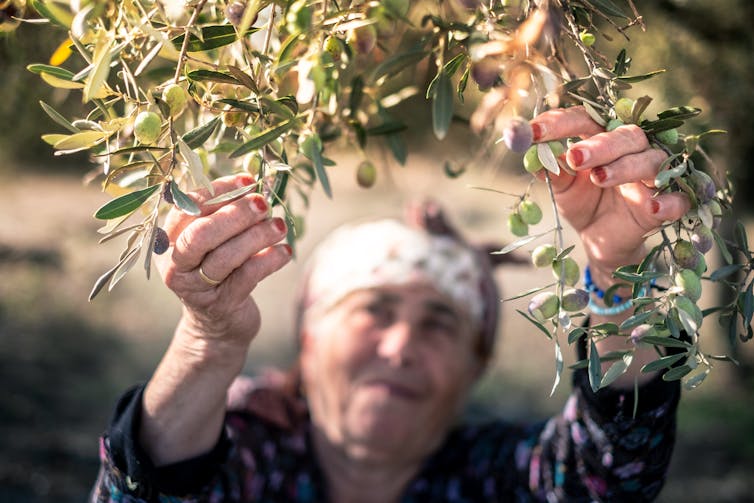
A woman has her arms outstretched towards a bunch of olives in a tree
The Mediterranean diet involves a set of skills, knowledge and rituals that relate in particular to cultivation, harvesting and picking. (Shutterstock)

In Cilento, the Mediterranean diet is synonymous with “lifestyle.” It’s part of local identity and a reference to the wider socio-cultural sphere (“our lifestyle,” the locals say).

In Soria, it embodies a “nutritional model” and in the domain of health: the adjectives most commonly used to describe it are “healthy,” “beneficial,” and “health-conscious.”

In Marseille, the term “diet” conjures up images of fasting, deprivation and abstinence, while the term “Mediterranean” refers to organic, seasonal and healthy food. The reference here is more to the food industry.

A sociocultural seismograph

Whether understood as a nutritional model, a way of life or an example of intangible heritage, the Mediterranean diet represents a way out of a system (societal, food, economic, environmental) in crisis and in constant search of reference points.

Seismographs are instruments that record and measure earthquakes. Like a “sociocultural seismograph,” the Mediterranean diet enables us to capture the vibrations, i.e. the changes taking place in contemporary society with which cultural (and dietary) practices must contend.The Conversation

Marco Romagnoli, Postdoctoral research fellow, Université du Québec à Montréal (UQAM)

Subscribe to support our independent and original journalism, photography, artwork and film.

Friday, 9 October 2026

Calabria: The revamped Hiking Trail Regenerating an Italian Region Blighted by Mafia Stereotypes

The mountain village called Pentedattilo at the start of the trail. Photograph: Polonio Shutterstock.


By Aurora Moxon 

Il Sentiero dell’Inglese – the Trail of the Englishman – is bringing new hope to Calabria’s Aspromonte mountains in southern Italy, one of the EU’s most marginal and economically depressed areas.The six-day trail is named after the English poet Edward Lear who walked these mountains in the 19th century. The route encourages hikers to challenge preconceptions of the Aspromonte and experience local hospitality, while boosting the economy of an area at risk of abandonment.

The Aspromonte has long been associated with the ’Ndrangheta – Italy’s most powerful mafia. In the 1970-1980s, organised criminals held high-profile kidnapping victims in these mountains, consolidating this association. The most famous of these was Jean Paul Getty III, grandson of the oil tycoon Jean Paul Getty Sr, whose kidnapping inspired the 2017 film All the Money in the World.

As well as researching food, farming and ecotourism in the Aspromonte mountains, my work investigates the negative effects of stereotypes of this area.

Although the ’Ndrangheta is still active in Calabria today, much of its primary activity now takes place in Italy’s north and overseas. Despite this shift, a negative image of the Aspromonte and its inhabitants still prevails among Italians.

It was not the ’Ndrangheta, but mountain brigands (robbers) that Lear feared when he set off on foot through the Aspromonte in 1847.

Best known for his poem The Owl and the Pussycat (1871), among Lear’s other works is Journals of a Landscape Painter in Southern Calabria. Published in 1852, he wrote about the people of the Aspromonte who shared their houses and food with him, from members of the landowning class to the poorest peasants.

Although he often interpreted his surroundings through a northern European lens, exaggerating the presumed backwardness of the area and its inhabitants, Lear was evidently impressed by this hospitality and Aspromonte’s physical  

Boosting the trail

In 2019, a hiking organisation called La Cooperativa San Leo, based in the village of Bova, opened Il Sentiero dell’Inglese. The trail follows the first 80km of Lear’s journey on old mule tracks with views of the Ionian Sea, Mount Etna and the dramatic valleys and peaks of the Aspromonte.

The cooperative runs a network of local B&B hosts across the seven villages along the route. They offer hikers local cuisine in private homes and no-frills eateries, with accommodation for around €60 a night. Now numbers of tourists from Italy’s north and other parts of Europe are on the rise.

Andrea Laurenzano, president of the cooperative and coordinator of the trail, told me that 2024 saw around 600 hikers walk the sentiero while approximately 1000 hikers completed it in 2025. This year has seen approximately 700 people walk it so far. However, despite Lear’s fundamental role in the trail’s story, hikers from the UK are rare.

The trail is becoming a vital economic artery. Locals with B&Bs can join the hosting network and earn a small income during the low-season (hiking is best avoided in the summer heat). It also provides employment for local guides and brings business to bars, restaurants, shops, museums, artisans and farmers.

Antonio Frangipani, local guide and vice-president of the association that runs the trail, explained that the cooperative’s restaurant in Bova uses organic ingredients such as cheeses from local herders and fruit and vegetables from local farmers.

Finding ways to protect and promote the unique agropastoral culture of this part of the Aspromonte, called the Area Grecanica, is important. Ancient rural know-how and the Greco-Calabro language, which includes words and phrases from ancient Greek, are at risk of dying out as inhabitants move away from the local villages. This movement is part of a wider pattern in Italy of human abandonment of inland regions.

The repercussions of the trail go well beyond the purely economic. Human geographers like Tim Edensor argue that walking has historically forged stereotypes, contributing to the marginalisation of cultures considered “other” from a western viewpoint. The bourgeois Lear and his travels across southern Europe arguably fall into this category.

Local guides, however, believe that hiking is helping to challenge negative associations of the Aspromonte. They say that hikers often arrive with varying degrees of prejudice regarding locals and their way of life, and leave with a new appreciation of the region.

Ugo Sergi, trail host, organic bergamot producer and well-known figure on the local ecotourism scene, described his experience to me: “Many people have come here … believing they would find a dangerous and backward underclass. I have taken great pleasure in helping them understand how they were mistaken.”

Similarly, local guide Stefania Praticò explained: “The Sentiero dell’Inglese has started to remove the stigma as people walk these paths [which] help to show these places in a new way. [The trail] creates this connection, they can understand with their own eyes that the [stories] are different from reality.”

Il Sentiero dell’Inglese is demonstrating that a form of slow tourism adapted to the particular culture and problems faced by locals in the Aspromonte is working to regenerate and rehabilitate a once notorious region of southern Italy. 

Subscribe to support our independent and original journalism, photography, artwork and film.

Thursday, 8 October 2026

The Shards Transforms Bret Easton Ellis’s 1980s LA Nightmare into a Warning for the Present

Igby Rigby as Bret and Kaia Gerber as Susan in a scene from the series thriller The Shards, set in 1981 Los Angeles following an elite group of prep school students. 
By Bran Nicol

Ryan Murphy, director of the controversial Netflix true-crime Monster Anthology (2022-), and Bret Easton Ellis, literary provocateur and author of American Psycho (1991), seem the perfect match. Sure enough, Murphy’s new TV adaptation of Ellis’s 2023 novel, The Shards, for Disney+ is an exhilarating mix of teen drama, serial killer nail-biter and homoerotic cat-and-mouse thriller.

The Shards features a fictionalised version of Ellis himself (a standout performance by Igby Rigney). The show details the unravelling of a close-knit group of friends during their senior year at a private LA high school in 1981. It’s triggered by the simultaneous arrival of a charismatic and mysterious newcomer, Robert Mallory (Homer Gere, son of Richard Gere), and the terror and destruction wrought by a serial killer at large in the community dubbed “the Trawler”. Are these events coincidental? Or connected in some way?

Ellis has said that the appeal of his precocious first novel, Less Than Zero (1985) (which he was indeed working on in his senior year, as the series shows) was that it allowed viewers to imagine what it would be like to be a privileged youngster in cool, affluent Beverley Hills.

The trailer for The Shards.

This TV incarnation of The Shards presents a particularly vivid version of this fantasy. The affluent teenagers pad around beautiful, empty houses, throw endless pool parties, drive through LA in their shiny cars and indulge in as much drugs and sex as they want.

Yet the flip-side of such extraordinary freedom is excessive vulnerability. The story of the Trawler recalls the dark history of late 1970s and 1980s LA. It was a time when over 20 serial killers – each given similarly foreboding monikers like the Night Stalker or the Hillside Strangler – were also traversing the city.

Watching the lives of such a privileged group become shattered might be considered just deserts: a secret satisfaction for viewers enamoured by that Beverley Hills fantasy life. This is, after all, the kind of dark morality which propels the slasher movie (a genre which has influenced both Ellis and Murphy) where characters, usually girls, die in seemingly direct proportion to how sexually active they are.

But The Shards wants to do more than glamorise and invite critique of the lives of affluent youth in the US. Outwardly its sumptuous rendering of Westside interiors and exteriors tempt viewers to regard it as another example of TV’s current fascination with displaying the indulgent existences of the super-wealthy, such as Big Little Lies (2017) or White Lotus (2021-).

The Shards aims at something more profound. At its heart is a comparison between 21st-century existence and the world of the early 1980s. The series reminds us that then there were no helicopter parents, no social media nor smartphones. Factors which explain how these teenagers can do what they wish without adult scrutiny.

Despite the permissive atmosphere – as Bret’s comparison of Mallory’s arrival to “a virus” signals subtly – all this sexual decadence was, in only a few years, about to be extinguished by the advent of Aids.

Lessons for today

Yet The Shards also insists this era is the gateway to understanding the world we exist in now. This is a core message of the novel, conveyed powerfully through references to songs from the period.

Ellis’s fiction has always used music as a way of summing up character or anchoring its narrative in a particular cultural moment. In The Shards, his observations about emblematic music tracks of the time – such as Ultravox’s Vienna or Kim Wilde’s video for Kids in America – focus on what he calls a pervasive social “numbness”.

The novel’s virtual soundtrack is one reason it feels so deeply personal. In literary terms, The Shards is what is known as an autofiction. It’s a mode of writing which differs from straight autobiography. Autofiction conveys personal truth in a way which keeps it unverifiable or obscure, perhaps even to the authors themselves.

Like Ellis’s Lunar Park (2006), another magnificent autofiction, The Shards seems an effort to understand which dark parts of his psyche could have summoned up a creation like Patrick Bateman, the psychopathic anti-hero of American Psycho.

Kids in America by Kim Wilde.

Murphy’s adaptation of The Shards – as expected given Ellis’s close involvement as executive producer and co-writer – preserves much of this personal significance. This helps to elevate it above racy, entertaining but essentially empty, bonkbuster thrillers such as Hunting Wives (2025). It is hard, for example, not to see the casting of newcomer Gere, who plays Robert Mallory with a perfect combination of beauty and menace, in the light of Ellis’s notes about the elemental impression the work of his father, Richard Gere, left on his own formative years.

Ellis’s novel is remarkable for how it creates such a deeply immersive blend of image, narrative and soundtrack in prose. The tools available to screen directors ensure they can do this much more easily, as Murphy’s version of The Shards demonstrates. But the pairing of director and writer ensures the series also, just about, avoids the superficial trap TV can fall into – the lingering on surfaces, the indulgence in sex scenes or gruesome murders. It preserves the powerful elements of autofiction and cultural analysis that drive the original work.

Bran Nicol, Professor of English, University of Surrey


Subscribe to support our independent and original journalism, photography, artwork and film.

Tuesday, 6 October 2026

Paris Fashion Week: Turning the Fabric of Fashion Inside Out, Lilia Litkovska Brings Ukrainian Avant-Garde Art, Exposed Construction and the Power of Reinvention into Focus

A vividly hued new creation by designer Lilia Litkovska in Paris. Photograph (above) and cover picture by Brittany Scott for DAM.

We look back at one of the highlights of Paris Fashion Week, Spring/Summer 2027, the Ukrainian designer Lilia Litkovska's new collection which challenges the conventions of dressing with avant-garde art, experimental tailoring and adaptable silhouettes. Inspired by artist Borys Kosarev, she exposes the beauty of construction while reflecting on the realities of war and the enduring power of creativity to transform how we see ourselves and the world. Story by Isabella Lancellotti. Feature photography by Brittany Scott 

One of the intriguing transformative
designs presented in Paris. 
Photograph: Brittany Scott
LILIA Litkovska presented her Stricha collection at Café Beaubourg, facing the Centre Pompidou in Paris.  The show brought Ukrainian artistic heritage into dialogue with the city's creative culture, while asking an intriguing question: who decides what a garment is supposed to be?

The designer explored the relationship between appearance and identity through experimental tailoring, fragmented imagery and garments designed to be worn in more than one way. A blouse could become a dress, a cape transforms into a coat, and seams that most designers would conceal become integral to the design.

Café Beaubourg, a place for conversation opposite one of Paris's principal centres of contemporary art, provided a fitting backdrop for a collection concerned with the unexpected connections between people, cultures and ideas.

The title comes from a dialect of Ukraine's Hutsul region, where stricha means a meeting or encounter. Litkovska describes the small but significant moments in which we first see one another, before appearances give way to a deeper understanding. “Everything begins with a meeting. Before words, before names, a glance, a gesture, a way of standing in a room.”

It is an idea that translates naturally into fashion, where the first impression is often visual, formed through silhouette, texture and the way a person inhabits their clothes. But Litkovska is interested in what happens after that initial encounter, when familiar appearances begin to shift. 

The artistic reference point was Borys Kosarev, one of the founding figures of the Ukrainian avant-garde

Voluminous proportions and adaptable 
pieces made for an experimental yet 
very wearable collection.
Photograph: Brittany Scott 
The artistic reference point was Borys Kosarev, one of the founding figures of the Ukrainian avant-garde. His experimental portraits and masks fragmented the human face into geometric planes, challenging the notion that identity could be captured through a single, coherent image. 

Litkovska translated this visual language into garments through prints, appliqué and collage, incorporating angular compositions into a collection already preoccupied with the possibilities of breaking things apart and putting them together differently.

Rather than simply reproducing Kosarev's artwork, she adopted his experimental approach. Traditional Ukrainian homespun textiles were turned inside out, while seams and construction details were deliberately exposed. 

Familiar silhouettes were similarly reconfigured: voluminous blouses extended into long dresses, and capes assumed the proportions of coats. The clothes revealed their own construction instead of presenting an immaculate exterior, giving the collection a graphic, architectural quality without sacrificing its sense of movement.

“I believe the construction is more honest than the silhouette,” Litkovska explains. “The seam, the cut, the place where two pieces meet and strain against each other. I do not want to conceal these. I want them spoken aloud, made part of the garment's own language.”

It is a compelling distinction. In luxury fashion, where craftsmanship is frequently celebrated through painstakingly perfected surfaces, Litkovska directs attention to the process itself. The visible seam becomes evidence of how a garment has been assembled, while its exposed interior suggests that what is usually hidden may be just as interesting as what is presented to the world.

Shaped by four generations of tailoring, Litkovska combines traditional craftsmanship with a willingness to challenge its conventions. 

Lilia Litkovska combines fine tailoring 
with an avant-garde sensibility.
Photograph: Brittany Scott
This approach has been central to the designer since the label was founded in Kyiv in 2009. Shaped by four generations of tailoring and garment-making in her family, Litkovska combines an understanding of traditional craftsmanship with a willingness to challenge its conventions. 

Her guiding principle, “there is no wrong side”, is not merely a slogan but a practical design philosophy: pieces can be reversed, deconstructed and restructured, inviting the wearer to discover alternative ways of using them.

The concept extends to the smallest detail. Each garment leaves the atelier with its label covered by a strip of white fabric, symbolically leaving space for the next chapter to be written by its owner. As the designer explains:

“Once a garment leaves the atelier, it is no longer entirely ours. It enters someone else's life, body, and imagination. We invite the person who wears it to become its co-author, to give it a new interpretation, to transform it through their own gestures, and ultimately to decide what the garment can become.”

This notion of shared authorship offers an alternative to fashion's familiar emphasis on designer signatures and prescribed styling. Rather than dictating a finished image, Litkovska provides the framework for personal interpretation. The wearer becomes an active participant in the creative process, bringing individual experience and imagination to the garment.

Since joining the official Paris Fashion Week calendar in 2017, the designer has developed an international presence while maintaining a strong connection to her Ukrainian origins. That connection carries particular significance in this collection, where the exploration of what remains essential takes place against the reality of war.

“During the war, a person does not simply survive, there is still a choice, again and again, to want, to love, to create, to open a door to someone new”

On the runway at the Cafe Beaubourg,
the models walked between the tables.
Photograph: Brittany Scott
At the Paris show, the words “SET MISSING. DESTROYED BY MISSILE” were above the runway. They introduced an abrupt and devastating reminder of the destruction confronting Ukraine. They are difficult to reconcile with the beauty and ingenuity of fashion, and that is precisely the point. Litkovska refuses to separate her creative practice from the circumstances in which it exists.

“Perhaps this is what life in Ukraine has taught me, more than anything else could have,” she says. “When the ground itself is uncertain, you stop mistaking decoration for substance. You learn, with a clarity that almost hurts, what is truly yours and, from everything you own, what is worth carrying into whatever comes next.”

The collection's message is therefore more nuanced than a simple celebration of resilience. It concerns the decision to remain receptive to life, even when circumstances encourage withdrawal: “During the war, a person does not simply survive, there is still a choice, again and again, to want, to love, to create, to open a door to someone new.”

That spirit informs the collection's broader vision. Through her Kyiv flagship, Litkovska Basecamp, the designer also supports a cultural programme of exhibitions, encounters and dialogue, extending her interest in the meeting of ideas beyond the runway. Fashion, in this context, is part of a larger conversation about how people express themselves, preserve their histories and imagine what comes next.

With Stricha, Litkovska brings these concerns together through clothes that are technically considered yet deliberately open-ended. The collection's most interesting proposition is that transformation need not mean abandoning what came before. Sometimes, it requires only a different perspective and the freedom to turn something inside out and perhaps discover what was there all along.

See the full collection from the Litkovska Spring/Summer 2027 Paris show 


Subscribe to support our independent and original journalism, photography, artwork and film.