Friday, 16 January 2026

Exhibition: Dangerously Modern ~ Australian Women Artists in Europe 1890–1940

Helen Stewart 'Portrait of a woman in red,' 1930s, oil on canvas,64.5 × 49.3cm. Museum of New Zealand Te Papa Tongarew, purchased 2006 with Ellen Eames Collection funds © estate of the artist. 
By Victoria Souliman

When art historian Linda Nochlin famously asked “why have there been no great women artists?” in 1971, her point wasn’t that women lacked talent. It was that the art world had systematically excluded and erased them from history.

In the 50 years since, scholars and curators have worked to reclaim these forgotten women artists. But change has been slow.

The Guerrilla Girls’ activism in the 1980s, the Countess Report’s damning statistics on gender inequality in Australian galleries, and the National Gallery of Australia’s recent Know My Name initiative show the fight for recognition is ongoing.

Dangerously Modern: Australian Women Artists in Europe 1890–1940 marks an exciting new chapter in this project. The new exhibition, from the Art Gallery of South Australia and the Art Gallery of New South Wales, makes a groundbreaking contribution to recovering the stories of overlooked women artists.

The global stage

With 222 works from 34 collections, Dangerously Modern celebrates the boldness and resilience of the first wave of professional Australian women artists who left for Europe between the turn of the 20th century and the second world war.

They went seeking advanced artistic training and the chance to compete on the global stage. Their time abroad was transformative.

Intimate portraits and domestic interiors by Florence Fuller (1867–1946) and Bessie Davidson (1879–1965) capture moments of quiet reflection. These artists navigated unfamiliar cultures, engaged with cutting-edge artistic movements and built new creative networks.

They lived far from home and maintained connections across two continents – often celebrated in one and forgotten in the other.

A girl looks into a small mirror.
Bessie Davidson, Jeune fille au miroir (Girl in the mirror), 1914, oil on canvas, 73 × 60 cm, National Gallery of Victoria, gift of Andrée Fay Harkness through the Australian Government’s Cultural Gifts Program 2020. © Art Gallery of South Australia

The exhibition sheds light on these expatriate artists. They engaged in artistic communities from bustling cosmopolitan centres like Paris and London to regional France, England, Ireland and North Africa.

It reveals the variety of artistic styles in which they worked while weaving together five themes that explore human experience and artistic purpose.

Truly modern

Bold and vibrant paintings by artists like Iso Rae (1860–1940) show their engagement with modern artistic movements.

Through painting en plein air (outdoors) and post-impressionist techniques (using vivid colours and expressive brushstrokes), these women expressed their own experience of modern life. For some, this included portraying their female lovers.

Art can help heal personal trauma. Here, in particular, these women looked at the devastation of war.

The pairing of paintings by Hilda Rix Nicholas (1884–1961) is especially powerful: The Pink Scarf (1913) glows with light, texture and delicate beauty; These Gave the World Away (1917) depicts her husband’s lifeless body on the battlefield.

A woman sits in a white dress with a pink scarf.
Hilda Rix Nicholas, The pink scarf, 1913, oil on canvas, 80.5 x 65 cm. Art Gallery of South Australia, gift of Mrs Roy Edwards through the Art Gallery of South Australia Foundation 1993 © Bronwyn Wright

By retracing the achievements and journeys of 50 expatriate women artists, the exhibition presents works never seen before in Australia. From the celebrated New Zealand artist Edith Collier (1885–1964), Girl in the Sunshine (c.1915) is notable for its bold use of colour, flattened perspective and simplified forms.

It also features works that haven’t been seen in Australia for over a century. A winter morning on the coast of France (1888) by Eleanor Ritchie Harrison (1854–95) was recently rediscovered and donated to the Art Gallery of New South Wales.

The exhibition also reunites works by artist friends who painted side by side.

A girl sits outside.
Edith Collier, Girl in the sunshine, c1915, oil on canvas, 78.7 × 59.7 cm. Collection of the Edith Collier Trust, in the permanent care of Te Whare o Rehua Sarjeant Gallery © the Edith Collier Trust

Women at the forefront

We are privy to moments of breakthrough in these artists’ creativity and careers.

The exhibition brings together landscapes Grace Crowley (1890–1979), Anne Dangar (1885–1951) and Dorrit Black (1891–1951) painted together in 1928 while studying under the French artist André Lhote (1885–1962) in the hilltop village of Mirmande in southeastern France.

These works, to which the artists applied cubist principles (breaking down forms into geometric shapes and showing multiple perspectives), testify to both artistic freedom and each woman’s individual vision and skill.

Dorrit Black, Mirmande, 1928, oil on canvas, 60.0 x 73.8 cm. Elder Bequest Fund 1940, Art Gallery of South Australia, Adelaide

Though such works placed them at the forefront of French modern art movements, these artists were largely overlooked back in Australia.

Why? At the time, Australia’s conservative art establishment promoted a nationalist agenda. They favoured masculine depictions of labour and Australian landscapes painted by male artists working in Australia.

This elite group marginalised not only women artists but also expatriates who participated in international artistic developments. The resulting nationalist narrative long overlooked the themes this exhibition explores.

The artist holds a paint palette.
Nora Heysen, Self-portrait, 1936, oil on linen, 63 × 50.5 cm. Private collection © Lou Klepac

Nora Heysen (1911–2003), daughter of celebrated landscape painter Hans Heysen, exemplifies this dual marginalisation. Despite becoming the first woman and youngest artist to win the Archibald Prize in 1938, her self-portraits – which reveal her search for identity and assertion during her London years – remained hidden from public view until the 1990s.

When Thea Proctor (1879–1966) returned to Sydney from London in the 1920s, she wrote, as the catalogue quotes, “it seemed very funny to me to be regarded by some people here as dangerously modern”.

“Dangerously modern” perfectly captures the spirit of the exhibition. These expatriate women artists were seen as threats to tradition, gender roles and to the prevailing definition of what Australian art should be.

A woman at a cafe table.
Agnes Goodsir, Girl with cigarette, c1925, oil on canvas, 99.5 x 81 cm. Bendigo Art Gallery, bequest of Amy E Bayne 1945, photo: Ian Hill

Beyond reclaiming the place of these women in the history of Australian art, the exhibition emphasises the importance of migration in shaping artistic identity.

By recognising works created abroad as integral to Australia’s artistic story, this exhibition transforms how we understand both Australian art and modernism as a global movement.

Dangerously Modern: Australian Women Artists in Europe 1890–1940 is at the Art Gallery of New South Wales until February 15 2026.The Conversation

Victoria Souliman, Lecturer, French and Francophone Studies, University of Sydney


Subscribe to support our independent and original journalism, photography, artwork and film.

Wednesday, 14 January 2026

Art Deco at One Hundred: Why the Sleek Design Aesthetic of the ‘Machine Age’ Still Endures

Against a backdrop of geometric skyscrapers, Tamara de Lempicka's Portrait of Romana de la Salle, 1928. The painting sold at Sotheby's New York in 2022 for $14.1 million and was previously owned by German fashion designer Wolfgang Joop for more than 20 years. 
By Lynn Hilditch

In Paris in 1925, the French government initiated its ambitious International Exhibition of Modern Decorative and Industrial Arts with one specific goal – to showcase and celebrate the excellence of French modern design. This display of innovative ideas contributed to the rise of a ubiquitous design style that became known as art deco.

In Toulouse, France, the Art Deco facade of the 
Depeche du Midi newspaper, built in 1926 by 
architect Leon Jaussely in rue Alsace Lorraine.
Originally conceived in western Europe in the 1910s, art deco became dominant in the 1920s and flourished between the first and second world wars. In the US it was known as art moderne (or streamline moderne), a symbol of American interwar prosperity, optimism and luxury – the epitome of the “roaring twenties”.

Although known by various names, the term art deco (short for the French arts décoratifs) has been attributed to the Swiss-French architectural designer Le Corbusier. He harshly criticised the new style in his journal L’Esprit Nouveau,pithily claiming that “modern decoration has no decoration”. Likewise, historian Nikolaus Pevsner considered its “jazzy modernism” a perversion of true modernism.

The term was only confirmed in 1968 with the publication of Bevis Hillier’s book Art Deco of the 20s and 30s, which fortified the style’s name. Hillier described art deco as “the last of the total styles” affecting “everything, from skyscrapers and luxury liners to powder compacts, thermos flasks, lampposts and letterboxes”.

In America, art deco spanned the boom of 1920s and the bust of the Depression-ridden 1930s. F. Scott Fitzgerald’s novels The Beautiful and the Damned (1922) and The Great Gatsby (1925) reflected the style of the period: flappers and “sheiks” embracing the spirit of frivolity, liberation and hopefulness.

The “machine age” was in full swing, and technology was rapidly improving quality of life. The period saw the introduction of the industrialised printing press, radio, the first skyscrapers and modern transportation. There was a sense of excitement and expectancy in the air, a time of anticipating a future filled with promise and possibility.

A sense of style

Radio City Music Hall's lobby in New York 
opened in 1932. Brian Logan/Shutterstock 
Stylistically, art deco’s distinct machine aesthetic replaced the flowing, floral motifs of the earlier arts and crafts and art nouveau styles. This movement incorporated streamlined, geometric designs that expressed the speed, power and scale of modern technology.

Design influences came from the early 20th century art movements of cubism, futurism and constructivism as well as from the ancient exotic cultures of Egypt, Assyria and Persia.

Zig-zags, sunbursts and stylistic flowers became synonymous with the style, along with the use of bright colours (influenced by fauvism), strong rectilinear shapes and new materials such as aluminium, stainless steel, chrome and plastic. According to art deco expert Alastair Duncan: “for the first time, the straight line became a source of beauty.”

Art deco often conjures up images of delicate Lalique glassware or the vibrant abstract designs of British ceramicist Clarice Cliff. But despite its European origin, art deco is perhaps best defined by American architecture.

The soaring Art Deco "Wisdom" design above the
main entrance to the Rockefeller Centre in New York 
from the plaza, with its strong verticality in limestone.
The Chrysler Building, the Empire State Building and the Radio City Music Hall are among the most impressive examples with their sleek, linear appearance with stylised, often geometric ornamentation that transformed New York City into a futuristic modern metropolis. It is perhaps inevitable that art deco would influence film-making (Fritz Lang’s Metropolis, from 1927, for example) and later 20th-century design styles, like retrofuturism.

While painting is not closely associated with art deco, Tamara de Lempicka’s highly stylised portraits of aristocrats and socialites echoed the 1920s glamour and sophistication. Her work defined the role of “the new woman”, a term originally coined in the late-19th century, but also referring to a generation of free-spirited women with liberal interpretations of gender in the early 20th century.

Many of Lempicka’s paintings were of nudes with several set against a background of New York skyscrapers. The cubist influence in her work is also evident through her use of bold lines and geometric, angular shapes. Lempicka’s work increased in popularity during the late-1980s when a string of celebrities, including Jack Nicholson and Barbra Streisand, expressed their admiration for her work.

A signature example of Art Deco style,
Tamara de Lempicka's "Young Girl in
Green" (1927) at the Centre Pompidou.
Madonna, an avid collector of the artist who has admitted to owning enough Lempicka paintings to open a museum, referenced Lempicka’s unique aesthetic in her music videos for Open Your Heart (1987), Express Yourself (1989), Vogue (1990) and included projections of Lempicka’s paintings in her 2023-24 Celebration Tour.

Today, the art deco style remains relevant and desirable. In January 2025, Country and Town House magazine announced “art deco is back for 2025” in interior design.

Mercedes-Benz recently showcased its new Vision Iconic show car – its dramatic radiator grille designed to harken back to the “golden era of automotive design in the 1930s”. Jaguar also created a pink show car earlier this year, the advert for which referenced the art deco architecture of Miami Beach.

A century after its Parisian debut, the art deco movement continues to inspire with its modernity, elegance and freedom of form, creating a sense of nostalgia through juxtaposing perspectives from the past and present..

Lynn Hilditch, Lecturer in Fine Art and Design Praxis,. Liverpool Hope University

Subscribe to support our independent and original journalism, photography, artwork and film.

Tuesday, 13 January 2026

How Self-Taught, Self-Made Mavericks Vivienne Westwood and Rei Kawakubo Redefined Punk

Rihanna wearing Commes des Garcons by Rai Kawakubo at The Met Gala in 2017. Photograph: Francois Durand/Getty 

By Sasha Grishin

Vivienne Westwood and Rei Kawakubo are two fashion designers who redefined “the look” of fashion on the street from the 1970s onwards.

They were born a year apart in the early 1940s, one in Derbyshire in England, the other in Tokyo in Japan. They were both largely self-taught, self-made mavericks who contributed to, and redefined, the punk scene in the 60s and 70s. Their use of unconventional materials and designs shocked the fashion establishment and helped to establish alternative realities of accepted dress codes.

The great achievement of many revolutionary National Gallery of Victoria exhibitions is the strategy of juxtaposing two vibrant artistic personalities, whereby a new and unexpected reality is created that allows us to establish a fresh perspective.

A model in a white dress with blue figures on it.
World’s End, London (fashion house), Vivienne Westwood (designer), Malcolm McLaren (designer), outfit from the Savage collection, spring–summer 1982. Pillar Hall, Olympia, October 22 1981. Photo © Robyn Beeche

Westwood and Kawakubo are household names in the fashion industry. But by bringing them together and clustering their works under five thematic categories, new insights appear.

It is a spectacular selection of over 140 key and signature pieces drawn from the growing holdings of the NGV supplemented with strategic loans from the Metropolitan Museum of Art, New York; The Victoria & Albert Museum, London; Palais Galliera, Paris; the Vivienne Westwood archive; and the National Gallery of Australia, among others.

Punk and provocation

Westwood, subsequently Dame Vivienne Isabel Westwood, initially in collaboration with Malcolm McLaren of Sex Pistols fame, helped to mould and dress the London punk scene.

For her, dress was never ideologically neutral but a lightning rod for social change.

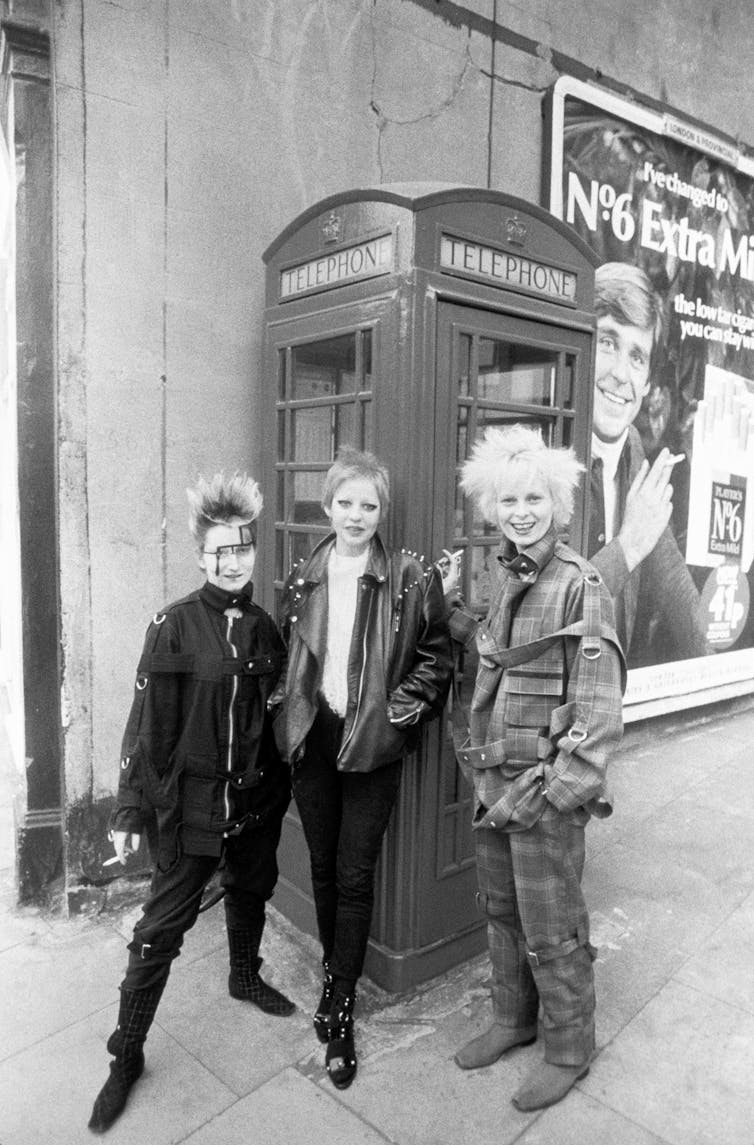
Black and white photo of three women in front of a London telephone booth.
Vivienne Westwood (right) with the model Jordan (Pamela Rooke) and another punk, London, 12 April 1977. Photo © Tim Jenkins / WWD / Penske Media via Getty Images

Pornographic slogans, emblems anchored in fetish practices and sadomasochism, and dresses made of plastics and supplemented with safety pins and chains subverted the comfortable status quo and allowed her fashion sense to penetrate into the middle classes.

What was once outrageous became something daringly respectable.

Kawakubo was born into an academic family and came to fashion design when making her own clothing in the 1960s under the label Comme des Garçons (“like the boys”) in Tokyo.

Conceived as anti-fashion, sober and severe, she made largely monochrome garments – black, dark grey and white – for women, with frayed, unfinished edges, holes and asymmetric shapes.

A men’s line was added in 1978. The number of outlets in Japan grew into the hundreds. Later, her designs established a strong presence in Paris.

The themes that bring the two fashion designers together in this exhibition include the opening section, Punk and Provocation. Both designers drew on the ethos of punk with its desire for change and the rejection of old ways.

Breaking orthodoxies

A second section is termed Rupture for the conscious desire to break with convention, whether it be Westwood’s Nostalgia of Mud collection of 1983 or Kawakubo’s Not Making Clothes collection of 2014.

There is a strongly expressed desire to break with the prevailing orthodoxies.

A model in a brown dress.
World’s End, London (fashion house), Vivienne Westwood (designer), Malcolm McLaren (designer) Outfit from the Nostalgia of Mud collection, autumn–winter 1982–83. Pillar Hall, Olympia, London, 24 March 1982. Photo © Robyn Beeche

A third section, Reinvention, hints at a postmodernist predilection of both artists to delve into traditions of art history and from unexpected sources, such as Rococo paintings, revive elements from tailoring traditions, ruffles and frills.

Although both artists are rule breakers, they do not act from a position of ignorance. It is from a detailed, and at times pedantic, knowledge of garments from the past.

A model in a red hat and a structural grey coat.
Comme des Garçons, Tokyo (fashion house), Rei Kawakubo (designer) Look 2, from the Smaller is Stronger collection, autumn–winter 2025. Paris, 8 March 2025. Image © Comme des Garçons. Model: Mirre Sonders

In the late 1980s, Westwood revived English tweeds and Scottish tartans. Kawakubo drew on the basics of traditional tailoring in menswear and applied it to unorthodox patterns and materials in her garments for women.

The ‘ideal’ body

A fourth section, The Body: Freedom and Restraints, perhaps most problematically challenges the conventions of idealised female beauty and the objectification of the female body.

It is argued in the exhibition that Westwood’s Erotic Zones collection (1995), and Kawakubo’s The Future of Silhouette (2017–18), may be viewed as attempts to redefine the female body.

Parker in a wedding dress.
Sarah Jessica Parker wearing a Vivienne Westwood wedding gown on the set of Sex and the City: The Movie, New York City, October 12 2007. Photo © James Devaney / WireImage via Getty Images

Kawakubo’s Body meets dress-Dress meets body collection, presented in 1996, systematically interrogates boundaries between bodies and garments. Westwood, at a similar time, played with padding and compression in her designs to question the ideals of a sexual, “ideal” body.

The final section of the exhibition is appropriately termed The Power of Clothes. This returns us to the recurring theme of employing fashion to make a statement concerning social change, whether this be the punk revolution or protests connected with climate change.

Mannequins in various outfits.
Installation view of Westwood | Kawakubo on display from 7 December 2025 to 19 April 2026, at NGV International, Melbourne. Vivienne Westwood Look 19, Jacket, shirt, knickers, bum pad, leggings, hat, crop, boots, 1994 and Look 34 Cape, shirt, corset, and boots and hat 1994 and Look 78, Dress, bum pad and shoes, 1994 from the On Liberty collection, 1994-1995. Courtesy of Vivienne Westwood Heritage. Photo: Sean Fennessy

Through their work, both Westwood and Kawakubo argue fashion is a political act and make broader social statements through their garments, particularly women’s wear.

Both fashion designers were prominent polemicists. As quoted in the exhibition, Westwood in 2011 declared,

I can use fashion as a medium to express my ideas to fight for a better world.

Kawakubo is quoted as saying in 2016,

Society needs something new, something with the power to provide stimulus and the drive to move us forward […] Maybe fashion alone is not enough to change our world, but I consider it my mission to keep pushing and to continue to propose new ideas.

This exhibition will be seen as historically significant and it is accompanied with a weighty catalogue. The NGV has established major collections of over 400 pieces of Westwood’s and Kawakubo’s work that lays the foundation for any further serious exploration of fashion from this period anywhere in the world.

Westwood | Kawakubo is at the National Gallery of Victoria until April 19.The Conversation

Sasha Grishin, Adjunct Professor of Art History, Australian National University

Subscribe to support our independent and original journalism, photography, artwork and film.

Monday, 12 January 2026

Why Jane Austen’s Leading Men are Such Enduringly Popular Heartthrobs

Mr Darcy played by Colin Firth in the BBC's beloved 1995 adaptation of Jane Austen's novel Pride and Prejudice.  


By Louise Curran

In Ang Lee’s adaptation of Sense and Sensibility (1995), the handsome cad Willoughby (played by Greg Wise) rescues Marianne (Kate Winslet) on horseback in the middle of a raging storm. Pathetic fallacy has rarely looked so good.

Marianne locks eyes with him and falls passionately in love. In Austen’s version, though, it is Marianne’s mother and sister who first register his attractions. “The eyes of both were fixed on him with an evident wonder and a secret admiration … his person, which was uncommonly handsome, received additional charms from his voice and expression.”

Willoughby has “exterior attractions” that the two women quickly notice. Once Marianne can master her own confusion, she rapidly constructs him in her mind as the ideal romantic protagonist.

“His person and air were equal to what her fancy had ever drawn for the hero of a favourite story … Her imagination was busy, her reflections were pleasant, and the pain of a sprained ankle was disregarded.”

Yet despite such auspicious beginnings, by the end of the novel Willoughby has proved to be feckless, shallow and passively cruel. The actual leading man turns out to be the respectable, yet taciturn, Colonel Brandon (played in the film by Alan Rickman).

In his introduction to the 1895 edition of Sense and Sensibility, the poet and essayist Henry Austin Dobson remarked upon the shrewd realism at work in Austen’s ending: “Every one does not get a Bingley, or a Darcy (with a park); but a good many sensible girls like Elinor pair off contentedly with poor creatures like Edward Ferrars, while not a few enthusiasts like Marianne decline at last upon middle-aged colonels with flannel waistcoats.”

For many modern readers, Brandon remains a disappointing compromise when compared with Willoughby’s flagrant virility.

Austen’s heartthrobs

All of Austen’s leading men are rich, which certainly helps to intensify their charms. Fitzwilliam Darcy of Pride and Prejudice is the wealthiest man of Austen’s fiction.

Initially he draws local attention for his “fine, tall person, handsome features, noble mien, and the report, which was in general circulation within five minutes after his entrance, of his having ten thousand a year”, until he is quickly “discovered to be proud”.

One of the key debates of Pride and Prejudice (1813) concerns marriage for love versus convenience and financial security. Elizabeth Bennet’s intelligent aunt Mrs Gardiner argues that the phrase “violently in love” is “so hackneyed, so doubtful, so indefinite” and “often applied to feelings which arise only from a half hour’s acquaintance”.

She eloquently expresses the problematic nature of infatuation and the fictional construction of the heroic ideal so prevalent in Regency culture.

Colin Firth’s infamous Pride and Prejudice wet shirt scene.

The phrase recurs right at the end of the novel, at the moment Elizabeth discloses her feelings for Darcy, producing a happiness in him that he “had probably never felt before; and he expressed himself on the occasion as sensibly and as warmly as a man violently in love can be supposed to do”.

The repeated phrase is a lovely touch, hesitating as it does between endorsing Darcy as a swoon-worthy leading man, burning with passion, and holding back from such excesses through the suggestion of a faint ridiculousness.

The 1995 BBC adaptation of Pride and Prejudice gave visual language to this conjunction of intrepid yet hesitant masculinity. Darcy (played memorably by Colin Firth) emerged from water like an Adonis in a wet shirt, only to face an embarrassed encounter with Elizabeth (Jennifer Ehle). Though usually handsome and always relatively rich, Austen’s leading men are also unconventional in that they can be awkward, mistaken, tongue-tied – even a bit dull.

When Darcy’s housekeeper at Pemberley describes him as “handsome”, this adjective, as Austen expert Janet Todd has noted, “extends over physical, social and moral qualities”. This conjunction of qualities shapes the leading men of Austen’s fiction not so much as suitors as familiar figures who come to be transformed by love.

Uncomfortable matches

Some aspects of this heroism might strike modern readers as odd, and they alert us to changing perceptions of the romantic hero since Austen’s time.

The age difference in Emma between Emma Woodhouse (21) and George Knightley (37) was not uncommon in the Regency era, when marriage was often predicated on women’s reproductive value and men’s financial security.

It can be uncomfortable for some readers when Knightley emphasises the fact that he was 16 years old when Emma was born (as he is cradling his baby niece). And when he jokes about having been in love with her since she was “13 at least”. Rather than suggesting anything dubious, this was intended to draw attention to the incremental steps the couple make from brother and sister-in-law to friends and then lovers.

Johnny Flynn’s Knightley has more youthful energy.

Recent adaptations of Emma seem uncomfortable with this age gap. Despite the fact that both Jeremy Northam and Johnny Flynn were in their mid-30s, and of similar age to Knightley in their respective versions (1996 and 2020), Flynn gives off a younger, more virile energy. He punches the air in joy when he realises Emma will marry him, in contrast to Northam’s emotional restraint.

Maria Edgeworth, a contemporary novelist and important influence on Austen, was struck by the way Austen’s leading men were supportive in private as much as in public.

In a letter, Edgeworth referenced the moment in Persuasion (1817) where Captain Wentworth shows his feelings for Anne by submitting to domestic chores: “The love and lover [are] admirably well drawn: don’t you see Captain Wentworth, or rather don’t you in her place feel him taking the boisterous child off her back as she kneels by the sick boy on the sofa?”

In figures such as Emma’s Mr Knightley, who represents the landed English class, and Persuasion’s Frederick Wentworth, a naval hero of the Napoleonic wars, Austen put emphasis on a new kind of domestic masculinity as a source of female desire and national pride.

Like Austen’s heroines, her leading men are not superlatively good. Their enduring appeal lies more in their capacity for self development and their acceptance of change and adaptation. Austen depicts love as the awakening of mutual esteem. It’s something to be worked on rather than something that magically arrives.

Louise Curran, Lecturer in Eighteenth-Century and Romantic Literature, University of Birmingham

Subscribe to support our independent and original journalism, photography, artwork and film.

Sunday, 11 January 2026

Purification and Holiness: How Ancient Greeks, Romans and Early Christians Used Olive Oil

Olive gathering, on an Ancient Greek amphora, circa 520 BC by the Antimenes Painter, in the black figure style
By Tamara Lewit, The University of Melbourne

Today, olive oil is often hailed as helping to protect against disease, but beliefs in its medicinal or even sacred properties date back millennia.

Olive oil was used for healing and purification and associated with important rituals from at least the second millennium BCE, in ways which still influence practices today.

A holy liquid

Mid 2nd millennium BCE texts from the capital of the Hittite empire (in what is now Turkey) describe the anointing of a newborn child and the mother to ward off the dangers of birth.

In ancient Syria the high priestess of the god Baal was initiated with an anointing of “fine oil of the temple”.

Mycenaean Bronze Age tablets from the palace of Pylos in what is now Greece record the making of special scented oil to be offered to the gods.

In the Hebrew scriptures, oil is used to to initiate priests and kings such as David and Solomon, and to sanctify ritual objects.

A preserver of health

Olive oil was used by Greeks and Romans for cleansing and healing.

Oiling while bathing was a vital part of health regimes. No visit to the baths was complete without rubbing your body with oil (in place of soap) and scraping it off with a metal tool called a strigil.

Roman author Pliny the Elder wrote:

There are two liquids that are especially agreeable to the human body: wine inside and oil outside […] but oil is an absolute necessity.

He recommended olive oil as a cure for nettle stings and a base for many medicinal herbs.

Celsus, a Greek medical writer of the second century CE Roman Empire, advised:

If an exhausted person is bordering on a fever, they should immerse themselves […] in warm water to which a little oil has been added and then gently rub the whole body […] with oil.

Another medical writer Soranus says to anoint a newborn with olive oil, as had the Hittites 1,500 years earlier.

A recent study has shown that perfumed oil was used in Greco-Roman offerings to deities, and for the ritual anointing of statues.

Olive oil and Christianity

When Christianity developed in the later Roman Empire, the Greek term Christos was used as a translation of the Hebrew word messiah, meaning “one anointed with sacred oil”. This was the origin of the words Christian and Christ.

Scented and blessed olive oil called a chrism was used for sanctification and purification.

A church council of 381 CE records that:

Those who […] are being saved from the heretics […] are first anointed with holy chrism on the forehead, eyes, nostrils, mouth and ears […] and then we baptise them.

Such perfumed olive oil was (and indeed still is) used to sanctify liturgical objects such as chalices, in rituals such as the ordination of priests, before baptism, and to anoint the sick.

A child is annointed with oil during a Catholic ceremony.
Oil is still used in religious rituals today. Photo by Matt McClain/The Washington Post via Getty Images

Churches were lit by a new type of lamp called a polycandelon, which had multiple glass bowls filled with scented olive oil, as well as lamps made in symbolic shapes such as a dove, crown or boat. These symbolised the light of God and contributed a heavenly fragrance.

The oil from saints’ tombs and sacred places was reputed to bring about healing miracles. Reliquaries containing the remains of saints had special holes for oil to be poured in and then dispensed.

This and the scented oil from lamps at martyrs’ shrines was used to anoint the sick.

A ninth century text describes how at Saint Menas’ tomb in Egypt:

a lamp before the grave […] burned day and night and was filled with fragrant oil. And when anyone took of this lamp oil […] and rubbed a sick person with it the sick person was healed.

Pilgrims who visited holy sites collected such oil in flasks, hoping to take home its healing power.

Ampulla (Flask) of Saint Menas
Pilgrims used flasks like this to carry oil from the pilgrimage site of Saint Menas. Rogers Fund, 1927/The Met

The early Church not only used olive oil, but also produced it.

Sixth century and later monastic and church archives record gifts of olive groves and enslaved workers to ecclesiastical and monastic estates.

This is confirmed by my own recent research into archaeological finds of oil production remains in episcopal complexes, annexes attached to churches, and in monasteries.

Christian symbols appear on the seals of oil transport containers from a fourth century CE shipwreck recently found off the coast of Mallorca.

Their painted inscriptions identify the contents as a special “sweet oil”, perhaps produced at monasteries in southern Spain and marketed for ritual and healing use.

Olive oil today

Ancient uses of olive oil for rituals of initiation, sanctification and healing have a modern legacy.

In 2023, oil for the coronation of Charles III was harvested from groves on the Mount of Olives, processed at local monasteries and blessed by archbishops in Jerusalem.

The anointing ritual continued a tradition derived from early medieval coronations of the first English kings, in turn modelled on that of the ancient King Solomon .

Olive oil is still used in Christian sacraments, the consecration of churches, and anointing of the sick.

Beautiful to taste, touch, see and smell, olive oil has had a special significance in human history. Its uses today have grown from the roots of a long tradition.The Conversation

Tamara Lewit, Honorary Fellow, School of Historical and Philosophical Studies, The University of Melbourne

Subscribe to support our independent and original journalism, photography, artwork and film.

Saturday, 10 January 2026

Brigitte Bardot Defined the Modern Woman and Defied Social Norms

Brigitte Bardot had a profound impact on French national identity and beauty standards; she rivalled Marilyn Monroe in global fame at her peak. Simone de Beauvoir wrote she "appears as a force of nature." Photograph: Sam Levin/Kobal/Shutterstock.

By Ben McCann 

Brigitte Bardot had one of the most extraordinary careers in post-war French cultural life. Best known as an actress, she was also a singer, a fashion icon, an animal rights activist and a symbol of France’s sexual liberation.

Famous enough to be known by her initials, B.B. symbolised a certain vision of French femininity – rebellious and sensual, yet vulnerable.

Her impact on beauty standards and French national identity was profound. At her peak, she rivalled Marilyn Monroe in global fame and recognition. Simone de Beauvoir, France’s leading feminist writer, famously wrote in 1959 that Bardot “appears as a force of nature, dangerous so long as she remains untamed”.

A star is born

Bardot was born in 1934 to a well-off Parisian family. Raised in a strict Catholic household, she studied ballet at the Conservatoire de Paris with hopes of becoming a professional dancer.

Bardot en pointe.
Brigitte Bardot, pictured here in 1946, studied ballet as a child. Roger Viollet via Getty Images

Her striking looks led her to modelling. By 14, she was appearing in Elle magazine, catching the eye of director Roger Vadim, whom she married in 1952.

She began acting in the early 1950s and her appearance as Juliette in Vadim’s And God Created Woman (Et Dieu… créa la femme, 1956) put her on the map.

Bardot was instantly catapulted to international stardom. Vadim presented his wife as the ultimate expression of youthful, erotic freedom that both shocked and captivated French audiences.

Watching this relatively tame film today, it’s difficult to imagine just how taboo-breaking Bardot’s performance was. But in sleepy Catholic, conservative 1950s France, it set new norms for on-screen sexuality.

The film became a global phenomenon. Critics loved it, but censors and religious groups grew nervous.

An 60s icon

Bardot’s lack of formal training as an actress paradoxically became part of her appeal: she adopted a spontaneous acting approach, as much physical as verbal.

She was stunning in Contempt (Le Mépris, 1963), Jean-Luc Godard’s masterpiece about a crumbling marriage. Godard used her beauty and fame both as spectacle and critique. The film’s most famous sequence was a 31-minute conversation between Bardot and her co-star Michel Piccoli. Bardot was never better.

In Henri-Georges Clouzot’s intense courtroom drama The Truth (La Vérité, 1960), she showcased her dramatic range playing a young woman on trial for the murder of her lover.

Bardot in a bed.
Bardot in a poster for The Truth, 1960. LMPC via Getty Images

In 1965, she co-starred with Jeanne Moreau in Louis Malle’s Long Live Maria (Viva Maria), a rare female buddy film that blended comedy and political satire. Bardot’s anarchic energy remains a dazzling feat.

A Very Private Affair (Vie privée, 1962) saw her portray a woman consumed by fame and chased by the media. The plotline was eerily predictive of Bardot’s own future.

She popularised fashion trends like the choucroute hairstyle and ballet flats. The Bardot neckline – off-the-shoulder tops and dresses – was named after her. She even wore pink gingham at her 1959 wedding.

Allure and provocation

Bardot’s star appeal lay in her contradictions. She appeared simultaneously natural and provocative, spontaneous and calculated. Her dishevelled glamour and effortless sexuality helped construct the archetype of the modern “sex kitten”.

She famously said “it is better to be unfaithful than to be faithful without wanting to be”.

Throwing off the shackles of bourgeois morality, Bardot epitomised a commitment to emotional and sexual freedom. Her turbulent love life was a case in point. She was married four times, with dozens of stormy relationships and extra-marital affairs along the way.

Forever immortalised as a free-spirited ingénue, Bardot was a muse for filmmakers, artists and musicians, from Andy Warhol to Serge Gainsbourg. Later on, Kate Moss, Amy Winehouse and Elle Fanning mentioned Bardot as an inspiration.

Famously, Bardot never succumbed to cosmetic surgery. As she once noted:

Women should embrace ageing because, at the end of the day, it’s much more beautiful to have a grandmother with white hair who looks like an elderly lady than to have a grandmother who’s bleached, dyed, and […] who looks much older but also really unhappy.

Life after the movies

Bardot retired from acting in 1973, aged only 39, citing disillusionment with fame. “It suffocated and destroyed me”, she said, about the film industry.

She shifted her attention to animal rights, founding the Brigitte Bardot Foundation in 1986. She became an uncompromising, vocal activist, campaigning against animal cruelty, fur farming, whaling and bullfighting.

But Bardot courted controversy from the mid-1990s for her far-right political views, remarks about Islam and immigration and repeated convictions for inciting racial hatred. She publicly defended disgraced actor Gérard Depardieu and pushed back on the #MeToo movement in France.

Such statements damaged her reputation, especially outside France, and created a troubling image: the once-liberating sex symbol now associated with nationalist conservatism.

While she never identified as a feminist, her unapologetic autonomy, early retirement and outspoken views led some to re-evaluate her as a figure of proto-feminist rebellion.

France gradually began to turn against Bardot, bothered by her outspoken views. But some applauded her couldn’t-care-less attitude and unwillingness to play by the rules.

Ultimately, by rejecting fame on her own terms, she parlayed her 50s free-spiritedness into a bold stand against conformity and societal norms.

Late in life, she told Danièle Thompson, the writer-director of the 2023 mini-series about her career, “I don’t understand why the whole world is still talking about me”.

The answer is simple – Bardot continues to fascinate us, flaws and all.The Conversation

Ben McCann, Associate Professor of French Studies, University of Adelaide

Subscribe to support our independent and original journalism, photography, artwork and film.

Wednesday, 7 January 2026

A Fresh Start Feels Powerful - Until Motivation Fades. Here’s How to Set Work Goals that Stick

Motivation is sustained when goals support three psychological needs: autonomy (feeling the goal is genuinely ours) competence (feeling capable of progress) and relatedness (feeling supported).

By Gayani Gunasekera

Every January, offices quietly reset. New planners appear on desks. Fresh notebooks open in meetings. To-do lists look neater, ambitions clearer. There is a shared sense that this year, things will be different.

And yet, by February, many of those planners sit half-used. The motivation that felt so real just weeks earlier fades. This pattern is often blamed on a lack of discipline or willpower. But psychology tells a more generous and useful story.

Fresh starts can help us begin, but they often don’t help us persist. Here’s why – and what research can tell us about setting work goals that actually stick.

Why fresh starts feel so powerful

The start of a new year acts as what psychologists call a “temporal landmark” – a moment that separates our “old” selves from the people we hope to become.

Behavioural science research has found landmarks such as New Year’s Day create a “fresh start effect”: people feel more motivated to pursue aspirational goals simply because a new chapter seems to be opening.

A person writing in a notebook
The start of a new year can feel energising. Karola G/Pexels

Researchers propose the appeal lies not in the new diary or planner itself, but in what it symbolises – a clean slate, untangled from last year’s unfinished tasks and perceived failures. A blank page makes it easier to believe progress will be smoother this time.

After the social, cognitive and emotional overload of December, crowded calendars, constant decisions, accumulated fatigue, that promise of a blank page can be deeply comforting.

Writing goals into a new notebook can offer a brief sense that life can be reordered, intentions clarified and control gently restored.

Why motivation fades

The problem is not that fresh starts don’t work. It’s that we often mistake the emotional lift of beginning something new for motivation that will last.

Self-determination theory, an established theory in motivation research, proposes an explanation for why enthusiasm drains quickly.

It suggests motivation is sustained when goals support three psychological needs: autonomy (feeling the goal is genuinely ours), competence (feeling capable of progress) and relatedness (feeling supported).

January goals often fail this test. They are often shaped by social pressure (“I should be more productive”), vague aspiration (“be better at work”), or unrealistic scope (“I’ll overhaul everything at once”). When early effort doesn’t translate into visible progress, competence falters and motivation follows.

This helps explain why hesitation creeps in after the first blank page is filled, ambitious planning cycles stall, and abandoned gym memberships mirror workplace initiatives. It isn’t poor character; it’s that enthusiasm was doing too much of the work.

As motivational researcher Richard Koestner has argued, goals pursued because we feel we ought to rarely sustain effort. Goals that feel self-endorsed and meaningful are more likely to endure once the initial excitement fades.

How to set goals that stick

Sustained follow-through depends on planning for the moment when motivation dips. At work, this means designing goals for psychological endurance, not peak January energy.

Ask not what success looks like when motivation is high, but what progress looks like in a busy, distracted week. Three shifts can help:

1. Plan for the dip


Assume motivation will fade and decide in advance what “continuing” looks like.

For example, instead of committing to a full project overhaul, identify the smallest meaningful step that still counts as progress. That could be a quick review, a strategic conversation or noting priorities for the week. Designing for low-energy moments ensures momentum survives early-year dips.

2. Anchor goals in autonomy


Goals aligned with personal values, rather than just external pressure, are often far more resilient – even when they’re part of performance reviews or team expectations. Motivation is stronger when you can find your own reason to care.

Ask yourself: how does this goal connect to my growth, sense of purpose or how I want to show up at work?

Woman at work on laptop writing in notebook
Set goals aligned with your own values – not just validation from others. Vitaly Gariev/Unsplash

3. Lower the effort required to persist


It helps to break intentions into small, concrete, repeatable actions so progress doesn’t depend on high motivation alone. Instead of aiming to “be more organised”, commit to reviewing your planner for ten minutes every Friday or noting one unfinished task before leaving.

Breaking goals into small “when … then” steps, also known as implementation intentions, makes follow-through easier.

Research shows these concrete cues can reduce the need for in-the-moment motivation, a principle author James Clear popularised in the book Atomic Habits as building systems that work even on low-energy days.

A more realistic approach

The urge to start fresh each January isn’t naïve. It reflects a deeply human need for renewal, coherence and hope. Blank pages matter – just not because they magically change behaviour.

Fresh starts can open the door to change. But lasting momentum depends on what we build after the novelty wears off. The real skill isn’t setting goals when motivation is high. It’s designing goals that survive the weeks when it isn’t.The Conversation

Gayani Gunasekera, Postdoctoral Research Fellow and Sessional Academic, Work and Organisational Studies, University of Sydney

Subscribe to support our independent and original journalism, photography, artwork and film.