American actor Teyana Taylor strikes a pose on the steps of the Petit Palais before the Schiaparelli show. Photograph (above) and cover picture of Jean-Christophe Bouvet (who plays Pierre Cadault in Emily in Paris) by Andrea Heinsohn for DAM
In Paris, haute couture does not always begin on the runway. During Spring/Summer 2026, the pavements, courtyards and grand staircases, notably outside Schiaparelli at the Petit Palais, formed a parallel arena where fashion was defined in real time. We document the evolving language of couture street style, tracing how influence moves fluidly between celebrity, industry, and a global audience. These images present a record of moments when the street did not simply reflect couture, it actively shaped it. Photography by Andrea Heinsohn
Heart Evangelista wears a tailored
Schiaparelli jacket to the Paris show.
LOOKING back to January’s Spring/Summer 2026 Paris Haute Couture Week, it is the scenes outside Schiaparelli at the Petit Palais that feel most enduring. The wide stone steps leading up to the gilded façade became a stage in their own right, an informal yet highly visible theatre where editors, stylists, and invited guests shaped the visual identity of the week.
Andrea Heinsohn's photographs capture this fleeting street choreography: the stillness before a pose, the movement between frames, the quiet negotiation between spectacle and self-possession.
Among the front-row regulars, fashion editors stood out as much as the stylists themselves, Suzy Menkes with her signature bouffant hair, Anna Dello Russo commanding attention in her signature maximalist yet elegant style, and the German fashion influencer Leonie Hanne.
Among celebrity arrivals was Teyana Taylor, whose arrival was self-possessed as she wore a pearly double crown. In the weeks since, that appearance has gained added context. At the 98th Academy Awards, she received a nomination for Best Supporting Actress for One Battle After Another, a role that had already earned her a Golden Globe earlier in the season. While the Oscar went to Amy Madigan, the film itself secured Best Picture, with Taylor joining the cast on stage during the acceptance, a moment that quickly circulated online.
Andrea Heinsohn's photographs capture the fleeting choreography of streetstyle: the stillness before a pose, the movement between frames, the quiet negotiation between spectacle and self-possession
Chiara Ferragni back in the
fashion ring after her legal
troubles kept her away.
Also on the steps was Heart Evangelista, whose presence underscores the increasingly global dimension of couture week. Known for her series I Am Heart and her multifaceted career spanning fashion, art, and philanthropy, she brought a polished yet personal sensibility to the setting, bridging the distance between high fashion and lived experience. Nearby, Chiara Ferragni maintained her signature poise, reinforcing the ongoing dialogue between couture and digital influence, after resolving her legal troubles in Italy.
Elsewhere in the city, beyond the steps of the Petit Palais, the street style narrative continued with equal intensity, even with umbrellas raised with the downpour before the Chanel show and the chilly temperatures at night for the evening events.
Jean-Christophe Bouvet, widely recognised for his role as Pierre Cadault in Emily in Paris, became an unexpected focal point for photographers and fans alike. Moving between shows, often accompanied by his signature fan and an air of theatrical ease, he blurred the line between character and self, embodying the enduring allure of Parisian fashion eccentricity.
Beyond these recognizable figures, the vitality of the street lay in its wider cast. Emerging creatives, independent stylists, and seasoned editors contributed to a visual landscape that felt considered rather than excessive. Tailoring was sharp, silhouettes strong, and even the more expressive looks carried a sense of editing, suggesting a shift toward style over spectacle. What follows is a portrait of couture beyond the runway, captured in passing moments across Paris, where fashion is not only shown, but lived. ~ Jeanne-Marie Cilento
See more highlights of the Paris Haute Couture Spring/Summer 2026 Streetstyle
The war in the Middle East has important implications for how air travel functions right now and in the future.
By Steven Leib
We are now three weeks into the war between the United States, Israel and Iran, which has grown to engulf much of the Middle East. There are few signs the conflict will slow down or stop anytime soon.
The situation has upended air travel. Missile and drone strikes have affected major airports, key routes through the Middle East have been shut down and the cost of jet fuel has shot up.
For airlines, these factors mean higher operating costs and reduced capacity. For many travellers, that means fewer options and higher prices.
Some travellers may be in a position to revise, delay or cancel upcoming travel plans. But many others who need to fly for work or personal reasons face high costs or may even be considering complex, unorthodox routes.
There are some important implications for how global air travel functions, right now and in the future. But there are also some general practical tips for ordinary travellers to help navigate the uncertainty.
Jet fuel costs soar
For virtually every airline in the world, fuel and labour represent the two highest costs. Since the beginning of the conflict, severe energy market disruption means the average jet fuel price has nearly doubled, with little indication relief is on the way.
And it’s possible the global energy market crisis could escalate further, as gas plants and gas fields in Qatar and Iran come under attack.
Right now, because of the increase in fuel prices for many airlines, jet fuel has likely surged to become the number-one cost (if it wasn’t already).
What’s happening with airfares?
Fuel costs aren’t the only factor. For Australians looking to travel to or through the Middle East, the removal of millions of airline seats from flight schedules has pushed serious demand onto other routes.
Unsurprisingly, many major airlines have hiked their international fares significantly. And they may go up further still. Qantas, for instance, this week said it would review its international airfares every two weeks.
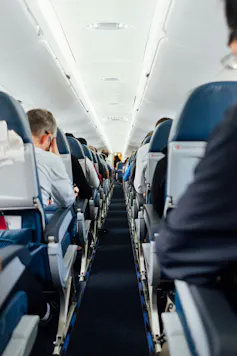
Airfares have spiked as a result of the conflict.Hanson Lu/Unsplash
Some tickets have appeared at an extraordinarily high price. Cathay Pacific attracted attention for advertising business class tickets from Sydney to London (via Hong Kong) for close to A$40,000 return.
This is obviously very expensive. However, it is a natural result of the way most airlines use “dynamic pricing”. In essence, airlines are trying to identify (typically by analysing your flight searches) the highest price you’re willing to pay, so they can sell you a ticket at that price.
In a crisis, some might see this as taking advantage of vulnerable passengers. But airlines could argue the system ensures there is a seat there for someone who desperately needs it.
Unfortunately, they rely on the price consumers are willing to pay to demonstrate that level of “need”.
Stuck in a holding pattern
More broadly, the conflict has dramatically altered airlines’ ability to predict their costs. That’s a problem, because seats are usually for sale up to nearly a year in advance.
Will we see a shift in popular flight routes around the world if this conflict drags on? It’s hard to say.
The Middle East is geographically well-positioned to access nearly the entire world with a non-stop flight. It sits at the intersection of several popular international travel corridors, and its airline ownership models typically include government backing (which can help carriers stay operationally and financially stable).
However, if this conflict threatens those advantages in the long term, other airlines may step in, perhaps able to lower their fares over time by boosting their capacity.
Going the longer way around
Airlines based in Asia are particularly well placed to serve Australians travelling to Europe, though high demand for these routes has driven up airfares.
Another option is to sequence together multiple tickets on different carriers. This can lower costs and may add an element of “adventure”.
However, there are some significant risks that could undo any cost savings. For one, the “extras” can really add up. A sequence of self-organised tickets often means additional expenses for:
overnight transits
multiple baggage fees
more meals on the road.
Travellers should also be mindful of visa requirements in transit countries, and any visa fees that apply.
Crucially, the “do-it-yourself” approach often means you are not protected from the impacts of delays or cancellations across multiple tickets on different airlines.
Other general tips
For those who are planning travel in the next couple of months, most carriers based in the Middle East are selling tickets with a reduced flight schedule to accommodate operational restrictions.
But given ongoing uncertainty, these schedules may not be as reliable as passengers would typically expect.
Buying flexible fares and travel insurance can help alleviate the effects of travel disruptions. But they introduce added costs.
What about those already booked, but anxious about whether they’ll be able to fly? Some airlines have cancellation or rebooking policies for passengers affected by the conflict for travel within a specified window of time.
Airlines may offer fee waivers, free rebooking or penalty-free cancellations.
But those whose dates aren’t eligible shouldn’t proactively cancel their flights themselves. Waiting for the airline to formally say, “we can’t take you there” gives you the best chance of ensuring it remains responsible for rebooking, a refund and other accommodations.
Steven Leib, Associate Professor in Aviation, CQUniversity Australia


.jpg)