Sunday, 11 January 2026

Purification and Holiness: How Ancient Greeks, Romans and Early Christians Used Olive Oil

Olive gathering, on an Ancient Greek amphora, circa 520 BC by the Antimenes Painter, in the black figure style
By Tamara Lewit, The University of Melbourne

Today, olive oil is often hailed as helping to protect against disease, but beliefs in its medicinal or even sacred properties date back millennia.

Olive oil was used for healing and purification and associated with important rituals from at least the second millennium BCE, in ways which still influence practices today.

A holy liquid

Mid 2nd millennium BCE texts from the capital of the Hittite empire (in what is now Turkey) describe the anointing of a newborn child and the mother to ward off the dangers of birth.

In ancient Syria the high priestess of the god Baal was initiated with an anointing of “fine oil of the temple”.

Mycenaean Bronze Age tablets from the palace of Pylos in what is now Greece record the making of special scented oil to be offered to the gods.

In the Hebrew scriptures, oil is used to to initiate priests and kings such as David and Solomon, and to sanctify ritual objects.

A preserver of health

Olive oil was used by Greeks and Romans for cleansing and healing.

Oiling while bathing was a vital part of health regimes. No visit to the baths was complete without rubbing your body with oil (in place of soap) and scraping it off with a metal tool called a strigil.

Roman author Pliny the Elder wrote:

There are two liquids that are especially agreeable to the human body: wine inside and oil outside […] but oil is an absolute necessity.

He recommended olive oil as a cure for nettle stings and a base for many medicinal herbs.

Celsus, a Greek medical writer of the second century CE Roman Empire, advised:

If an exhausted person is bordering on a fever, they should immerse themselves […] in warm water to which a little oil has been added and then gently rub the whole body […] with oil.

Another medical writer Soranus says to anoint a newborn with olive oil, as had the Hittites 1,500 years earlier.

A recent study has shown that perfumed oil was used in Greco-Roman offerings to deities, and for the ritual anointing of statues.

Olive oil and Christianity

When Christianity developed in the later Roman Empire, the Greek term Christos was used as a translation of the Hebrew word messiah, meaning “one anointed with sacred oil”. This was the origin of the words Christian and Christ.

Scented and blessed olive oil called a chrism was used for sanctification and purification.

A church council of 381 CE records that:

Those who […] are being saved from the heretics […] are first anointed with holy chrism on the forehead, eyes, nostrils, mouth and ears […] and then we baptise them.

Such perfumed olive oil was (and indeed still is) used to sanctify liturgical objects such as chalices, in rituals such as the ordination of priests, before baptism, and to anoint the sick.

A child is annointed with oil during a Catholic ceremony.
Oil is still used in religious rituals today. Photo by Matt McClain/The Washington Post via Getty Images

Churches were lit by a new type of lamp called a polycandelon, which had multiple glass bowls filled with scented olive oil, as well as lamps made in symbolic shapes such as a dove, crown or boat. These symbolised the light of God and contributed a heavenly fragrance.

The oil from saints’ tombs and sacred places was reputed to bring about healing miracles. Reliquaries containing the remains of saints had special holes for oil to be poured in and then dispensed.

This and the scented oil from lamps at martyrs’ shrines was used to anoint the sick.

A ninth century text describes how at Saint Menas’ tomb in Egypt:

a lamp before the grave […] burned day and night and was filled with fragrant oil. And when anyone took of this lamp oil […] and rubbed a sick person with it the sick person was healed.

Pilgrims who visited holy sites collected such oil in flasks, hoping to take home its healing power.

Ampulla (Flask) of Saint Menas
Pilgrims used flasks like this to carry oil from the pilgrimage site of Saint Menas. Rogers Fund, 1927/The Met

The early Church not only used olive oil, but also produced it.

Sixth century and later monastic and church archives record gifts of olive groves and enslaved workers to ecclesiastical and monastic estates.

This is confirmed by my own recent research into archaeological finds of oil production remains in episcopal complexes, annexes attached to churches, and in monasteries.

Christian symbols appear on the seals of oil transport containers from a fourth century CE shipwreck recently found off the coast of Mallorca.

Their painted inscriptions identify the contents as a special “sweet oil”, perhaps produced at monasteries in southern Spain and marketed for ritual and healing use.

Olive oil today

Ancient uses of olive oil for rituals of initiation, sanctification and healing have a modern legacy.

In 2023, oil for the coronation of Charles III was harvested from groves on the Mount of Olives, processed at local monasteries and blessed by archbishops in Jerusalem.

The anointing ritual continued a tradition derived from early medieval coronations of the first English kings, in turn modelled on that of the ancient King Solomon .

Olive oil is still used in Christian sacraments, the consecration of churches, and anointing of the sick.

Beautiful to taste, touch, see and smell, olive oil has had a special significance in human history. Its uses today have grown from the roots of a long tradition.The Conversation

Tamara Lewit, Honorary Fellow, School of Historical and Philosophical Studies, The University of Melbourne

Subscribe to support our independent and original journalism, photography, artwork and film.

Saturday, 10 January 2026

Brigitte Bardot Defined the Modern Woman and Defied Social Norms

Brigitte Bardot had a profound impact on French national identity and beauty standards; she rivalled Marilyn Monroe in global fame at her peak. Simone de Beauvoir wrote she "appears as a force of nature." Photograph: Sam Levin/Kobal/Shutterstock.

By Ben McCann 

Brigitte Bardot had one of the most extraordinary careers in post-war French cultural life. Best known as an actress, she was also a singer, a fashion icon, an animal rights activist and a symbol of France’s sexual liberation.

Famous enough to be known by her initials, B.B. symbolised a certain vision of French femininity – rebellious and sensual, yet vulnerable.

Her impact on beauty standards and French national identity was profound. At her peak, she rivalled Marilyn Monroe in global fame and recognition. Simone de Beauvoir, France’s leading feminist writer, famously wrote in 1959 that Bardot “appears as a force of nature, dangerous so long as she remains untamed”.

A star is born

Bardot was born in 1934 to a well-off Parisian family. Raised in a strict Catholic household, she studied ballet at the Conservatoire de Paris with hopes of becoming a professional dancer.

Bardot en pointe.
Brigitte Bardot, pictured here in 1946, studied ballet as a child. Roger Viollet via Getty Images

Her striking looks led her to modelling. By 14, she was appearing in Elle magazine, catching the eye of director Roger Vadim, whom she married in 1952.

She began acting in the early 1950s and her appearance as Juliette in Vadim’s And God Created Woman (Et Dieu… créa la femme, 1956) put her on the map.

Bardot was instantly catapulted to international stardom. Vadim presented his wife as the ultimate expression of youthful, erotic freedom that both shocked and captivated French audiences.

Watching this relatively tame film today, it’s difficult to imagine just how taboo-breaking Bardot’s performance was. But in sleepy Catholic, conservative 1950s France, it set new norms for on-screen sexuality.

The film became a global phenomenon. Critics loved it, but censors and religious groups grew nervous.

An 60s icon

Bardot’s lack of formal training as an actress paradoxically became part of her appeal: she adopted a spontaneous acting approach, as much physical as verbal.

She was stunning in Contempt (Le Mépris, 1963), Jean-Luc Godard’s masterpiece about a crumbling marriage. Godard used her beauty and fame both as spectacle and critique. The film’s most famous sequence was a 31-minute conversation between Bardot and her co-star Michel Piccoli. Bardot was never better.

In Henri-Georges Clouzot’s intense courtroom drama The Truth (La Vérité, 1960), she showcased her dramatic range playing a young woman on trial for the murder of her lover.

Bardot in a bed.
Bardot in a poster for The Truth, 1960. LMPC via Getty Images

In 1965, she co-starred with Jeanne Moreau in Louis Malle’s Long Live Maria (Viva Maria), a rare female buddy film that blended comedy and political satire. Bardot’s anarchic energy remains a dazzling feat.

A Very Private Affair (Vie privée, 1962) saw her portray a woman consumed by fame and chased by the media. The plotline was eerily predictive of Bardot’s own future.

She popularised fashion trends like the choucroute hairstyle and ballet flats. The Bardot neckline – off-the-shoulder tops and dresses – was named after her. She even wore pink gingham at her 1959 wedding.

Allure and provocation

Bardot’s star appeal lay in her contradictions. She appeared simultaneously natural and provocative, spontaneous and calculated. Her dishevelled glamour and effortless sexuality helped construct the archetype of the modern “sex kitten”.

She famously said “it is better to be unfaithful than to be faithful without wanting to be”.

Throwing off the shackles of bourgeois morality, Bardot epitomised a commitment to emotional and sexual freedom. Her turbulent love life was a case in point. She was married four times, with dozens of stormy relationships and extra-marital affairs along the way.

Forever immortalised as a free-spirited ingénue, Bardot was a muse for filmmakers, artists and musicians, from Andy Warhol to Serge Gainsbourg. Later on, Kate Moss, Amy Winehouse and Elle Fanning mentioned Bardot as an inspiration.

Famously, Bardot never succumbed to cosmetic surgery. As she once noted:

Women should embrace ageing because, at the end of the day, it’s much more beautiful to have a grandmother with white hair who looks like an elderly lady than to have a grandmother who’s bleached, dyed, and […] who looks much older but also really unhappy.

Life after the movies

Bardot retired from acting in 1973, aged only 39, citing disillusionment with fame. “It suffocated and destroyed me”, she said, about the film industry.

She shifted her attention to animal rights, founding the Brigitte Bardot Foundation in 1986. She became an uncompromising, vocal activist, campaigning against animal cruelty, fur farming, whaling and bullfighting.

But Bardot courted controversy from the mid-1990s for her far-right political views, remarks about Islam and immigration and repeated convictions for inciting racial hatred. She publicly defended disgraced actor Gérard Depardieu and pushed back on the #MeToo movement in France.

Such statements damaged her reputation, especially outside France, and created a troubling image: the once-liberating sex symbol now associated with nationalist conservatism.

While she never identified as a feminist, her unapologetic autonomy, early retirement and outspoken views led some to re-evaluate her as a figure of proto-feminist rebellion.

France gradually began to turn against Bardot, bothered by her outspoken views. But some applauded her couldn’t-care-less attitude and unwillingness to play by the rules.

Ultimately, by rejecting fame on her own terms, she parlayed her 50s free-spiritedness into a bold stand against conformity and societal norms.

Late in life, she told Danièle Thompson, the writer-director of the 2023 mini-series about her career, “I don’t understand why the whole world is still talking about me”.

The answer is simple – Bardot continues to fascinate us, flaws and all.The Conversation

Ben McCann, Associate Professor of French Studies, University of Adelaide

Subscribe to support our independent and original journalism, photography, artwork and film.

Wednesday, 7 January 2026

A Fresh Start Feels Powerful - Until Motivation Fades. Here’s How to Set Work Goals that Stick

Motivation is sustained when goals support three psychological needs: autonomy (feeling the goal is genuinely ours) competence (feeling capable of progress) and relatedness (feeling supported).

By Gayani Gunasekera

Every January, offices quietly reset. New planners appear on desks. Fresh notebooks open in meetings. To-do lists look neater, ambitions clearer. There is a shared sense that this year, things will be different.

And yet, by February, many of those planners sit half-used. The motivation that felt so real just weeks earlier fades. This pattern is often blamed on a lack of discipline or willpower. But psychology tells a more generous and useful story.

Fresh starts can help us begin, but they often don’t help us persist. Here’s why – and what research can tell us about setting work goals that actually stick.

Why fresh starts feel so powerful

The start of a new year acts as what psychologists call a “temporal landmark” – a moment that separates our “old” selves from the people we hope to become.

Behavioural science research has found landmarks such as New Year’s Day create a “fresh start effect”: people feel more motivated to pursue aspirational goals simply because a new chapter seems to be opening.

A person writing in a notebook
The start of a new year can feel energising. Karola G/Pexels

Researchers propose the appeal lies not in the new diary or planner itself, but in what it symbolises – a clean slate, untangled from last year’s unfinished tasks and perceived failures. A blank page makes it easier to believe progress will be smoother this time.

After the social, cognitive and emotional overload of December, crowded calendars, constant decisions, accumulated fatigue, that promise of a blank page can be deeply comforting.

Writing goals into a new notebook can offer a brief sense that life can be reordered, intentions clarified and control gently restored.

Why motivation fades

The problem is not that fresh starts don’t work. It’s that we often mistake the emotional lift of beginning something new for motivation that will last.

Self-determination theory, an established theory in motivation research, proposes an explanation for why enthusiasm drains quickly.

It suggests motivation is sustained when goals support three psychological needs: autonomy (feeling the goal is genuinely ours), competence (feeling capable of progress) and relatedness (feeling supported).

January goals often fail this test. They are often shaped by social pressure (“I should be more productive”), vague aspiration (“be better at work”), or unrealistic scope (“I’ll overhaul everything at once”). When early effort doesn’t translate into visible progress, competence falters and motivation follows.

This helps explain why hesitation creeps in after the first blank page is filled, ambitious planning cycles stall, and abandoned gym memberships mirror workplace initiatives. It isn’t poor character; it’s that enthusiasm was doing too much of the work.

As motivational researcher Richard Koestner has argued, goals pursued because we feel we ought to rarely sustain effort. Goals that feel self-endorsed and meaningful are more likely to endure once the initial excitement fades.

How to set goals that stick

Sustained follow-through depends on planning for the moment when motivation dips. At work, this means designing goals for psychological endurance, not peak January energy.

Ask not what success looks like when motivation is high, but what progress looks like in a busy, distracted week. Three shifts can help:

1. Plan for the dip


Assume motivation will fade and decide in advance what “continuing” looks like.

For example, instead of committing to a full project overhaul, identify the smallest meaningful step that still counts as progress. That could be a quick review, a strategic conversation or noting priorities for the week. Designing for low-energy moments ensures momentum survives early-year dips.

2. Anchor goals in autonomy


Goals aligned with personal values, rather than just external pressure, are often far more resilient – even when they’re part of performance reviews or team expectations. Motivation is stronger when you can find your own reason to care.

Ask yourself: how does this goal connect to my growth, sense of purpose or how I want to show up at work?

Woman at work on laptop writing in notebook
Set goals aligned with your own values – not just validation from others. Vitaly Gariev/Unsplash

3. Lower the effort required to persist


It helps to break intentions into small, concrete, repeatable actions so progress doesn’t depend on high motivation alone. Instead of aiming to “be more organised”, commit to reviewing your planner for ten minutes every Friday or noting one unfinished task before leaving.

Breaking goals into small “when … then” steps, also known as implementation intentions, makes follow-through easier.

Research shows these concrete cues can reduce the need for in-the-moment motivation, a principle author James Clear popularised in the book Atomic Habits as building systems that work even on low-energy days.

A more realistic approach

The urge to start fresh each January isn’t naïve. It reflects a deeply human need for renewal, coherence and hope. Blank pages matter – just not because they magically change behaviour.

Fresh starts can open the door to change. But lasting momentum depends on what we build after the novelty wears off. The real skill isn’t setting goals when motivation is high. It’s designing goals that survive the weeks when it isn’t.The Conversation

Gayani Gunasekera, Postdoctoral Research Fellow and Sessional Academic, Work and Organisational Studies, University of Sydney

Subscribe to support our independent and original journalism, photography, artwork and film.

What’s on Your Holiday Reading List? We Asked Six Dedicated Readers

Holiday books are about page-turners as well as catching up on those that have been left on the bedside table during the year. Cover picture of Robert Redford on the beach in Malibu by Annie Leibovitz. 

By Jo Case

When I think about holiday reading, I think about relaxing with an easy page-turner … but I also think about finally having the headspace for the more complex, challenging books that have haunted my bedside table during the busy year.

Summer reading is often characterised as paperback romance or detective fiction. And it is that. But it’s also anything your tired, finally well-rested brain wants to apply itself to in the sunnier months: on a beach, by a pool or splayed on a couch under an air conditioner.

We asked six avid readers what they plan to read this holiday – and their answers reflected all of the above and more. I’ve already stolen a few ideas to add to my own hopeful pile. (So far, it includes Susie Boyt’s much-raved-about novel Loved and Missed, a biography of her father Lucian Freud, Dominic Amerena’s literary satire, I Want Everything … and Anna Karenina.)


The Summer Book and Belgian crime

What better time to revisit The Summer Book, by Tove Jansson? It helps that there is a film adaptation on the way (starring Glenn Close), though I wonder how this bittersweet, funny and pitch perfect story of a girl, her grandmother and her father spending a summer on a tiny island in the Gulf of Finland can be rendered in filmic form.

Talking of adaptation, the latest TV adaptation of the chief inspector Maigret detective novels has recently dropped – and that encourages me to read more of the short novels by the Belgian writer, Georges Simenon. I read half a dozen Maigret novels last summer, but that’s fine – there are 75 books in the series. Good times.

David McCooey is professor of writing and literature, Deakin University.


Page-turning rural noir

As a former managing editor of television and video for ABC News, Tim Ayliffe has always had a keen eye for the hot button issues of the day. That’s reflected in his John Bailey series of tense political thrillers. But Dark Desert Road promises to be something different.

Here, Ayliffe heads west into the New South Wales Riverina and the territory of the rural noir. His usual burnt-out journalist in the eye of the storm is replaced by a burnt-out cop. Kit McCarthy hasn’t seen her twin sister Billie in years. This is quite understandable as Billie seems to have got herself involved in a survivalist cult hell bent on blowing things, and people, up. So now she needs help.

That’s the premise – and it promises to be just the right kind of energetic page-turner for a lazy holiday read.

Sue Turnbull is honorary professor of communication and media studies, University of Wollongong – and a crime fiction expert.


Patricia Lockwood

Last summer I read Patricia Lockwood’s No One is Talking About This, a novel that’s up-to-the-minute smart about contemporary life on social media until halfway through when it takes you by the throat and leaves you gasping.

I went quickly to her 2017 memoir, Priestdaddy, where she recounts life as the child of a married Catholic priest. More lately, I read her viral poem, Rape Joke, a remarkable reshaping of thought and talk around women’s experiences of rape. You have to love a writer who can come up with (in a London Review of Books column):

Perhaps for the bug reason, she could only ever picture Kafka lying on his back. Perhaps because of his surviving photos, she had the idea that he medically could not blink.

This summer, I hope to read her new post-COVID novel, Will There Ever Be Another You, hoping for more writing that identifies and breaks our taboos – like the best jokes do.

Kevin Brophy is emeritus professor of creative writing at University of Melbourne.


Novels about academia

To some, summertime means spontaneity. To me, an adorer of a syllabus if there ever was one, it means a carefully curated reading list. This year, the plan is to spend as much time as possible reading novels about the idiosyncrasies and hypocrisies of academia.

I’ll start by revisiting three classics – Mary McCarthy’s The Groves of Academe, Vladimir Nabokov’s inimitable Pnin, David Lodge’s Changing Places – before I move on to books I haven’t read before.

At the top of my list is Alison Lurie’s The War Between the Tates, a portrait of infidelity and pomposity at Corinth University (a fictional reimagining of Cornell). Next are two darkly comic novels from the nineties: Javier Marías’ Oxford novel All Souls and Ishmael Reed’s Japanese by Spring. Then, I intend to round out the summer with My Education by Susan Choi (shortlisted for this year’s Booker for Flashlight) and Elif Batuman’s The Idiot.

If there’s any summer left at the end of all this, I’ll devote it to rereading some old favourites: JM Coetzee’s Disgrace, Philip Roth’s The Human Stain, and Zadie Smith’s On Beauty.

Joseph Steinberg is Forrest Foundation postdoctoral fellow, English & Literary Studies, The University of Western Australia.


Book & film: The Virgin Suicides

Every summer, I return to the same perfect pairing: Jeffrey Eugenides’s elegiac novel The Virgin Suicides and Sofia Coppola’s fever-dream adaptation. The story – a meditation on loss and longing – follows the tragic fates of the Lisbon sisters (Cecilia, Lux, Bonnie, Mary and Therese) who are withdrawn from school by their stifling mother and imprisoned at home – before eventually dying by suicide.

Set in 1970s Michigan, in the heart of the Rust Belt, the story brushes against some big themes: the horror of the mundane, the decay of memory, the failure of the American Dream. But the novel’s thematic complexity is not as powerful as its aesthetic imagination. I revisit the girls’ world obsessively because its hazy, dreamlike quality captures, with unnerving accuracy, how it felt to be a teenage girl. Simply put, the summer was long and languorous, and the house was always too small.

Eugenides’s novel, like Coppola’s film, skilfully blends the magic and misery of adolescence: the sacred rituals and secret pacts, the constant scrutiny and creeping sense of entrapment. Like adolescence, summer too is defined by its inevitable ending.

Kate Cantrell is a senior lecturer in writing, editing, and publishing at the University of Southern Queensland.


Australian romantic comedies

A couple of years ago, I nominated Abra Pressler’s Love and Other Scores as my beach book and noted that it was part of an increased investment from major Australian publishers in local romantic comedies. As someone who both writes and studies romance fiction, I’m delighted that this trend has continued.

There has been a spate of excellent Australian rom-coms released this year: Steph Vizard’s A Smart Girl’s Guide to Second Chances, Patrick Lenton’s In Spite of You, Emma Mugglestone’s In the Long Run, Darcy Green’s After the Siren, Karina May’s That Island Feeling, and Holly Brunnbauer’s What did I Miss?, just to name a few.

My beach read this summer is also a local rom-com: Brooke Crawford’s Better Than the Real Thing. This is a story about a Melbourne teacher in the midst of a series of life crises who unexpectedly finds a reclusive rock star’s childhood diary. When he offers to pay her a lot of money to travel in London and return it to him – how can she refuse?

Jodi McAlister is a senior lecturer in writing, literature and culture, Deakin University.The Conversation

Subscribe to support our independent and original journalism, photography, artwork and film.

Thursday, 1 January 2026

Why Does it Feel So Hard to Work Out in the Morning? Here are Some Scientific Reasons Why

You are not imagining it, there are good reasons why it feels so difficult to workout in the morning. 

By Hunter Bennett, University of South Australia

Your alarm goes off. Somehow you manage to get dressed, drag yourself to the gym, and start squatting.But why does it feel so hard? Your legs are heavy and the weight you lifted only a couple of days ago – in the afternoon – feels almost impossible.

No, you’re not imagining it. There’s a large body of evidence to suggest most of us are stronger, more powerful, and have better endurance later in the day.

There are several reasons exercising can feel much harder first thing in the morning. Here’s why, and how you can adjust to morning exercise if you need to.

Your circadian rhythm affects your workout

Your body has a natural 24-hour clock that regulates hormones, body temperature and when you feel most awake or ready for sleep.

This clock is called your circadian rhythm. It is controlled by the brain but can also be influenced by external factors such as sunlight. This might explain why exercising in the morning in winter can be especially hard for some of us.

Research shows your circadian rhythm is clearly linked to exercise performance, which tends to follow a daily pattern.

Most people reach their peak between 4 and 7pm. This means we tend to be stronger, faster and more powerful in the afternoon and early evening.

We don’t know exactly why. But there are a few potential explanations.

Matt Garrow/The Conversation. Adapted from Delos, CC BY

Body temperature

Your core body temperature is at its lowest around 5am, and steadily increases across the day. When your body temperature rises, your muscles contract more efficiently. We think this is part of the reason people are typically stronger and more powerful later in the day.

Hormonal fluctuations

Insulin – the hormone that regulates blood sugar (glucose) levels – tends to be highest in the morning. This leads to a decrease in blood sugar, meaning less glucose your body can use as fuel, likely affecting how hard you can push.

Nervous system function

While we don’t know exactly why, there is some evidence to suggest your nervous system is better at sending signals to your muscles throughout the day. This allows you to use more of your muscle fibres during exercise, essentially making you stronger.

But what if I’m a morning person?

Your sleep chronotype can also affect exercise performance.

This describes your natural inclination for sleep and wakefulness at certain parts of the day – basically whether you’re a “morning person” (an “early bird”), or feel more productive and alert in the evening (a “night owl”).

Research shows night owls with a late chronotype do notably worse when exercising in the morning, compared to people with an early chronotype.

While we don’t know why this is the case, it might be that night owls experience smaller fluctuations in hormones and temperature throughout the day – although this is just speculation.

Interestingly, being sleep deprived seems to affect physical performance in the afternoon more than in the morning. So if you’re staying up late and not getting much sleep, you may actually find it easier to exercise the next morning than the next afternoon.

So, does timing matter?

Whatever time of day, if you can feel yourself working you will make progress – for example, increasing muscle strength and improving aerobic fitness and heart health.

So if you’re exercising to get bigger, stronger and fitter, the timing doesn’t actually matter.

Besides, when we exercise often comes down to motivation and convenience. If you like to exercise earlier in the day and that suits you best, there’s no reason to change.

But you can adapt if you need

If you have a sporting event coming up in the morning – and you usually train in the afternoon – you might want to prepare by doing some early exercise so you’re at your peak.

There is evidence to suggest that repeatedly training in the morning can close the gap between your afternoon and morning performance.

Basically, your body can get used to exercising at a particular time, although it will likely take a few weeks to adapt.

Finally, if you find exercising close to bedtime makes you feel too alert and is disrupting your sleep, you may want to try doing something more gentle at night and/or exercising earlier in the day.The Conversation

Hunter Bennett, Lecturer in Exercise Science, University of South Australia

Subscribe to support our independent and original journalism, photography, artwork and film.

Tuesday, 30 December 2025

Planning Your Next Holiday? Here’s How to Spot and Avoid Greenwashing

The Bawah Reserve hotel has villas built around ancient trees or above gleaming waters, set in the pristine Anambas archipelago in a far flung corner of Indonesia, one of the country's first marine conservation areas. 

By Rawan Nimri, Liz Simmons and Salman Majeed

More of us than ever are trying to make environmentally responsible travel choices. Sustainable travel is now less niche and more mainstream, with 93% of travellers in one survey saying they would consider sustainable choices. Accordingly, an increasing number of hotels have become certified. This means they have been officially checked and approved to meet sustainability standards by an independent organisation.

Secret Bay, Dominica, treehouse villas have 
views from a secluded clifftop perch to the sea. 
The World Sustainable Hospitality Alliance says hotels need to reduce waste and emissions by as much as 66% by 2030 to deliver meaningful change. The World Travel and Tourism Council reports that more than 5,000 hotels worldwide have adopted its independent verification program.

Major chains, including Hilton, Marriott and Accor, have also set measurable sustainability targets. These commitments are shared with guests through hotel websites, signs in lobbies and cards placed in rooms.

So when it comes to booking accommodation, navigating the sheer volume of buzzwords and promises – “eco”, “sustainable”, “green”, “responsible” – can feel overwhelming.

When you’re planning your next trip, how can you check whether the sustainability claims live up to the promises?

Don’t believe all the claims

When hotels present themselves as environmentally friendly or sustainable through marketing, but don’t live up to those claims, it’s called greenwashing.

In our study, just published in the Journal of Vacation Marketing, we conducted focus groups with Australian travellers and asked them how well they understood hotel sustainability messages.

We learned that guests don’t always believe claims. They viewed simple actions, like skipping daily room cleaning or turning off the air-conditioning, as too small to really count. One traveller said:

They only mention towel reuse, but nothing else, but what about food waste or cleaning chemicals?

Motivations of hotels were often questioned, too. Guests felt that hotels expected them to do most of the “green” work, such as reusing towels or using the in-room recycling bin.

That made them feel the responsibility was being pushed onto them. It also created suspicion that sustainability is disguised as cost-cutting, so trust in the hotels’ initiatives suffered. Other travellers noted:

They had signs all over the place, and for me, it felt like they were trying too hard and making it seem better than it actually was.

Hotels talk a lot about being green, but to me, it feels more like branding than real action.

When the promises are backed by action

But when hotels explain exactly what they’re doing, show proof of their actions, and admit where they’re improving, guests feel more confident. They may even pay more for their stay.

What we found supports a growing consensus among travellers.

Nobody wants to fall for greenwashing, and consumers want to feel empowered to make the right choice for the environment. Guests want to know if they’re at risk of supporting greenwashing, so they can choose hotels whose efforts are verifiable.

Information matters. So when hotels get their messages wrong, they can undermine the trust of their customers.

Waterfall gardens forest
Hotels can get certified with independent registers. Riley Jackson/unsplash, FAL

In recent years, a number of registers have been established that certify sustainability actions taken by hotels. External registers are financially independent of the tourism industry, and have minimum standards required for registration.

Here’s what to watch for

Not everybody can become an expert in sustainability, so we have put together a list of things you can look out for when you’re booking accommodation, as well as what you can do to help other travellers.

  • Look for independent proof. Book with hotels with recognised third-party certifications, such as EarthCheck or Green Key. If there is no certifier named and no explanation of what was checked, treat the claim as marketing, not evidence.

  • Check for details. Trustworthy green claims use concrete details such as percentages, dates and clear actions. Phrases like “eco-friendly,” “sustainable”, or “planet positive” without statistics or examples are too vague to trust.

  • Compare the claims against what you see. Test promises against reality. Reviews, guest photos and what you notice on arrival should show real changes, such as refillable toiletries, recycling and less waste, not just posters.

  • Ask: who is really doing the work? Many “eco” messages ask guests to reuse towels or skip cleaning, which are actually cost-cutting initiatives. Better signs are investments in efficient systems, using solar power, water-saving fixtures and proper recycling. If the towel card is all you see, the balance is wrong.

  • Look for honesty about limits. No hotel is perfect, and honest ones admit it. Brief explanations of current limitations with future goals are more believable than claims of being fully sustainable.

  • Watch out for suspicious language and pressure. Be cautious of absolute claims like “zero impact” or “100% sustainable” without proof. Also be wary of messages that make you feel guilty for wanting normal comfort.

  • Use your power as a consumer. Ask simple questions before you book and notice how clearly the hotel replies. Check independent review sites, too. After your stay, mention specific practices, good or bad, in your review to deter hotels from greenwashing behaviour.

Not just a green label

Travel is changing, and so are travellers. More people want holidays that feel good for them and for the planet.

When you know what to look for, you can spot shaky green claims and choose hotels that match your values. That pressure matters. It nudges the industry to be authentic, cuts down on greenwashing, and supports the hotels that are actually doing the work, not just putting a green label on the door.


We would like to acknowledge Dr Farah Shishan from the University of Jordan who contributed to this research.The Conversation

Rawan Nimri, Lecturer in Tourism and Hospitality, Griffith University; Liz Simmons, Assistant researcher, Griffith University, and Salman Majeed, Associate Professor, University of Technology Sydney

Subscribe to support our independent and original journalism, photography, artwork and film.

Sunday, 28 December 2025

How Tom Stoppard Made Us All Philosophers: ‘It’s Wanting to Know that Makes Us Matter’

British playwright Tom Stoppard assumed his audience was as well read and inquisitive as he was. Photograph/ALAMY


By Fergus Edwards

Tom Stoppard was one of the most critically acclaimed and commercially successful playwrights of our age. He won his first Tony Award for Rosencrantz and Guildenstern Are Dead in 1968, and his last for Leopoldstadt in 2023.

Stoppard directing the film adaptation of his play
Rosencrantz and Guildenstern are Dead in 1990. 
His life was extraordinary. Born Tomáš Straussler in Zlín, Czechoslovakia, in 1937, his Jewish family fled Nazi occupation to India and then England. 

He chose to become a journalist rather than go to university, and became close friends with Nobel Prize winners, presidents – and Mick Jagger.

The wit and intellectual curiosity of Stoppard’s plays was so distinctive that “Stoppardian” entered the Oxford English Dictionary in 1978. Hermione Lee’s biography of him contains a cartoon with annoyed audience members hissing: “Look at the Jones’s pretending to get all the jokes in a Stoppard play.”

Stoppard just assumed his audience was as well read and inquisitive as he was.

Philosophy is the foundation

As Stoppard said to American theatre critic Mel Gussow in 1974,

most of the propositions I’m interested in have been kidnapped and dressed up by academic philosophy, but they are in fact the kind of proposition that would occur to any intelligent person in his bath.

Philosophy is the foundation of Stoppard’s plays. They cite Aquinas, Aristotle, Ayer, Bentham, Kant, Moore, Plato, Ramsey, Russell, Ryle and Zeno. One philosopher in Stoppard’s radio play Darkside (2013) is never sure if he is spelling Nietzsche correctly.

In 2003, the actor Simon Russell-Beale recalled to a National Theatre audience Stoppard introducing a cast to

2,000 years of philosophy in an hour – it was rather brilliant – just to explain what the debate was and why it was dramatically exciting.

Philosophy – but not before life

Stoppard’s interest in philosophy began in 1968. He wrote to a friend that he was

in a ridiculous philosophy\logic\math kick. I don’t know how I got into it, but you should see me […] following Wittgenstein through Tractatus Logico-Philosophicus.

The Austro-British philosopher Ludwig Wittgenstein (1889–1951) had a philosophy of philosophy. He argued lots of academic philosophy was literal nonsense. Some things we think are important are beyond words.

Stoppard saw theatre similarly, saying in a lecture to Canadian students in 1988 that “theatre is a curious equation in which language is merely one of the components”.

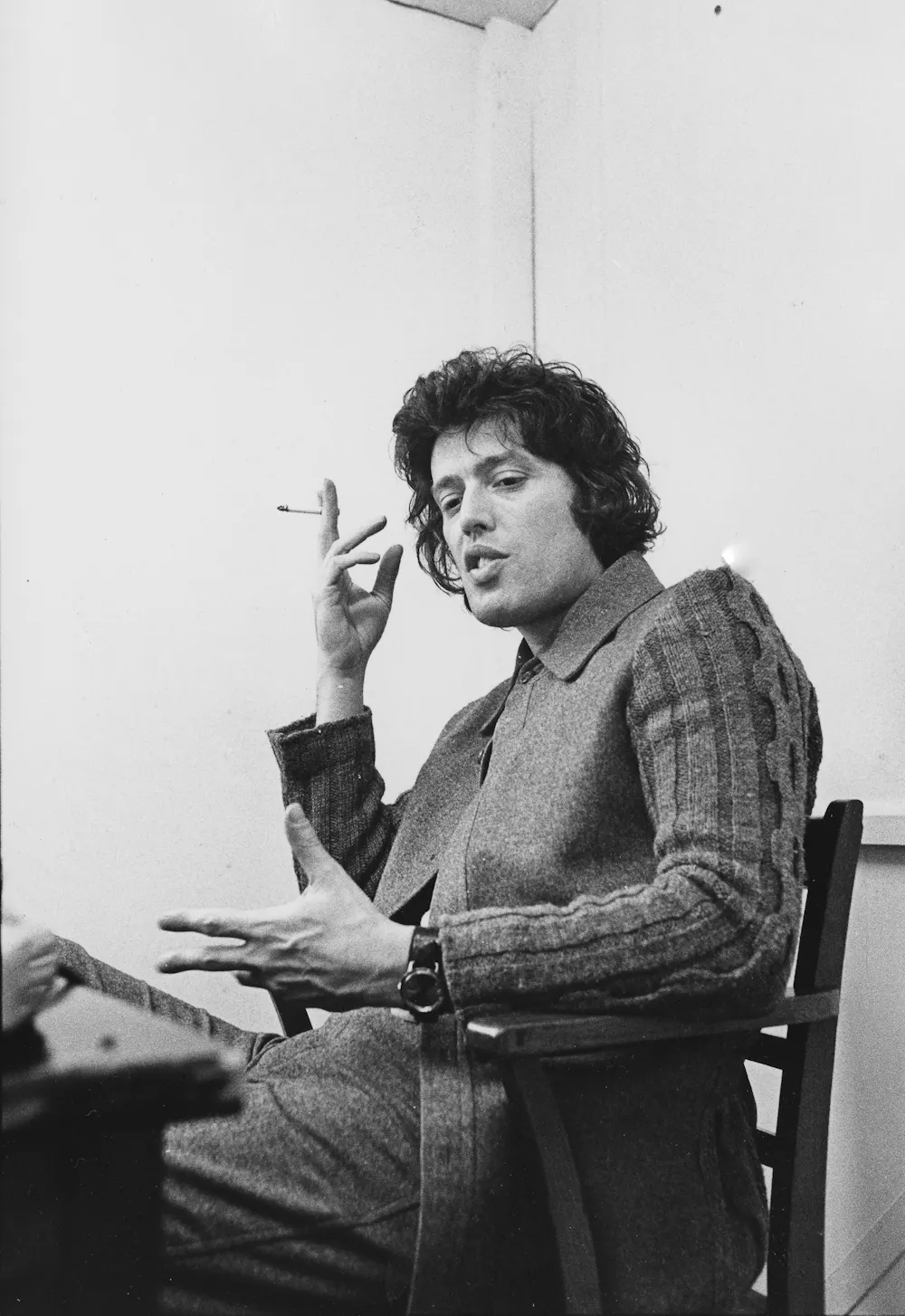
Stoppard  sitting at a table and smoking a cigarette.
Stoppard as a young playwright in 1972. Clive Barda/Radio Times/Getty Images

Stoppard wrote philosophers who tie themselves into cerebral knots failing to prove what they want to believe about God, morals or consciousness in plays such as Jumpers (1972), Rock ‘n’ Roll (2006) and The Hard Problem (2015).

One of Stoppard’s philosophers dictates a lecture in Jumpers, saying “to begin at the beginning: is God? (To SECRETARY). Leave a space”.

Stoppard’s plays sympathise with this forlorn desire to know until it leads characters to ignore other people. Action in the world is more important than the search for knowledge if there is a marriage to be saved, a dying wife to be cared for, or an adopted child to be found. Wittgenstein’s Lecture on Ethics is complex – but Stoppard’s plays show it in effect.

What we know, and how

In his TV play Professional Foul (1977), Stoppard sent philosophers to a conference in Prague. Scholarly debate was contained by totalitarian censorship. The professor of ethics at Cambridge University makes his call for action by riffing on Wittgenstein’s Tractatus: “Whereof we cannot speak, thereof we are by no means silent.”

Stoppard also staged lines from Wittgenstein’s Philosophical Investigations in Dogg’s Hamlet, Cahoot’s Macbeth (1979). Some characters speak English, others use the same words but with different meanings. The audience observes and learns this new nonsense language, laughing at its jokes. They understand the philosophy of language as Wittgenstein did: social conventions between people, not words pinned on things.

What we can know, and how, is crucial to Stoppard’s plays even when the immediate subject matter isn’t philosophy.

It might be quantum physics in Hapgood (1988) or chaos theory in Arcadia (1993); European history in The Coast of Utopia (2002) or contemporary politics in Rock ‘n’ Roll; individual consciousness in The Hard Problem or even whatever we might mean by “love” in The Real Thing (1982). The characters really do want to know. They debate and interrogate but never find definite answers.

As Hannah suggests in Arcadia:

It’s all trivial […] Comparing what we’re looking for misses the point. It’s wanting to know that makes us matter. Otherwise we’re going out the way we came in.

But there are jokes too. Arcadia opens in 1809 with a precocious 13-year-old girl asking her dashing 22-year-old tutor: “Septimus, what is carnal embrace?” before the tutor (originally played by a smoldering Rufus Sewell) pauses, and cautiously replies “Carnal embrace is the practice of throwing one’s arms around a side of beef”.

The audience erupted in laughter. I was one of them.

And as the play draws to a close, a waltz in 1809 happens in the same room as a waltz in the present. As the two dancing couples circle each other, Stoppard’s play suggests that what one person can share with another is more meaningful than justified true belief.

It is a beautiful, theatrical moment. And it is beyond words.The Conversation

Fergus Edwards, Lecturer in English, University of Tasmania

Subscribe to support our independent and original journalism, photography, artwork and film.