Tuesday, 30 December 2025

Planning Your Next Holiday? Here’s How to Spot and Avoid Greenwashing

The Bawah Reserve hotel has villas built around ancient trees or above gleaming waters, set in the pristine Anambas archipelago in a far flung corner of Indonesia, one of the country's first marine conservation areas. 

By Rawan Nimri, Liz Simmons and Salman Majeed

More of us than ever are trying to make environmentally responsible travel choices. Sustainable travel is now less niche and more mainstream, with 93% of travellers in one survey saying they would consider sustainable choices. Accordingly, an increasing number of hotels have become certified. This means they have been officially checked and approved to meet sustainability standards by an independent organisation.

Secret Bay, Dominica, treehouse villas have 
views from a secluded clifftop perch to the sea. 
The World Sustainable Hospitality Alliance says hotels need to reduce waste and emissions by as much as 66% by 2030 to deliver meaningful change. The World Travel and Tourism Council reports that more than 5,000 hotels worldwide have adopted its independent verification program.

Major chains, including Hilton, Marriott and Accor, have also set measurable sustainability targets. These commitments are shared with guests through hotel websites, signs in lobbies and cards placed in rooms.

So when it comes to booking accommodation, navigating the sheer volume of buzzwords and promises – “eco”, “sustainable”, “green”, “responsible” – can feel overwhelming.

When you’re planning your next trip, how can you check whether the sustainability claims live up to the promises?

Don’t believe all the claims

When hotels present themselves as environmentally friendly or sustainable through marketing, but don’t live up to those claims, it’s called greenwashing.

In our study, just published in the Journal of Vacation Marketing, we conducted focus groups with Australian travellers and asked them how well they understood hotel sustainability messages.

We learned that guests don’t always believe claims. They viewed simple actions, like skipping daily room cleaning or turning off the air-conditioning, as too small to really count. One traveller said:

They only mention towel reuse, but nothing else, but what about food waste or cleaning chemicals?

Motivations of hotels were often questioned, too. Guests felt that hotels expected them to do most of the “green” work, such as reusing towels or using the in-room recycling bin.

That made them feel the responsibility was being pushed onto them. It also created suspicion that sustainability is disguised as cost-cutting, so trust in the hotels’ initiatives suffered. Other travellers noted:

They had signs all over the place, and for me, it felt like they were trying too hard and making it seem better than it actually was.

Hotels talk a lot about being green, but to me, it feels more like branding than real action.

When the promises are backed by action

But when hotels explain exactly what they’re doing, show proof of their actions, and admit where they’re improving, guests feel more confident. They may even pay more for their stay.

What we found supports a growing consensus among travellers.

Nobody wants to fall for greenwashing, and consumers want to feel empowered to make the right choice for the environment. Guests want to know if they’re at risk of supporting greenwashing, so they can choose hotels whose efforts are verifiable.

Information matters. So when hotels get their messages wrong, they can undermine the trust of their customers.

Waterfall gardens forest
Hotels can get certified with independent registers. Riley Jackson/unsplash, FAL

In recent years, a number of registers have been established that certify sustainability actions taken by hotels. External registers are financially independent of the tourism industry, and have minimum standards required for registration.

Here’s what to watch for

Not everybody can become an expert in sustainability, so we have put together a list of things you can look out for when you’re booking accommodation, as well as what you can do to help other travellers.

  • Look for independent proof. Book with hotels with recognised third-party certifications, such as EarthCheck or Green Key. If there is no certifier named and no explanation of what was checked, treat the claim as marketing, not evidence.

  • Check for details. Trustworthy green claims use concrete details such as percentages, dates and clear actions. Phrases like “eco-friendly,” “sustainable”, or “planet positive” without statistics or examples are too vague to trust.

  • Compare the claims against what you see. Test promises against reality. Reviews, guest photos and what you notice on arrival should show real changes, such as refillable toiletries, recycling and less waste, not just posters.

  • Ask: who is really doing the work? Many “eco” messages ask guests to reuse towels or skip cleaning, which are actually cost-cutting initiatives. Better signs are investments in efficient systems, using solar power, water-saving fixtures and proper recycling. If the towel card is all you see, the balance is wrong.

  • Look for honesty about limits. No hotel is perfect, and honest ones admit it. Brief explanations of current limitations with future goals are more believable than claims of being fully sustainable.

  • Watch out for suspicious language and pressure. Be cautious of absolute claims like “zero impact” or “100% sustainable” without proof. Also be wary of messages that make you feel guilty for wanting normal comfort.

  • Use your power as a consumer. Ask simple questions before you book and notice how clearly the hotel replies. Check independent review sites, too. After your stay, mention specific practices, good or bad, in your review to deter hotels from greenwashing behaviour.

Not just a green label

Travel is changing, and so are travellers. More people want holidays that feel good for them and for the planet.

When you know what to look for, you can spot shaky green claims and choose hotels that match your values. That pressure matters. It nudges the industry to be authentic, cuts down on greenwashing, and supports the hotels that are actually doing the work, not just putting a green label on the door.


We would like to acknowledge Dr Farah Shishan from the University of Jordan who contributed to this research.The Conversation

Rawan Nimri, Lecturer in Tourism and Hospitality, Griffith University; Liz Simmons, Assistant researcher, Griffith University, and Salman Majeed, Associate Professor, University of Technology Sydney

Subscribe to support our independent and original journalism, photography, artwork and film.

Sunday, 28 December 2025

How Tom Stoppard Made Us All Philosophers: ‘It’s Wanting to Know that Makes Us Matter’

British playwright Tom Stoppard assumed his audience was as well read and inquisitive as he was. Photograph/ALAMY


By Fergus Edwards

Tom Stoppard was one of the most critically acclaimed and commercially successful playwrights of our age. He won his first Tony Award for Rosencrantz and Guildenstern Are Dead in 1968, and his last for Leopoldstadt in 2023.

Stoppard directing the film adaptation of his play
Rosencrantz and Guildenstern are Dead in 1990. 
His life was extraordinary. Born Tomáš Straussler in Zlín, Czechoslovakia, in 1937, his Jewish family fled Nazi occupation to India and then England. 

He chose to become a journalist rather than go to university, and became close friends with Nobel Prize winners, presidents – and Mick Jagger.

The wit and intellectual curiosity of Stoppard’s plays was so distinctive that “Stoppardian” entered the Oxford English Dictionary in 1978. Hermione Lee’s biography of him contains a cartoon with annoyed audience members hissing: “Look at the Jones’s pretending to get all the jokes in a Stoppard play.”

Stoppard just assumed his audience was as well read and inquisitive as he was.

Philosophy is the foundation

As Stoppard said to American theatre critic Mel Gussow in 1974,

most of the propositions I’m interested in have been kidnapped and dressed up by academic philosophy, but they are in fact the kind of proposition that would occur to any intelligent person in his bath.

Philosophy is the foundation of Stoppard’s plays. They cite Aquinas, Aristotle, Ayer, Bentham, Kant, Moore, Plato, Ramsey, Russell, Ryle and Zeno. One philosopher in Stoppard’s radio play Darkside (2013) is never sure if he is spelling Nietzsche correctly.

In 2003, the actor Simon Russell-Beale recalled to a National Theatre audience Stoppard introducing a cast to

2,000 years of philosophy in an hour – it was rather brilliant – just to explain what the debate was and why it was dramatically exciting.

Philosophy – but not before life

Stoppard’s interest in philosophy began in 1968. He wrote to a friend that he was

in a ridiculous philosophy\logic\math kick. I don’t know how I got into it, but you should see me […] following Wittgenstein through Tractatus Logico-Philosophicus.

The Austro-British philosopher Ludwig Wittgenstein (1889–1951) had a philosophy of philosophy. He argued lots of academic philosophy was literal nonsense. Some things we think are important are beyond words.

Stoppard saw theatre similarly, saying in a lecture to Canadian students in 1988 that “theatre is a curious equation in which language is merely one of the components”.

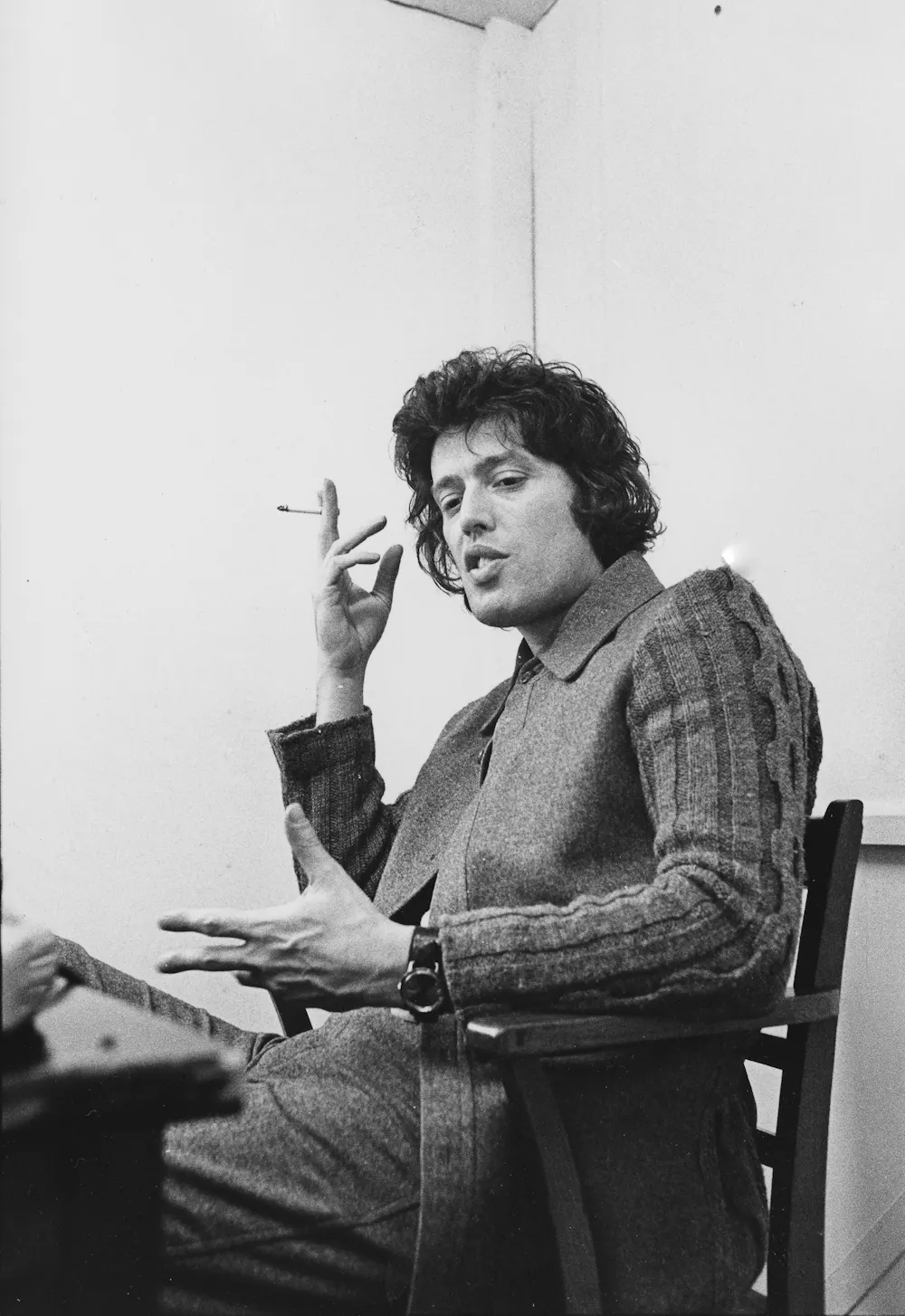
Stoppard  sitting at a table and smoking a cigarette.
Stoppard as a young playwright in 1972. Clive Barda/Radio Times/Getty Images

Stoppard wrote philosophers who tie themselves into cerebral knots failing to prove what they want to believe about God, morals or consciousness in plays such as Jumpers (1972), Rock ‘n’ Roll (2006) and The Hard Problem (2015).

One of Stoppard’s philosophers dictates a lecture in Jumpers, saying “to begin at the beginning: is God? (To SECRETARY). Leave a space”.

Stoppard’s plays sympathise with this forlorn desire to know until it leads characters to ignore other people. Action in the world is more important than the search for knowledge if there is a marriage to be saved, a dying wife to be cared for, or an adopted child to be found. Wittgenstein’s Lecture on Ethics is complex – but Stoppard’s plays show it in effect.

What we know, and how

In his TV play Professional Foul (1977), Stoppard sent philosophers to a conference in Prague. Scholarly debate was contained by totalitarian censorship. The professor of ethics at Cambridge University makes his call for action by riffing on Wittgenstein’s Tractatus: “Whereof we cannot speak, thereof we are by no means silent.”

Stoppard also staged lines from Wittgenstein’s Philosophical Investigations in Dogg’s Hamlet, Cahoot’s Macbeth (1979). Some characters speak English, others use the same words but with different meanings. The audience observes and learns this new nonsense language, laughing at its jokes. They understand the philosophy of language as Wittgenstein did: social conventions between people, not words pinned on things.

What we can know, and how, is crucial to Stoppard’s plays even when the immediate subject matter isn’t philosophy.

It might be quantum physics in Hapgood (1988) or chaos theory in Arcadia (1993); European history in The Coast of Utopia (2002) or contemporary politics in Rock ‘n’ Roll; individual consciousness in The Hard Problem or even whatever we might mean by “love” in The Real Thing (1982). The characters really do want to know. They debate and interrogate but never find definite answers.

As Hannah suggests in Arcadia:

It’s all trivial […] Comparing what we’re looking for misses the point. It’s wanting to know that makes us matter. Otherwise we’re going out the way we came in.

But there are jokes too. Arcadia opens in 1809 with a precocious 13-year-old girl asking her dashing 22-year-old tutor: “Septimus, what is carnal embrace?” before the tutor (originally played by a smoldering Rufus Sewell) pauses, and cautiously replies “Carnal embrace is the practice of throwing one’s arms around a side of beef”.

The audience erupted in laughter. I was one of them.

And as the play draws to a close, a waltz in 1809 happens in the same room as a waltz in the present. As the two dancing couples circle each other, Stoppard’s play suggests that what one person can share with another is more meaningful than justified true belief.

It is a beautiful, theatrical moment. And it is beyond words.The Conversation

Fergus Edwards, Lecturer in English, University of Tasmania

Subscribe to support our independent and original journalism, photography, artwork and film.

Thursday, 25 December 2025

To Feel Loneliness is to be Human: Here’s How to Handle it at Christmas

The Christmas season is like a golden thread, spanning our lives, pulling us back to the past. We often us it as a time to reflect on what we've lost, what we've become and what didn't happen. It can cut deeply. Cover picture of Juana Martin Haute Couture AW25 in Paris by Andrea Heinsohn for DAM


By Paul Jones  

Christmas is often considered a time of connection, warmth and belonging. That’s the script, anyway. But for many people, the reality feels different; isolating, emotionally weighted and filled with comparisons that sting.

Whether you’re spending Christmas alone, navigating grief, or simply don’t feel “festive,” it can feel like you’ve slipped out of sync with the rest of the world. However, that feeling isn’t the same as being alone. Loneliness, isn’t about the number of people around you. It’s about connection, and the absence of it.

This time of year intensifies emotional experience. Rituals such as decorating a tree or watching a favourite film may bring up memories. These could be of people, or they could be of former versions of ourselves.

We measure time differently in December, a phenomenon psychologists refer to as “temporal anchoring”. The season acts as a golden thread spanning our lives, pulling us back to the past. We often use it to reflect on what we’ve lost, who we’ve become, and what didn’t happen. It can cut deeply.

It is a sharp counterpoint to the cultural messaging: people coming together, the push to be joyful and the idea that gratitude must prevail. It’s not just tinsel that is expected to sparkle. We are, too.

Some people are more vulnerable at this time of year, particularly those in flux or transitioning. A recent breakup, moving house, a medical diagnosis or redundancy can often lead to feeling emotionally unanchored. Others carry complex feelings about family, grief or past trauma, which make forced joy or cheerfulness jarring.

Personality plays a role too. People high in traits such as neuroticism or socially prescribed perfectionism can be more vulnerable to distress and loneliness when life does not live up to their expectations.

Your brain on loneliness

Studies have shown that chronic loneliness can increase stress hormones such as cortisol, impair immune function and even affect cardiovascular health. Social neuroscientist John Cacioppo described loneliness as “a biological warning system” that our need for connection isn’t being met.

Loneliness, though, is a normal human response. It is a reaction to a mismatch between our desired social experience and our reality. Self-discrepancy theory helps explain why this mismatch causes emotional pain. When there’s a gap between who we are and who we feel we should be, whether it is socially, emotionally or even seasonally, discomfort follows. Christmas, with all its trimmings, amplifies that gap.

Close up of person sitting on floor with mug of tea surrounded by Christmas-y things.
Do Christmas your own way. Bogdan Sonjachnyj/Shutterstock

Solitude isn’t the enemy

That said, being alone at Christmas doesn’t automatically mean something’s wrong. In fact, it might be exactly what you need.

For many, this time can be a rare opportunity for space, stillness and healing. It might be the only time of year when you get the space to hear your own thoughts, reflect or reset. Choosing solitude purposefully can be deeply restorative.

Connecting with yourself can be just as important as connecting with others. Research into self-determination theory also highlights autonomy, competence and relatedness as core psychological needs.

Autonomy, in particular, means honouring your own choices, not other people’s expectations. For example, choosing to spend the day quietly reading, cooking for yourself, or creating a personal ritual supports both autonomy and competence. These acts reinforce your ability to care for yourself and reduce the pressure to seek validation from others.

Philosophers such as 19th-century Danish thinker Søren Kierkegaard and ancient stoic Epictetus emphasised the importance of tuning into your own inner life rather than being governed by external forces. They remind us that authenticity doesn’t come from performing joy for others, but from noticing what we need and choosing to honour it.

The key is alignment. Do what nourishes you, not what performs well on Instagram, and let the societal pressures wash over you rather than be driven by them.

So what can help?

Trying to “fix” loneliness with a to-do list isn’t the answer. It’s about tuning into what you need. These approaches are rooted in psychological and philosophical insight. They are not quick fixes.

1. Let yourself feel it

Loneliness hurts. It’s okay to name it. Pushing it away rarely works. Accepting and sitting with it can be the first step toward softening its grip.

2. Create micro-rituals

Small routines bring meaning and structure. Brew a particular tea. Rewatch a film that resonates. Light a candle for someone you miss. Rituals connect you to something larger but also connect you to yourself.

3. Reframe connection

Closeness doesn’t have to mean crowds. It might mean sending a message, joining a quiet online space or simply being present with yourself. Journaling, voice notes or reflective walks can all be forms of inward connection.

4. Celebrate your uniqueness

You are not a statistic. You don’t need to aim for the “average” mental health baseline. Your emotional life is yours alone. A little variation, a little eccentricity, these are signs of being alive.

5. Find what works for you

There’s no one right way to do Christmas. Whether it’s a solo walk, a day in pyjamas, or calling one person you trust, the point is to honour your individuality.

If you’re feeling out of step this Christmas, that doesn’t make you broken. It makes you aware. You’re noticing what’s missing; you are listening. That’s not weakness, it’s one of the greatest sources of wisdom.

In The Book of Disquiet, Portuguese poet and philosopher Fernando Pessoa wrote: “To feel today what one felt yesterday isn’t to feel – it’s to remember today what was felt yesterday, to be today’s living corpse of what yesterday was lived and lost.”

It’s a stark image, but a truthful one. At Christmas, we often try to summon old feelings, those of joy, warmth, and belonging, as if they can be reactivated on command. But what if we didn’t force it? Christmas doesn’t have to be remembered joy. It can be present truth.

Loneliness isn’t something to be solved or suppressed. It’s a companion on the journey inward.

And sometimes, the most meaningful connection we can make is with ourselves.

Paul Jones, Associate Dean for Education and Student Experience, Aston University, UK.

Subscribe to support our independent and original journalism, photography, artwork and film.

Wednesday, 24 December 2025

A Brief History of Mulled Wine: From Health Tonic to Festive Treat

    Artsiom Lebedzeu/Alamy
By Sara Read

When frost sparkles in the morning and our breath is visible as we venture outside, thoughts turn to winter warming treats like mulled wine – a drink full of ingredients that have become synonymous with Christmas.

Mulled wine is made by adding spices such as cinnamon, cloves, ginger, mace and nutmeg to sweetened red wine, which is then warmed gently. Across Europe and Scandinavia, it can be purchased in many pubs, bars and festive markets – while supermarket shelves groan with bottles of readymade mulled wines for you to heat at home.

There are many different English recipes out there, including some dating back to the 14th century – from a collection of manuscripts that later became known as The Forme of Cury. The beverage made by following this recipe would certainly have packed a punch, as it contains several spices from the ginger family including galangal, in addition to the more familiar ones.

And before wine was known as mulled, drinking wine flavoured with spices has a long history. There is a mention of drinking spiced wine in the biblical poem the Song of Solomon, which states: “I would give you spiced wine to drink.”

It is thought that spice-infused wine was introduced to Britain by the Romans. An older name for it was “hippocras”, although this was mainly taken as a health tonic – made from spice-infused red or white wine and taken hot or cold.

A man drinking wine.
An illustration from a medieval manuscript showing ‘ypocras’ being made. Wikimedia

In The Merchant’s Tale from Geoffrey Chaucer’s Canterbury Tales (1392), the wealthy, elderly knight January takes “ypocras, clarre, and vernage / Of spices hote, to encrese his corrage” (hypocras, clary, and vernage / of spices hot to increase his courage). January sups these three types of spiced wine to boost his virility on his wedding night for his young bride, May.

Diarist and civil servant Samuel Pepys also mentions taking “half-a-pint of mulled sack” – a sweetened Spanish wine – in an almost medicinal way to comfort himself in the middle of a working morning in March 1668, when things had been going wrong for him.

The name mulled wine comes from the Old English mulse – an archaic name for any drink made of honey mixed with water or wine, derived from the Latin word for honey (mel) and still used in modern Welsh as mêl. From mulse we get “musled”, which was used to describe anything that has been “mingled with honey”.

Before the growth of the global sugar trade, honey was the main way that food and drink was sweetened. Vin chaud, the French equivalent of mulled wine, is traditionally sweetened with honey. England imported spiced wine from Montpellier in large quantities from the 13th century, but only those of social status, like Chaucer’s knight January, would have been able to indulge in those days.

Warm sweet and spiced wine continued to be drunk for health and enjoyment throughout the centuries. But in the 18th century, mulled wine evolved again, as reflected in a recipe in Elizabeth Raffald’s The Experienced English House-keeper (1769) for a warm drink thickened with egg yolks:

Grate half a nutmeg into a pint of wine and sweeten to your taste with loaf sugar. Set it over the fire. When it boils, take it off to cool.

Beat the yolks of four eggs exceeding well, add to them a little cold wine, then mix them carefully with your hot wine a little at a time. Pour this backwards and forwards several times till it looks fine and bright.

Set it on the fire and heat a little at a time till it is quite hot and pretty thick, and pour it backwards and forwards several times.

Send it in chocolate cups and serve it up with dry toast, cut in long narrow pieces.

The result of this method is a frothy, velvety smooth confection, enjoyed with dipping toast or biscuits.

Our ancestors didn’t associate mulled wines with Christmas, so it seems likely that the pairing was popularised by Charles Dicken’s 1843 novella A Christmas Carol – like so much of what we now regard as a traditional Christmas.

After Mr Scrooge has seen the error of his miserly ways, he says to Bob Cratchit: “We will discuss your affairs this very afternoon, over a Christmas bowl of Smoking Bishop, Bob!” Smoking Bishop is a recipe for mulled wine that combines port in the wine and uses dried oranges for an added flavour note. The smoke refers to the steam rising from this hot drink.

So this year, as you cup your hands around the warm mug and inhale the fragrant steam coming off your mulled wine, think of the long history you are a part of.

The ConversationSara Read, Lecturer in English, Loughborough University

Subscribe to support our independent and original journalism, photography, artwork and film.

Friday, 5 December 2025

How a Medieval Oxford Friar Used Light and Colour to Find Out What Stars and Planets are Made Of

Fishacre would have been delighted to know that nearly 800 years after his discoveries, contemporary astronomy is using light and colour to show far flung stars and planets are all made from the same elements.


By William Crozier, Durham University

During the 1240s, Richard Fishacre, a Dominican friar at Oxford University, used his knowledge of light and colour to show that the stars and planets are made of the same elements found here on Earth. In so doing he challenged the scientific orthodoxy of his day and pre-empted the methods and discoveries of the 21st-century James Webb space telescope.

Following the Ancient Greek philosopher Aristotle, medieval physics affirmed that the stars and planets were made from a special celestial element – the famous “fifth element” (quinta essentia) or “quintessence”. Unlike the four elements found here on Earth (fire, water, earth and air), this “fifth element” is perfect and unchanging.

Fully transparent, it formed the basis of what were believed to be the nine concentric celestial “spheres” surrounding the Earth, as well as the various stars and planets attached to them. These, it was argued, were merely condensed versions of the “fifth element”, with each of the first seven spheres having its own planet, and the outermost eighth and ninth spheres containing the stars and heaven itself, respectively.

A Medieval chart of the nine 
concentric celestial 'spheres’ 
surrounding the earth. 
Oxford University

Colour, light and the stars

Lacking access to telescopes and rock samples, Fishacre – the first Dominican friar to teach theology at Oxford University – openly rejected the idea that the stars and planets were made from some special “fifth element”. In his opinion, they consisted of the same four elements found here.

His reason for asserting this position was his understanding of how colour and light behave.

Colour, Fishacre noted, is typically associated with opaque bodies. These, however, are always composite, meaning made up of two or more of the four terrestrial elements. When we look up at the stars and planets, however, we see that the light they emit often has a faint colour. Mars appears red, and Venus yellow, for example. This suggests, of course, that they are composite and thus made “ex quattuor elementis” – “out of the four elements”.

In Fishacre’s opinion the surest proof that the stars and planets were not made of some special “fifth element” came from the Moon. It has a very definite colour, and, crucially, every so often it eclipses the Sun. Were it made from the transparent fifth element – even a highly condensed version of it – then surely the Sun’s light would pass through it, just as it does a pane of glass. This, however, is not the case.

The Moon, Fishacre reasoned, must therefore be made of the same elements found on Earth. And if this was true of the Moon, which is the lowest celestial body, then it must also be true of all the other stars and planets.

The James Webb space 
telescope confirmed 
what Richard Fishacre 
claimed about the 
composition of stars.

A brave move

In arguing this, Fishacre knew that he was risking criticism. “If we posit this position,” he wrote, “then they, that crowd of Aristotelian know-it-alls (scioli aristoteli), will cry out and stone us”.

Sure enough, stones were thrown at Fishacre – and from high places. In 1250, his teaching was denounced at the University of Paris by St Bonaventure of Bagnoregio, a Franciscan friar who ridiculed in his lectures those “moderns” like Fishacre who foolishly questioned Aristotle’s teaching on the celestial fifth element.

Contemporary astrophysics has, of course, vindicated Fishacre’s position. The stars and planets are not made of some special fifth element, but rather from many of the same metals and elements found here on our home planet. The James Webb space telescope, for example, recently established that the atmosphere of the Neptune-like exoplanet TOI-421 b, some 244 light years away, contains high quantities of water and sulphur dioxide.

Remarkably, how the James Webb space telescope established this – a process known as transmission spectroscopy – is very similar, at least in principle, to the method which Fishacre employed. It detected subtle variations in the brightness and colour of the light emitted by TOI-421 b which could only be caused by water and sulphur dioxide.

Given how much criticism his claims received, Fishacre would no doubt have been delighted to know that nearly 800 years after his death, contemporary astronomy, just like him, is using light and colour to show that far flung stars and planets are all made from the same elements.

The ConversationWilliam Crozier, Duns Scotus Assistant Professor of Franciscan Studies, Durham University

Subscribe to support our independent and original journalism, photography, artwork and film.

Thursday, 4 December 2025

How a Gustav Klimt Portrait was Saved from the Nazis and its Contribution to a New Record Sale Price

Painted between 1914 and 1916, the painting played a role in Elizabeth Lederer's deception of the Nazis, after Austria was annexed in the 1930s. Cover picture of byFang SS26 collection. 
By Benedict Carpenter van Barthold

Gustav Klimt’s Portrait of Elisabeth Lederer has sold to an anonymous phone bidder for US$236.4 million (£180.88 million) at Sotheby’s New York. Only Leonardo Da Vinci’s Salvator Mundi has achieved a higher hammer price. For modern art, Klimt is the uncontested champion.

What’s more, this record was achieved despite a cooling global art market, and with Klimt lacking the universal household recognition of Da Vinci in much of the world.

The painting is valued so highly because it carries a deep personal and political history – and because the artist’s incredible skill once helped it serve as a life-saving disguise.

Standing over six-foot tall, the canvas depicts Elisabeth Lederer, daughter of Klimt’s most important patrons, August and Szerena Lederer. Painted between 1914 and 1916, it represents the artist’s late, ornamental style.

Elisabeth is swaddled in a billowing, diaphanous dress, nestled within a textured and ornamental pyramid, an implied Imperial dragon robe. The upper half of her torso is ensconced in an arc of stylised Chinese figures. The effect reminds me of a halo in an icon (religious images painted on wooden panels).

Black and white photo of a woman stood next to a life-size portrait
Elisabeth’s mother Szerena in her apartment in Vienna with the portrait. Wiki Commons

The setting is fantastical, abstracted, unreal, ornamental – above all, rich. Despite the jewel-like setting, Elisabeth’s face is painted with a striking, psychological realism. Her expression is detached, enigmatic, perhaps isolated. Her hands seem fretful.

It is hard not to project meaning with the benefit of hindsight, but she seems to gaze out from a world of immense Viennese wealth, a world unknowingly on the brink of annihilation.

The Lederers were a prominent Jewish family. After the 1938 Anschluss (the annexation of Austria by Nazi Germany), they faced persecution. The family scattered. But Elisabeth remained, divorced and isolated, in Vienna.

Classified as a Volljüdin (“full Jew”) under the Nazi regime’s antisemitic rule, she faced a likely death. In desperation, she circulated a rumour that she was the illegitimate child of Klimt, the Austrian and Aryan painter of her earlier portrait.

To aid this endeavour, her mother Szerena, who had fled to Budapest, swore an affidavit that Elisabeth’s biological father was not her Jewish husband, August, but Klimt, a notorious philanderer. The claim was not without plausibility. Klimt had a long personal relationship with the Lederer household. Elisabeth’s portrait is itself a document of this interest and closeness.

The Nazis, eager to reclaim Klimt’s genius for the Reich, accepted the fabrication. If Elisabeth was not a “full Jew” but instead a Mischling (half-Jewish), then the painting itself could be reclassified as an Aryan work of art. With Elisabeth’s desperate sleight of hand, both she and the painting were saved.

Aided by her former brother-in-law, a high-ranking Nazi official, Elisabeth was legally reclassified as illegitimate and “half-Aryan”. This lie successfully shielded her from the death camps, uniting art history, gossip and survival in a single legal document.

Klimt in a painter's gown
Klimt in 1914, the same year he began the portrait of Elisabeth. Wiki Commons

This deception also ensured the painting’s physical survival. The Lederer Klimts fell into two camps. The Jewish portraits were degenerate art, and were set aside to be sold. But the rest were considered important heritage. While the Nazis moved the bulk of the looted Lederer collection to the castle Schloss Immendorf for safekeeping, Elisabeth’s portrait remained in Vienna due to its newly contested “Aryan” status, in limbo. In May 1945, SS troops set fire to the Schloss, incinerating over a dozen Klimt masterpieces, including a painting of Elisabeth’s grandmother. But in Vienna, the painting of Elisabeth, and another of her mother, Szerena, survived. This brutal and arbitrary destruction is what makes Elisabeth’s painting such a statistical anomaly.

As one of only two full-length Klimt portraits remaining in private hands, its scarcity is near absolute. For collectors, this auction was an inelastic opportunity. On Tuesday November 18, if you wanted to own a major Klimt portrait, it was this one, or none.

The work’s post-war provenance further amplifies its value. The painting was restituted to Elisabeth’s brother Erich in 1948. In 1985, it was purchased by the cosmetics billionaire Leonard A. Lauder.

Unlike many investment-grade masterpieces that are sequestered in free ports, unseen and treated as financial assets, Lauder lived intimately with the work for 40 years, reportedly eating lunch beside it daily.

He frequently loaned it anonymously to major institutions, ensuring its visibility to art history and scholarship, but without testing its value on the market for four decades. Lauder’s loving stewardship added a premium, presenting the work not just as a commodity, but as a cherished, well-documented piece of cultural heritage.

Ultimately, the US$236.4 million price tag reflects a value proposition that transcends simple supply and demand. The anonymous buyer has acquired an object of extreme aesthetic power, but also a tangible relic of resilience. It is a painting saved by a daughter’s lie, a mother’s perjury, the vanity and cupidity of an odious regime, emerging intact from the wreckage of the second world war.

In a market characterised by hype and speculation, this sale rewards deep historical density and incredible technical prowess. Elisabeth’s portrait, which is both monumental and deeply personal, opens a window to the tragic heart of the 20th century.

This legacy should not be financialised, but it is disturbing to speculate to what extent its dark past is reflected in the hammer price. Let’s hope the new owner treats the work as lovingly as her previous custodian. The painting deserves to be shared with the world.

The ConversationBenedict Carpenter van Barthold, Lecturer, School of Art & Design, Nottingham Trent University

Subscribe to support our independent and original journalism, photography, artwork and film.

Wednesday, 26 November 2025

Stuck in a Creativity Slump at Work? Here are Some Surprising Ways to Get Your Spark Back

Research indicates that if you want to be consistently creative, it is important to break away from the things that helped you achieve creative success in the past. 

By Poornika Ananth, University of Bath

The latest entry in the Marvel Cinematic Universe’s movie slate, Captain America: Brave New World, arrived earlier this year with the hopes of continuing the legacy of the beloved sub-franchise. But the film struggled to hit the heights of the three earlier instalments. Critics hit out at its messy plot, unremarkable characters, tired visuals – and an overall absence of creativity.

This raises an interesting and broader question about creativity at work. Most advice on this focuses on having one creative idea. But what does it take to stay creative over time? After all, creativity at work isn’t just about having great ideas – it’s about having them consistently.

Yet over time, even the most innovative minds and organisations like the Marvel Cinematic Universe can hit a creative slump that they struggle to recover from.

Long-term creativity is often hindered by two broad factors. The first is the “expertise trap”. Expertise can initially be great for creativity. After all, as a person develops greater knowledge and skills, they can combine different elements of that knowledge to develop unique ideas and solutions to problems.

Over time however, expertise can actually limit flexibility and creativity. When people become exceptionally skilled or knowledgeable in a particular field, they tend to experience “cognitive entrenchment”, a fixation where deeply ingrained knowledge of a topic leads to rigid ways of thinking.

This might work well in familiar situations, but it can also make it harder for people to see things in a new light.

The second factor is the “success trap”. Research suggests that success – and receiving recognition for a creative idea or outcome – can affect creativity in unexpected ways.

Creative success can motivate people to come up with more ideas, increasing the quantity and pace of their output. But on the other hand, it can also encourage creators to focus on the things that worked well in the past. They often try to replicate or tweak them instead of coming up with something genuinely new.

Of course all is not lost. There are inspiring examples of people and organisations who break out of a creative slump. Taylor Swift faced being pigeonholed after her initial country-pop success, but came back even stronger with her shift to synth-pop in 2014.

headquarters of lego in billund, denmark
It’s hard to believe Danish firm LEGO ever struggled – but it built back better. olrat/Shutterstock

And Danish firm LEGO, which was on the brink of bankruptcy in 2003, regained its supremacy in the toy sector by coming up with new ways of making their core products – LEGO bricks – popular again. This even included taking the creative leap into movies based on their bricks.

Get your creative spark back

Research indicates that if you want to be consistently creative, it is important to break away from the things that helped you achieve creative success in the past.

This can mean moving away from familiar environments as your career advances. Or it could be adding to your knowledge sources so that you are not merely reliant on the depth of your knowledge but also on the breadth. You may also benefit from collaborating with people who already have that additional knowledge so you can combine your brainpower.

Second, if you have had a recent success this can often come with expectations to replicate it and chase more opportunities. While this may have some short-term benefits, in the long run insulating yourself from those expectations – and the rapid increase in opportunities – can give you the time and space to come up with new ideas instead of retreading old ground.

My own research suggests that sustaining creativity over time is not just about generating ideas repeatedly, it is also about managing a portfolio of developing ideas. This is a better approach than merely focusing on one central idea.

It involves putting aside (or stockpiling) ideas that have limited use or value right now and turning your attention to other ideas in the portfolio. Stockpiled ideas can exist and develop in the background, but you can return to them in the future and use them flexibly to learn from, seek inspiration or develop new projects.

For people who work in the knowledge economy, ideas can be their primary currency. But beyond that, creativity can also improve wellbeing and so is a fundamental part of being human. By following these tips to reignite your creative spark, you can reap those benefits of continued creativity over a long period of time.The Conversation

Poornika Ananth, Assistant Professor in Strategy and Organisations, School of Management, University of Bath

Subscribe to support our independent and original journalism, photography, artwork and film.