Wednesday, 26 November 2025

Stuck in a Creativity Slump at Work? Here are Some Surprising Ways to Get Your Spark Back

Research indicates that if you want to be consistently creative, it is important to break away from the things that helped you achieve creative success in the past. 

By Poornika Ananth, University of Bath

The latest entry in the Marvel Cinematic Universe’s movie slate, Captain America: Brave New World, arrived earlier this year with the hopes of continuing the legacy of the beloved sub-franchise. But the film struggled to hit the heights of the three earlier instalments. Critics hit out at its messy plot, unremarkable characters, tired visuals – and an overall absence of creativity.

This raises an interesting and broader question about creativity at work. Most advice on this focuses on having one creative idea. But what does it take to stay creative over time? After all, creativity at work isn’t just about having great ideas – it’s about having them consistently.

Yet over time, even the most innovative minds and organisations like the Marvel Cinematic Universe can hit a creative slump that they struggle to recover from.

Long-term creativity is often hindered by two broad factors. The first is the “expertise trap”. Expertise can initially be great for creativity. After all, as a person develops greater knowledge and skills, they can combine different elements of that knowledge to develop unique ideas and solutions to problems.

Over time however, expertise can actually limit flexibility and creativity. When people become exceptionally skilled or knowledgeable in a particular field, they tend to experience “cognitive entrenchment”, a fixation where deeply ingrained knowledge of a topic leads to rigid ways of thinking.

This might work well in familiar situations, but it can also make it harder for people to see things in a new light.

The second factor is the “success trap”. Research suggests that success – and receiving recognition for a creative idea or outcome – can affect creativity in unexpected ways.

Creative success can motivate people to come up with more ideas, increasing the quantity and pace of their output. But on the other hand, it can also encourage creators to focus on the things that worked well in the past. They often try to replicate or tweak them instead of coming up with something genuinely new.

Of course all is not lost. There are inspiring examples of people and organisations who break out of a creative slump. Taylor Swift faced being pigeonholed after her initial country-pop success, but came back even stronger with her shift to synth-pop in 2014.

headquarters of lego in billund, denmark
It’s hard to believe Danish firm LEGO ever struggled – but it built back better. olrat/Shutterstock

And Danish firm LEGO, which was on the brink of bankruptcy in 2003, regained its supremacy in the toy sector by coming up with new ways of making their core products – LEGO bricks – popular again. This even included taking the creative leap into movies based on their bricks.

Get your creative spark back

Research indicates that if you want to be consistently creative, it is important to break away from the things that helped you achieve creative success in the past.

This can mean moving away from familiar environments as your career advances. Or it could be adding to your knowledge sources so that you are not merely reliant on the depth of your knowledge but also on the breadth. You may also benefit from collaborating with people who already have that additional knowledge so you can combine your brainpower.

Second, if you have had a recent success this can often come with expectations to replicate it and chase more opportunities. While this may have some short-term benefits, in the long run insulating yourself from those expectations – and the rapid increase in opportunities – can give you the time and space to come up with new ideas instead of retreading old ground.

My own research suggests that sustaining creativity over time is not just about generating ideas repeatedly, it is also about managing a portfolio of developing ideas. This is a better approach than merely focusing on one central idea.

It involves putting aside (or stockpiling) ideas that have limited use or value right now and turning your attention to other ideas in the portfolio. Stockpiled ideas can exist and develop in the background, but you can return to them in the future and use them flexibly to learn from, seek inspiration or develop new projects.

For people who work in the knowledge economy, ideas can be their primary currency. But beyond that, creativity can also improve wellbeing and so is a fundamental part of being human. By following these tips to reignite your creative spark, you can reap those benefits of continued creativity over a long period of time.The Conversation

Poornika Ananth, Assistant Professor in Strategy and Organisations, School of Management, University of Bath

Subscribe to support our independent and original journalism, photography, artwork and film.

Tuesday, 25 November 2025

To Understand the History of European Culture Start with the Minoans, Not the Ancient Greeks

Ruins of the ancient Minoan settlement in Gournia, Crete.  Photograph: Georgios Tschilis/Shutterstock
By Ellen Adams, King's College London

The Minoan culture was the first highly complex society on modern European soil, with palaces, writing, stunning art – and even flushing toilets. The Minoans lived in the bronze age (circa 3000-1200BC) on the Mediterranean island of Crete, which served as a stepping stone between Europe, Africa and Asia.

My new book, The Minoans, presents key features of their archaeology, including architecture, art, religion, writing, bureaucracy and the economy. It explores how this pioneering European civilisation has influenced western culture – and how Minoan culture has been reconstructed, re-imagined and represented in museum displays.

Traditionally, the ancient Greeks have been viewed as the fountainhead of European civilisation, but Minoan culture was flourishing many hundreds of years earlier. Despite this expanse of time, there was a loose dialogue between them: the Minoans influenced the Mycenaeans, who themselves were early Greeks, and the later classical Greeks indicate some “memory” of the Minoans, as filtered down through their myths.

For example, in the later Greek stories (from the first millennium BC), Crete is closely associated with bulls. Zeus took the form of a bull when he seized the Phoenician princess Europa and forced her to the island to initiate the Minoan bloodline. She bore Minos whose wife, Pasiphae, submitted to her passion for Poseidon’s bull, producing the minotaur.

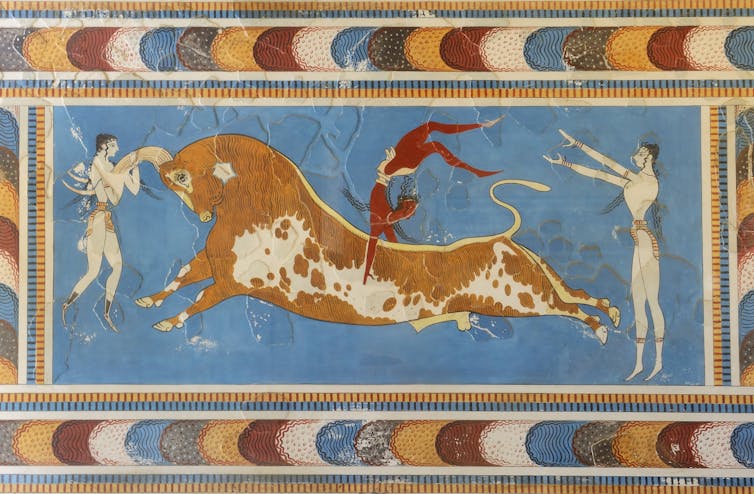
In Minoan art, bulls are everywhere. Archaeologists have found bronze age ritual libation vessels – used for pouring liquid sacrifices to the gods – crafted into the shape of a bull’s head, and large gold rings depicting people leaping over bulls. The echoes of history, myth and ritual seem to have rippled through the generations, to later be reproduced and re-imagined by the ancient Greeks.

Fresco showing two people and a bull
A bull fresco from Knossos Palace in Crete. Pecold/Shutterstock

It is therefore essential for people who want to understand the history of Europe to study the influence the Minoans have had on the ancient Greeks and modern Europeans – in particular, the evidence coming from the great digs conducted on the island in the early 20th century. These include the excavations by the British archaeologist Arthur Evans at Knossos, Crete, a vast site with complexity that may lend itself to the Greek labyrinth myth.

While the image of the bull is particularly widespread here, there is little association between this creature and women, as later appears in the myths. Women are linked with other animals, though, such as serpents, as shown by the snake goddess figurines that Evans found in the Palace of Knossos in 1903.

Snakes in Minoan art

These snake goddesses were found hidden in large stone-lined pits, in a very fragmentary state. Numerous riches were in this deposit: hundreds of shells, clay and stone vessels, clay seal impressions (used for documentation), Linear A inscriptions (a writing script) and animal bones.

The remains of five or six female figurines were found, but only two have been reconstructed. They have become icons of Minoan culture and poster girls for Crete, standing out due to their eye-catching costumes. These are tight, corseted jackets that leave the breasts bare, with floor-length full skirts – their heaviness serving to emphasise the exposed breasts even more.

Sepia photo of figurines.
The remains of the figurines found in the Palace of Knossos in 1903. Wiki Commons

The slightly larger one is a matronly figure with a tall, conical hat. Her snake-entwined arms are held at around 45 degrees, palms up and set approximately in line with her navel. Snakes drape over her as she stares straight ahead.

The second figure raises her bright white arms, bent at the elbow, up and out to her sides, flexed slightly forward. She clutches snakes, and a feline creature balances on her hat.

These figurines offer food for thought about the reconstruction processes that archaeologists undertake. First, Evans gave the title “goddess” to the larger figurine, and “votary” (meaning a worshipper who has taken vows) to the smaller one. This is arbitrary: we cannot know who these figurines represented, whether they were human, as a dignitary or priestess, or divine – we just sense they were VIPs.

Furthermore, when viewing these extraordinary objects in the Heraklion Museum in Crete today, the visitor may be unaware of the extent to which they have been reconstructed, and how much is an early 20th-century creation.

For example, the votary’s head, with its distinctive, wide-eyed stare, is entirely modern, as is her left arm, added soon after she was excavated. The object held in her right hand was broken off – only a very small piece of the original remained in her clenched fist. The reconstruction of snakes as the objects she holds is not so absurd – her sister has them running all over her as a comparison – but recent research has cast some doubt on what she originally held.

In addition to reconstructing the originals, people have also re-imagined these striking figurines in numerous ways – in replicas as souvenirs, as Barbie dolls, in graffiti (particularly in Heraklion) and in advertisements. They have appeared as book covers and inspired modern literature as well as visual and performative art.

Adaptations of them have come to life in poetry, opera, dance and music. A performer led the historical procession as the snake goddess in the opening ceremony for the 2004 Olympic Games in Athens. The Many Lives of a Snake Goddess project, which I am part of, seeks to understand the cultural biographies of these objects. It shows their legacy has been great partly because we have recreated them in such varied ways.

Minoan Crete is important not only because of any claims made for its place as the fountainhead of European civilisation, but also because its art and archaeology have done so much to shape modern culture.

Ellen Adams, Professor in Classical Archaeology and Museum Access, King's College London


Subscribe to support our independent and original journalism, photography, artwork and film.

Monday, 24 November 2025

The Romance of Ruin: How Designers Use Grime, Decay, and Upcycling to Redefine Fashion

Iamisigo, hand-woven raffia cotton blend look dyed with coffee and mud, Shadows, Spring/Summer 2024.  Photograph by Fred Odede. Courtesy of Iamisigo. 

In a world where fashion often dazzles with perfection, the Barbican’s latest exhibition takes a deliberate step into the mire. Dirty Looks: Desire and Decay in Fashion unearths the beauty of what is usually hidden, unwanted, or discarded. From rust-stained gowns to mud-soaked textiles and upcycled couture, the show reveals how designers across decades have embraced imperfection not as flaw but as force, challenging ideals of luxury, exploring our ties to the earth, and imagining fashion’s future in an age of crisis. Story by Antonio Visconti

Yuima Nakazato, Couture
Spring/Summer 2023.
Photograph: Morgan O'Donovan
WHAT happens when silk meets soil, or satin is left to rust? The Barbican’s exhibition Dirty Looks: Desire and Decay in Fashion invites us to linger in that space where beauty collides with entropy. Here, clothing becomes both relic and rebellion, carrying traces of time, memory, and the earth itself.

Few exhibitions capture that tension as vividly as this exhibition at the Barbican Art Gallery. The show casts its gaze on fashion’s fascination with all things sullied, frayed, and imperfect: an embrace of dirt and decay that is as much about culture, politics and the environment as it is about aesthetics.

This is no simple celebration of ripped jeans or distressed leather. Instead, the show positions “the dirty” as an idea with a surprisingly long and layered history. 

Across more than a hundred works, the exhibition tracks how grime, rust, stains, and even microbial erosion have been reimagined as symbols of rebellion, spirituality, and renewal. In doing so, the show challenges the long-standing myth that fashion’s ultimate aim is flawless beauty. 

"This exhibition brings together a remarkable breadth of global designers who are radically reshaping what fashion can mean and do today. With its focus on decay, renewal and the aesthetics of imperfection, Dirty Looks invites us to reconsider beauty, value and the regenerative power of making in a world in flux," explains Shanay Jhaveri, head of visual arts at the Barbican. 

More than a hundred works tracks how grime, rust, stains, and even microbial erosion are symbols of rebellion, spirituality, and renewal

Maison Margiela, Artisanal
Spring/Summer 2024
©Catwalkpictures

For centuries, luxury has been synonymous with polish. The shimmer of silk, the gleam of polished shoes, the perfection of a couture gown, these were signals of wealth and refinement, markers of distance from the messy business of everyday life. Dirt was, to borrow anthropologist Mary Douglas’s phrase, “matter out of place.” To carry a stain was to carry shame.

But beginning in the late 20th century, designers began to turn that assumption on its head. Punk’s ragged safety-pinned uniforms, the raw hems of Japanese avant-garde tailoring, and the oxidised garments of Hussein Chalayan all suggested that imperfection could be a radical aesthetic choice. 

It was not simply about shock value; it was about dismantling hierarchies of taste and class. What had once been described as low or unworthy elements of creative power.

The exhibition's curators, Karen Van Godtsenhoven and Jon Astbury, situate this trajectory within broader cultural currents. Dirt in fashion, they argue, is not only visual but metaphorical: it speaks to environmental decline, colonial legacies, and the tension between our digital lives and our yearning for the natural world. In their view, to look at dirty clothes is also to look at the dirty truths of the industry itself.

The line-up of designers featured is as ambitious as it is eclectic. Established titans such as Alexander McQueen, Vivienne Westwood, Maison Margiela, are shown alongside a new generation of experimental voices such as Yuima Nakazato, Solitude Studios, and IAMISIGO. The juxtapositions make clear that “dirty fashion” is not a passing trend but a recurring impulse that reinvents itself across decades and continents.

Japanese couturier Yuima Nakazato vision of decay is not an end point but the raw material for something startlingly new

Hussian Chalayan,
Temporary Interference
Spring/Summer 1995
Courtesy of Niall McInerney
Highlights include Chalayan’s legendary Tangent Flows collection, where dresses were literally buried in a London backyard until they rusted into fragile relics. Robert Wun’s sculptural gowns, stained with wine and scorched by fire, reinterpret decay as grandeur. Meanwhile, Nigerian designer Bubu Ogisi and her label Iamisigo use natural fibres and indigenous craft to symbolically restore connections severed by colonialism.

Japanese couturier Yuima Nakazato offers one of the exhibition’s most poignant contributions. His work, born from encounters with mountains of textile waste in Nairobi, transforms discarded clothing into luminous new fabrics through advanced recycling technologies. In Nakazato’s vision, decay is not an end point but the raw material for something startlingly new.

One of the exhibition’s more surprising threads is what curators call the “nostalgia of mud.” It suggests that our fascination with dirt is not only about disruption but also about longing. Displays such as Queen Elizabeth II’s worn wellington boots and Kate Moss’s festival-soaked footwear illustrate how muddy encounters, whether on a royal estate or in the chaos of Glastonbury, carry a cultural cachet of authenticity.

Elsewhere, the show looks further back, drawing connections to ancient rituals in which soil and bogs were linked to fertility, sacrifice, and spiritual transformation. Solitude Studios, for example, submerges cloth in Danish bogs, letting microorganisms partially consume the fabric before presenting it as couture. What emerges is less about fashion as surface decoration and more about clothing as a living, breathing participant in the cycles of nature.

The show reminds us of fashion’s environmental toll as one of the world’s most polluting industries, producing waste on an extraordinary scale

Comme des Garcon,
Autumn/Winter 2005
'Broken Bride'
 ©Catwalkpictures
The physical staging of the exhibition itself part of the narrative. Studio Dennis Vanderbroeck, known for pushing the boundaries of theatrical design, has transformed the Barbican’s galleries into a series of uneasy contrasts: pristine white walls interrupted by surfaces that appear corroded, worn, or broken down. The installation insists that visitors confront both glamour and grit at once, collapsing the divide between the gallery and the garment.

Beyond spectacle, the show is a pointed reminder of fashion’s environmental toll. The industry remains among the world’s most polluting, producing waste at an extraordinary scale. By showcasing garments that revel in imperfection, upcycling, and decomposition, the exhibition suggests that alternative approaches, whether folkloric, technological, or spiritual, might offer blueprints for a more responsible future.

Yet this is not a didactic climate change show. Its power lies in its refusal to separate aesthetics from politics, beauty from decay. It insists that the act of getting dirty, whether through mud, rust, or creative reuse, is as much about desire as it is about critique. To stain a dress is not only to mark time but to open up possibilities of transformation.

It has been eight years since the Barbican last staged a major fashion exhibition, and this one arrives with a sense of occasion. Building on past successes with Viktor & Rolf, Jean Paul Gaultier, and Japanese avant-garde fashion, Dirty Looks: Desire and Decay in Fashion signals a renewed commitment to exploring fashion as a vital strand of contemporary culture.

By the time visitors leave the show, they may find themselves looking differently at their own wardrobes, the frayed cuffs, the grass-stained shoes, the jumper that has outlasted seasons of wear. Far from being discarded, these imperfections might be recast as part of a much larger narrative: one in which dirt is not an enemy to beauty, but its most honest companion.

Dirty Looks: Desire and Decay in Fashion is at the Barbican Art Gallery, London from 25th of September to January 25th, 2026. Visit: Barbican

Subscribe to support our independent and original journalism, photography, artwork and film.

Monday, 17 November 2025

Why Does it Feel So Hard to Work Out in the Morning? Here are Some Scientific Reasons Why

You are not imagining it, there are good reasons why it feels so difficult to workout in the morning. 

By Hunter Bennett, University of South Australia

Your alarm goes off. Somehow you manage to get dressed, drag yourself to the gym, and start squatting.But why does it feel so hard? Your legs are heavy and the weight you lifted only a couple of days ago – in the afternoon – feels almost impossible.

No, you’re not imagining it. There’s a large body of evidence to suggest most of us are stronger, more powerful, and have better endurance later in the day.

There are several reasons exercising can feel much harder first thing in the morning. Here’s why, and how you can adjust to morning exercise if you need to.

Your circadian rhythm affects your workout

Your body has a natural 24-hour clock that regulates hormones, body temperature and when you feel most awake or ready for sleep.

This clock is called your circadian rhythm. It is controlled by the brain but can also be influenced by external factors such as sunlight. This might explain why exercising in the morning in winter can be especially hard for some of us.

Research shows your circadian rhythm is clearly linked to exercise performance, which tends to follow a daily pattern.

Most people reach their peak between 4 and 7pm. This means we tend to be stronger, faster and more powerful in the afternoon and early evening.

We don’t know exactly why. But there are a few potential explanations.

Matt Garrow/The Conversation. Adapted from Delos, CC BY

Body temperature

Your core body temperature is at its lowest around 5am, and steadily increases across the day. When your body temperature rises, your muscles contract more efficiently. We think this is part of the reason people are typically stronger and more powerful later in the day.

Hormonal fluctuations

Insulin – the hormone that regulates blood sugar (glucose) levels – tends to be highest in the morning. This leads to a decrease in blood sugar, meaning less glucose your body can use as fuel, likely affecting how hard you can push.

Nervous system function

While we don’t know exactly why, there is some evidence to suggest your nervous system is better at sending signals to your muscles throughout the day. This allows you to use more of your muscle fibres during exercise, essentially making you stronger.

But what if I’m a morning person?

Your sleep chronotype can also affect exercise performance.

This describes your natural inclination for sleep and wakefulness at certain parts of the day – basically whether you’re a “morning person” (an “early bird”), or feel more productive and alert in the evening (a “night owl”).

Research shows night owls with a late chronotype do notably worse when exercising in the morning, compared to people with an early chronotype.

While we don’t know why this is the case, it might be that night owls experience smaller fluctuations in hormones and temperature throughout the day – although this is just speculation.

Interestingly, being sleep deprived seems to affect physical performance in the afternoon more than in the morning. So if you’re staying up late and not getting much sleep, you may actually find it easier to exercise the next morning than the next afternoon.

So, does timing matter?

Whatever time of day, if you can feel yourself working you will make progress – for example, increasing muscle strength and improving aerobic fitness and heart health.

So if you’re exercising to get bigger, stronger and fitter, the timing doesn’t actually matter.

Besides, when we exercise often comes down to motivation and convenience. If you like to exercise earlier in the day and that suits you best, there’s no reason to change.

But you can adapt if you need

If you have a sporting event coming up in the morning – and you usually train in the afternoon – you might want to prepare by doing some early exercise so you’re at your peak.

There is evidence to suggest that repeatedly training in the morning can close the gap between your afternoon and morning performance.

Basically, your body can get used to exercising at a particular time, although it will likely take a few weeks to adapt.

Finally, if you find exercising close to bedtime makes you feel too alert and is disrupting your sleep, you may want to try doing something more gentle at night and/or exercising earlier in the day.The Conversation

Hunter Bennett, Lecturer in Exercise Science, University of South Australia

Subscribe to support our independent and original journalism, photography, artwork and film.

Friday, 14 November 2025

Almost Unimaginable Beauty and Opulence: the Paradise Pleasure Gardens of Ancient Persia

Nine paradise gardens in Iran are collectively listed as a UNESCO World Heritage site, the Eram Garden (pictured above) built in the 12th century is one of the most splendid.  
By Peter Edwell

Some of the most enduring ancient myths in the Persian world were centred around gardens of almost unimaginable beauty and opulence.

The biblical Garden of Eden and the Epic of Gilgamesh’s Garden of the Gods are prominent examples. In these myths, paradise was an opulent garden of tranquillity and abundance.

But how did this concept of paradise originate? And what did these beautiful gardens look and feel like in antiquity?

Pairi-daēza is where we get the word ‘paradise’

The English word “paradise” derives from an old Persian word pairidaeza or pairi-daēza, which translates as “enclosed garden”.

The origins of paradise gardens lie in Mesopotamia and Persia (modern Iraq and Iran).

The Garden of the Gods from the Epic of Gilgamesh from about 2000 BCE is one of the earliest attested in literature.

Some argue it was also the inspiration for the legend of the Garden of Eden in the book of Genesis. In both of these stories, paradise gardens functioned as a type of utopia.

When the Achaemenid kings ruled ancient Persia (550–330 BCE), the development of royal paradise gardens grew significantly. The paradise garden of the Persian king, Cyrus the Great, who ruled around 550 BCE, is the earliest physical example yet discovered.

During his reign, Cyrus built a palace complex at Pasargadae in Persia. The entire complex was adorned with gardens which included canals, bridges, pathways and a large pool.

One of the gardens measured 150 metres by 120 metres (1.8 hectares). Archaeologists found evidence for the garden’s division into four parts, symbolising the four quarters of Cyrus’s vast empire.

Technological wonders

A feature of paradise gardens in Persia was their defiance of often harsh, dry landscapes.

This required ingenuity in supplying large volumes of water required for the gardens. Pasargadae was supplied by a sophisticated hydraulic system, which diverted water from the nearby Pulvar River.

The tradition continued throughout the Achaemenid period. Cyrus the Younger, probably a descendant of Cyrus the Great, had a palace at Sardis (in modern Turkey), which included a paradise garden.

According to the ancient Greek writer, Xenophon, the Spartan general Lysander visited Cyrus at the palace around 407 BCE.

When he walked in the garden, astounded by its intricate design and beauty, Lysander asked who planned it. Cyrus replied that he had designed the garden himself and planted its trees.

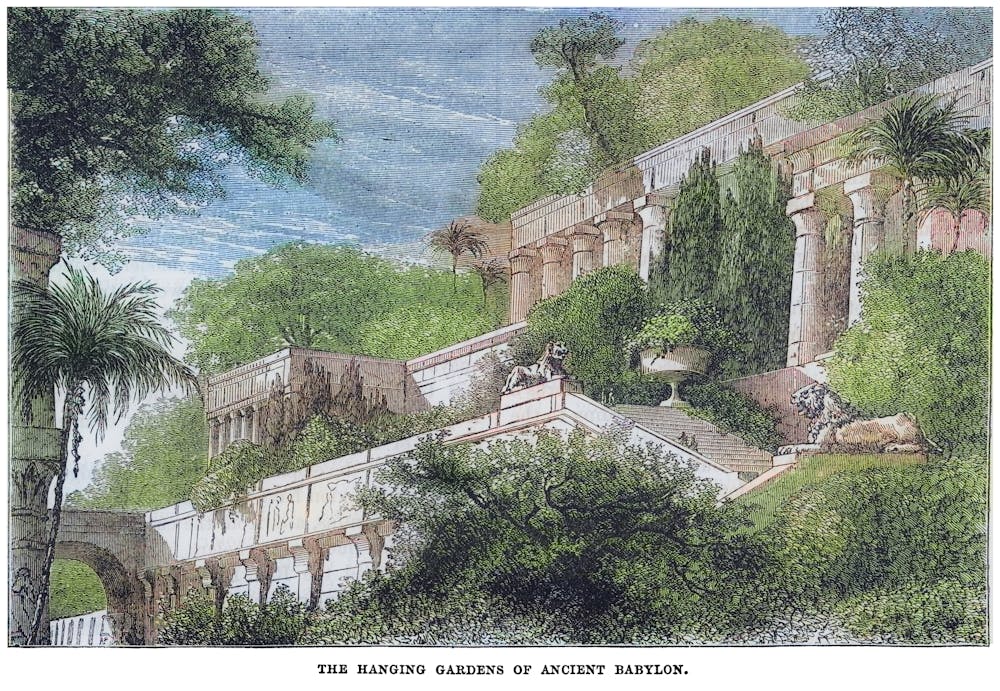
Perhaps the ultimate ancient paradise garden was the legendary Hanging Gardens of Babylon.

In one tradition, the gardens were built by the neo-Babylonian King, Nebuchadnezzar II (605–562 BCE).

The gardens were so magnificent and technologically advanced they were later counted among the Seven Wonders of the World.

An engraving depicting the hanging gardens of Babylon.
Perhaps the ultimate ancient paradise garden was the legendary Hanging Gardens of Babylon. mikroman6/Getty Images

In a later Roman account, the Hanging Gardens consisted of vaulted terraces resting on cube-shaped pillars.

Flowing water was a key feature, with elaborate machines raising water from the Euphrates river. Fully grown trees with vast root systems were supported by the terraces.

In another account, the Hanging Gardens were built by a Syrian king for his Persian wife to remind her of her homeland.

When the Sasanian dynasty (224–651 CE) came to power in Persia, its kings also built paradise gardens. The 147-hectare palace of Khosrow II (590–628 CE) at Qasr-e Shirin was almost entirely set in a paradise garden.

The paradise gardens were rich in symbolic significance. Their division into four parts symbolised imperial power, the cardinal directions and the four elements in Zoroastrian lore: air, earth, water and fire.

The gardens also played a religious role, offering a glimpse of what eternity might look like in the afterlife.

They were also a refuge in the midst of a harsh world and unforgiving environments. Gilgamesh sought solace and immortality in the Garden of the Gods following the death of his friend Enkidu.

According to the Bible, God himself walked in the Garden of Eden in the cool of the evening.

But in both cases, disappointment and distress followed.

Gilgamesh discovered the non-existence of immortality. God discovered the sin of Adam and Eve.

Paradise on Earth

The tradition of paradise gardens continued after the Islamic conquest of Persia in the 7th century CE.

The four-part gardens (known as chahar-bagh) of the Persian kingdoms were also a key feature of the Islamic period.

The Garden of Paradise described in the Quran comprised four gardens divided into two pairs. The four-part garden became symbolic of paradise on Earth.

The tradition of paradise gardens has continued in Iran to the present day.

Nine paradise gardens in Iran are collectively listed as a UNESCO World Heritage site. The Eram garden, built in about the 12th century CE, and the 19th-century Bagh-e Shahzadeh are among the most splendid.

Today, the word “paradise” evokes a broader range of images and experiences. It can foster many different images of idyllic physical and spiritual settings.

But the magnificent enclosed gardens of the ancient Persian world still inspire us to imagine what paradise on Earth might look and feel like.The Conversation

Peter Edwell, Associate Professor in Ancient History, Macquarie University

Subscribe to support our independent and original journalism, photography, artwork and film.

Thursday, 13 November 2025

Often Overlooked, Tudor Art Richly Reflected a Turbulent Century of Growth and Change

Elizabeth I as the Queen of Love and Beauty c.1600 possibly by Marcus Gheeraerts the Younger. also known as the Rainbow Portrait. Hatfield House, Hertfordshire, England.  
By Christina Faraday, University of Cambridge

It can sometimes seem like the Tudors are everywhere, at least in Britain: on television, in bookshops and in historic houses and galleries across the country. Yet within the discipline of art history, appreciation for pictures and objects produced in England between 1485 and 1603 has been slow to take hold.

The Embarkation of Henry VIII at Dover by artist
unknown, c. 1520-40 was meant to show the 
military might of the Tudors. Hampton Court
Palace, London. 
For a long time, narratives about the popular impetus behind the Reformation led some historians to believe art was unwelcome in Protestant England, for fear it would inspire people to commit idolatry.

Meanwhile, long-held scholarly prejudices towards easel paintings and sculptures (which, excepting portraits, are few and far between in Tudor England) and against “decorative” arts and household objects, reinforced the notion that the country was practically barren of visual art in the 16th century.

Happily, times are now changing. In the last few years, the period’s beautiful and intriguing artworks have been receiving more attention in mainstream art history, not least in the New York Metropolitan Museum’s 2022 exhibition The Tudors: Art and Majesty in Renaissance England.

Still, to date there has never been a comprehensive introduction to Tudor art aimed at the general public. My new book, The Story of Tudor Art will be the first to unite artworks and contexts across the whole of the “long Tudor century”, looking at the works of famous names like Hans Holbein the Younger and Nicholas Hilliard, but also beyond them, to interior furnishings, fashion and objects by unknown makers.

The book considers art made for the royal court, but also for increasing numbers of “middling” professionals, who embraced art and material objects to mark their new-found status in society.

Rather than appreciating art on purely aesthetic terms, Tudor viewers had practical expectations for the objects they owned and commissioned. Art was primarily a mode of communication, akin to speeches or the written word. Images had an advantage, however, as vision was considered the highest of the senses, exerting the greatest power over the mind.

Henry VIII AT 49 years old, by Hans Holbein
the Younger, 1540. Palazzo Barberini, Rome.
Images could shape the viewer morally – for example, through exposure to long galleries full of portraits of the great and the good, where viewers could learn about them and emulate their virtues. But this shaping was also physical, as with stories of pregnant women who, viewing certain images, were thought to unconsciously shape the foetus in their womb, a phenomenon known as “maternal impression”.

Most casual observers probably recognise Holbein’s magnificent portraits of Henry VIII, and some of Elizabeth I’s many painted personae. But even for aficionados, artworks produced under Henry VII, Edward VI and Mary I remain relatively obscure. 

One of the book’s aims is to draw attention to these overlooked periods, showing that even during the so-called mid-Tudor crisis (when England had four different rulers in just 11 years), art and architecture remained a priority for shaping narratives about individuals and institutions such as the Church.

Henry VII emerges as a canny patron of visual arts, using various means to promote himself in his new role as king of England. Artists looked to legendary characters, ancient and recent, to bolster his tentative claim to the throne.

Popular legends originating in Geoffrey of Monmouth’s (largely fabricated) “British history”, resurface in a genealogical manuscript in the British Library showing Henry VII’s descent from Brutus, the legendary Trojan founder of Britain. This positions Henry as the Welsh messiah destined to rescue Britain from its Saxon invaders.

Architectural patronage at Westminster Abbey in London and King’s College Chapel in Cambridge aligned him with his half-uncle and Lancastrian predecessor, Henry VI. Rumours of miracles had been swirling about him since his probable murder in 1471. Meanwhile, reforms to the coinage included the first accurate royal likeness on English coins, changing the generic face used by his predecessors into a recognisable portrait of Henry VII himself.

The Protestant monarch Edward VI and his regime passed the first official laws against religious images, resulting in the tearing down of religious images and icons in cathedrals and parish churches. But Edward VI’s reign was not only a time of destruction. Under the influence of the two successive leaders of his council, elite patrons began to embrace classical architecture, a development that may relate to Protestant ideas about restoring the church to the time of Christ’s apostles.

Edward’s successor, Mary I, a staunch Catholic, made many attempts to undo the work of her Protestant-minded predecessor, including legislation to restore some church images. Perhaps more significantly, her marriage to Philip II of Spain brought England into closer artistic alignment with continental Europe. This saw a flood of artworks and artists associated with the Habsburg empire enter the country, including the first Titian portrait ever seen in England.

Due to the long neglect of Tudor art in mainstream art history, a vast amount of research remains to be done. Even within the better-studied reigns of Henry VIII and Elizabeth I, discoveries are waiting, and whole avenues of cultural and intellectual interpretation are yet to be explored.

Christina Faraday, Research Fellow in History of Art, University of Cambridge

Subscribe to support our independent and original journalism, photography, artwork and film.

Wednesday, 12 November 2025

Why Jane Austen’s Leading Men are Such Enduringly Popular Heartthrobs

Mr Darcy played by Colin Firth in the BBC's beloved 1995 adaptation of Jane Austen's novel Pride and Prejudice.  


By Louise Curran

In Ang Lee’s adaptation of Sense and Sensibility (1995), the handsome cad Willoughby (played by Greg Wise) rescues Marianne (Kate Winslet) on horseback in the middle of a raging storm. Pathetic fallacy has rarely looked so good.

Marianne locks eyes with him and falls passionately in love. In Austen’s version, though, it is Marianne’s mother and sister who first register his attractions. “The eyes of both were fixed on him with an evident wonder and a secret admiration … his person, which was uncommonly handsome, received additional charms from his voice and expression.”

Willoughby has “exterior attractions” that the two women quickly notice. Once Marianne can master her own confusion, she rapidly constructs him in her mind as the ideal romantic protagonist.

“His person and air were equal to what her fancy had ever drawn for the hero of a favourite story … Her imagination was busy, her reflections were pleasant, and the pain of a sprained ankle was disregarded.”

Yet despite such auspicious beginnings, by the end of the novel Willoughby has proved to be feckless, shallow and passively cruel. The actual leading man turns out to be the respectable, yet taciturn, Colonel Brandon (played in the film by Alan Rickman).

In his introduction to the 1895 edition of Sense and Sensibility, the poet and essayist Henry Austin Dobson remarked upon the shrewd realism at work in Austen’s ending: “Every one does not get a Bingley, or a Darcy (with a park); but a good many sensible girls like Elinor pair off contentedly with poor creatures like Edward Ferrars, while not a few enthusiasts like Marianne decline at last upon middle-aged colonels with flannel waistcoats.”

For many modern readers, Brandon remains a disappointing compromise when compared with Willoughby’s flagrant virility.

Austen’s heartthrobs

All of Austen’s leading men are rich, which certainly helps to intensify their charms. Fitzwilliam Darcy of Pride and Prejudice is the wealthiest man of Austen’s fiction.

Initially he draws local attention for his “fine, tall person, handsome features, noble mien, and the report, which was in general circulation within five minutes after his entrance, of his having ten thousand a year”, until he is quickly “discovered to be proud”.

One of the key debates of Pride and Prejudice (1813) concerns marriage for love versus convenience and financial security. Elizabeth Bennet’s intelligent aunt Mrs Gardiner argues that the phrase “violently in love” is “so hackneyed, so doubtful, so indefinite” and “often applied to feelings which arise only from a half hour’s acquaintance”.

She eloquently expresses the problematic nature of infatuation and the fictional construction of the heroic ideal so prevalent in Regency culture.

Colin Firth’s infamous Pride and Prejudice wet shirt scene.

The phrase recurs right at the end of the novel, at the moment Elizabeth discloses her feelings for Darcy, producing a happiness in him that he “had probably never felt before; and he expressed himself on the occasion as sensibly and as warmly as a man violently in love can be supposed to do”.

The repeated phrase is a lovely touch, hesitating as it does between endorsing Darcy as a swoon-worthy leading man, burning with passion, and holding back from such excesses through the suggestion of a faint ridiculousness.

The 1995 BBC adaptation of Pride and Prejudice gave visual language to this conjunction of intrepid yet hesitant masculinity. Darcy (played memorably by Colin Firth) emerged from water like an Adonis in a wet shirt, only to face an embarrassed encounter with Elizabeth (Jennifer Ehle). Though usually handsome and always relatively rich, Austen’s leading men are also unconventional in that they can be awkward, mistaken, tongue-tied – even a bit dull.

When Darcy’s housekeeper at Pemberley describes him as “handsome”, this adjective, as Austen expert Janet Todd has noted, “extends over physical, social and moral qualities”. This conjunction of qualities shapes the leading men of Austen’s fiction not so much as suitors as familiar figures who come to be transformed by love.

Uncomfortable matches

Some aspects of this heroism might strike modern readers as odd, and they alert us to changing perceptions of the romantic hero since Austen’s time.

The age difference in Emma between Emma Woodhouse (21) and George Knightley (37) was not uncommon in the Regency era, when marriage was often predicated on women’s reproductive value and men’s financial security.

It can be uncomfortable for some readers when Knightley emphasises the fact that he was 16 years old when Emma was born (as he is cradling his baby niece). And when he jokes about having been in love with her since she was “13 at least”. Rather than suggesting anything dubious, this was intended to draw attention to the incremental steps the couple make from brother and sister-in-law to friends and then lovers.

Johnny Flynn’s Knightley has more youthful energy.

Recent adaptations of Emma seem uncomfortable with this age gap. Despite the fact that both Jeremy Northam and Johnny Flynn were in their mid-30s, and of similar age to Knightley in their respective versions (1996 and 2020), Flynn gives off a younger, more virile energy. He punches the air in joy when he realises Emma will marry him, in contrast to Northam’s emotional restraint.

Maria Edgeworth, a contemporary novelist and important influence on Austen, was struck by the way Austen’s leading men were supportive in private as much as in public.

In a letter, Edgeworth referenced the moment in Persuasion (1817) where Captain Wentworth shows his feelings for Anne by submitting to domestic chores: “The love and lover [are] admirably well drawn: don’t you see Captain Wentworth, or rather don’t you in her place feel him taking the boisterous child off her back as she kneels by the sick boy on the sofa?”

In figures such as Emma’s Mr Knightley, who represents the landed English class, and Persuasion’s Frederick Wentworth, a naval hero of the Napoleonic wars, Austen put emphasis on a new kind of domestic masculinity as a source of female desire and national pride.

Like Austen’s heroines, her leading men are not superlatively good. Their enduring appeal lies more in their capacity for self development and their acceptance of change and adaptation. Austen depicts love as the awakening of mutual esteem. It’s something to be worked on rather than something that magically arrives.

Louise Curran, Lecturer in Eighteenth-Century and Romantic Literature, University of Birmingham

Subscribe to support our independent and original journalism, photography, artwork and film.