Gleaming, green leopard skin combined with floaty feathers, a striking look outside the Lapointe show during New York Fashion Week. Photograph by Brittany Scott for DAM.
As New York enjoyed the electric energy of Fashion Week, the
streets surrounding the city’s runways became their own stage, where creativity,
individuality, and style converged. Spring/Summer 2026 marked yet another
vibrant chapter in the ongoing dialogue between designers and the public, with
the sidewalks acting as a living, breathing showcase of the trends shaping the
season, photographed by Brittany Scott
Brilliant colour and
diaphanous silk lit up
a streetcorner at NYFW.
BEYOND the catwalks, streetstyle has become a barometer for cultural currents, a space where personal expression meets the influence of global fashion movements. This season, the city’s sartorial pulse oscillated between
maximalist exuberance and understated elegance.
Oversized silhouettes, bold
prints, and unexpected color combinations dominated, while a new wave of
tailored minimalism offered a counterpoint—proof that modern street style
thrives in the tension between statement and subtlety.
Accessories were no afterthoughts;
oversized handbags, sculptural jewellery, and experimental footwear punctuated ensembles,
emphasizing how attention to detail transforms everyday dressing into
performance.
Yet street style is about more than clothing, it captures an
atmosphere, a collective mood that pulses through the city during Fashion Week.
There is a sense of possibility in the air, a tension between anticipation and
spontaneity as editors, influencers, buyers, and fashionistas intersect in
fleeting encounters on cobblestone streets and city avenues. The streets
themselves become a canvas, reflecting the city’s rhythm: yellow taxis,
bustling sidewalks, and towering skyscrapers all frame the sartorial spectacle.
Insightful images play a crucial role in documenting this urban theatre.
Our photographer, Brittany Scott, captured the interplay of movement, light,
and texture, each frame preserves a moment of creative audacity and cultural
commentary. From the eclectic layering that defines New York’s streetwise
aesthetic to the quiet confidence of monochrome ensembles, these images reveal
how the city’s fashion ecosystem extends far beyond the confines of the runway.
In this feature, we celebrate the diverse voices and visual
narratives that defined New York Fashion Week’s streets for Spring/Summer 2026.
From the bold and avant-garde to the quietly inventive, this season’s street
style demonstrates how personal style continues to inform and inspire global
fashion discourse, offering a vivid, intimate glimpse into the city’s sartorial
soul. ~ Antonio Visconti
Scroll down or tap pictures to see more highlights from New York Fashion Week Streetstyle
Portrait of Giorgio Armani in one of his signature navy blue looks. Photograph: Stefano Guindani/SGP. Cover picture of Coperni Autumn/Winter 2025 by Karim Sadli.
By John Potvin, Professor of Art and Design History, Concordia University
Giorgio Armani pictured backstage before his
Autumn/Winter 2006 menswear runway in Milan.
Despite the hyperbolic and fleeting tendencies of the fashion industry, few designers have had the impact of Giorgio Armani.
The new look and attitude the designer offered 50 years ago is today largely taken for granted and, at first glance, seems rather unassuming. But from the outset, Armani’s focus and determination was to provide his customers with an easier way of dressing that was at once practical, sophisticated and thoughtful, yet unpretentious, powerful and subtle.
His suits required little effort on the part of the wearer, whose individuality and identity were meant to shine rather than being overwhelmed by his clothes. His approach to tailoring coincided with the growing awareness of health and fitness in the 1970s and 1980s.
Armani’s body-conscious approach soon garnered attention in Hollywood, and he was asked to provide the wardrobe for Richard Gere in the now cult-classic 1980 film American Gigolo.
Humble beginnings
The designer working on drawings
in his Milan studio in 1979.
Born in 1934 in the small northern Italian town of Piacenza, Armani was originally destined to be a country family doctor. Before founding his own fashion house in 1975 relatively late in life, at the age of 41, Armani began in the fashion industry as a window dresser for the Milanese department store La Rinascente.
In 1961, he was hired by stylist and businessman Nino Cerruti to work in the Cerruti family’s textile factory. This new and fertile environment proved seminal to Armani’s future in textile development and would determine his own aesthetic formula.
While working at Cerruti, designing for the firm’s Hitman menswear collection, Armani proverbially and literally took the stuffing out of traditional Italian tailoring, offering men a modern attitude and a novel, less rigid way of moving and living in their jackets and suits.
Quickly, and throughout his 50-year career, the now iconic multi-purpose Armani jacket provided men and women alike armour as much as comfort and support for the body underneath.
Encouraged by his romantic and business partner Sergio Galeotti, an architect who remained Armani’s business partner until his untimely death in 1984, Armani officially founded his own fashion house in July 1975.
He quickly changed the vocabulary of both menswear and womenswear: he incorporated and adapted textiles traditionally reserved for men’s tailoring for his womenswear collections while at the same time softening the fabrics and silhouettes of his menswear. Women appeared stronger, independent, resilient and ready to take on the workplace of the 1980s, while the Armani man was less aggressive and instead attractive and glamourous.
Conquering Hollywood
Julia Roberts wearing Giorgio Armani
Prive with the designer at the Met Gala.
For American Gigolo, Armani sidestepped vulgarity and provided the lead character with a fluid and unstructured swagger and sex appeal.
Hollywood was immediately hooked. Armani had been enamoured by the classic era of cinema as a child and the star quality of actors like Katharine Hepburn, Cary Grant, Geta Garbo and Marlene Dietrich, so he was keenly aware of the value and cultural potential of not only dressing actors in films, but also saw the red carpet as what was, until then, an untapped resource.
Armani soon had a major impact on red carpet dressing, so much so that industry bible Women’s Wear Daily dubbed the 1990 Oscars the “Armani Awards.”
This red carpet transformation was the result of Armani’s love of cinema and his business acumen as much it was his collaboration with Wanda McDaniel, an American whom he recruited in 1988, the same year he opened his first boutique in Beverly Hills.
As a social columnist and well connected to Hollywood’s elite, McDaniel was hired as a special liaison to Armani’s increasing film industry clientele. Their collaboration was a force to be reckoned with in the industry.
Armani’s personal abode
Armani launched his own label at 41,
and presented his first menswear and
womenswear collections in 1975.
Fuelled by a steadfast drive, the personal and professional was indistinguishable for Armani, so much so that the designer’s palazzo at 21 via Borgonuovo in the heart of Milan served as both his home as well as the theatre where he staged his men’s and women’s runway collections from 1984 until 2000.
The space provided a personal and intimate invitation to more than just fashion shows, but a lifestyle empire in the making.
In addition to co-curating a 25-year retrospective exhibition at the Guggenheim Museum in New York, the year 2000 also saw the designer transform the brand’s DNA into a global lifestyle proposition that today encompasses hotels, spas, Michelin Star-awarded restaurants, makeup, jewellery, home furnishings and chocolates, among other items.
From the unstructured jacket that’s worn with ease to the social media frenzy garnered by red carpets, Armani’s imprint can be seen in every corner of the fashion industry and around the globe. His impact and legacy will be felt for decades to come.
John Potvin, Professor, Art and Design History, Concordia University
American Vogue editor Anna Wintour at the Met Gala she oversees in New York. Photograph: Charles Sykes/Invision/AP. Cover picture of Coperni Autumn/Winter 2025 by Karim Sadli.
By Jye Marshall and Rachel Lamarche-Beauchesne
Queen Elizabeth II and Anna Wintour
at British designer Richard Quinn's
2018 runway show.
AFTER 37 years at the helm, fashion industry heavyweight Anna Wintour stepped down from her position as editor-in-chief of American Vogue.
It was not a retirement, though, as Wintour maintains a leadership position at global fashion and lifestyle publisher Condé Nast (the owner of Vogue and other publications, such as Vanity Fair and Glamour).
Nonetheless, Wintour’s departure from the US edition of the magazine is a big moment for the fashion industry – one which she has single-handedly changed forever.
Fashion Magazine Fever
Fashion magazines as we know them today were first formalised in the 19th century. They helped establish the “trickle down theory” of fashion, wherein trends were traditionally dictated by certain industry elites, including major magazine editors.
In Australia, getting your hands on a monthly issue meant rare exposure to the latest European or American fashion trends.
Vogue itself was established in New York in 1892 by businessman Arthur Baldwin Turnure. The magazine targeted the city’s elite class, initially covering various aspects of high-society life. In 1909, Vogue was acquired by Condé Nast. From then, the magazine increasingly cemented itself as a cornerstone of the fashion publishing.
Cover of a 1921 edition of Vogue.Wikimedia, CC BY
The period following the second world war particularly opened the doors to mass fashion consumerism and an expanding fashion magazine culture.
Wintour came on as editor of Vogue in 1988, at which point the magazine became less conservative, and more culturally significant.
Not Afraid to Break the Mould
Fashion publishing changed as a result of Wintour’s bold editorial choices – especially when it came to the magazine’s covers. Her choices both reflected, and dictated, shifts in fashion culture.
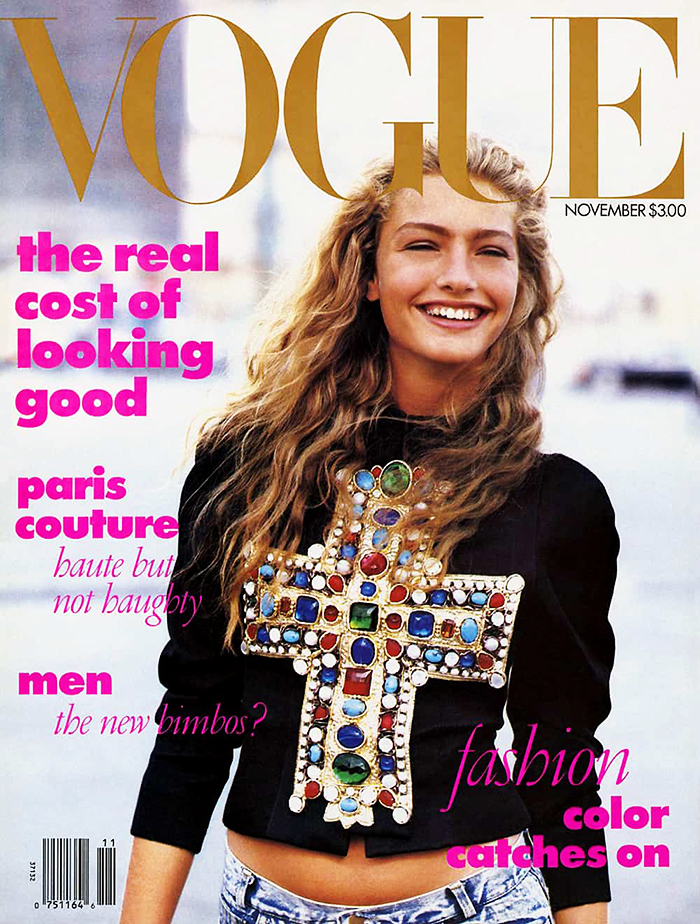
Wintour’s first cover at Vogue, published in 1988, mixed couture garments (Christian Lacroix) with mainstream brands (stonewashed Guess jeans) – something which had never been done before. It was also the first time a Vogue cover had featured jeans at all – perfectly setting the scene for a long career spent pushing the magazine into new domains.
Anna Wintour's first Vogue cover in November 1988 featuring a revolutionary mix of what we call today hi/o: a Christian Lacroix heavily bejewelled top and a pair of Guess Jeans.
Wintour also pioneered the centring of celebrities (rather than just models) within fashion discourse. And while she leveraged big names such as Beyonce, Madonna, Nicole Kidman, Kate Moss, Michelle Obama and Oprah Winfrey, she also featured rising stars as cover models – often helping propel their careers in the process
Wintour’s legacy at Vogue involved elevating fashion from a frivolous runway to a powerful industry, which is not scared to make a statement. Nowhere is this truer than at the Met Gala, which is held each year to celebrate the opening of a new fashion exhibit at the Metropolitan Museum of Art’s Costume Institute.
The event started as a simple fundraiser for the Met in 1948, before being linked to a fashion exhibit for the first time in 1974.
Wintour took over its organisation in 1995. Her focus on securing exclusive celebrity guests helped propel it to the prestigious event it is today.
This year’s theme for the event was Superfine: Tailoring Black Style. In a time where the US faces great political instability, Wintour was celebrated for her role in helping elevate Black history through the event.
Not Without Controversy
However, while her cultural influence can’t be doubted, Wintour’s legacy at American Vogue is not without fault.
Notably, her ongoing feud with animal rights organisation PETA – due to the her unwavering support for fur – has bubbled in the background since the heydays of the anti-fur movement.
Wintour has been targeted directly by anti-fur activists, both physically (she was hit with a tofu cream pie in 2005 while leaving a Chloe show) and through numerous protests.
This issue was never resolved. Vogue has continued to showcase and feature fur clothing, even as the social license for using animal materials starts to run out.
Fashion continues to grow increasingly political. How magazines such as Vogue will engage with this shift remains to be seen.
A Changing Media Landscape
The rise of fashion blogging in recent decades has led to a wave of fashion influencers, with throngs of followers, who are challenging the unidirectional “trickle-down” structure of the fashion industry.
Today, social media platforms have overtaken traditional media influence both within and outside of fashion. And with this, the power of fashion editors such as Wintour is diminishing significantly.
Many words will flow regarding Wintour’s departure as editor-in-chief, but nowhere near as many as what she oversaw at the helm of the world’s biggest fashion magazine.
Jye Marshall, Lecturer, Fashion Design, School of Design and Architecture, Swinburne University of Technology and Rachel Lamarche-Beauchesne, Senior Lecturer in Fashion Enterprise, Torrens University Australia
Decades of international research have consistently shown materialistic goals - acquiring wealth and possessions for reasons associated with image and status -undermine wellbeing.
By Brad Elphinstone, Swinburne University of Technology
Over the next decade, Elon Musk could become the world’s first trillionaire. The Tesla board recently proposed a US$1 trillion (A$1.5 trillion) compensation plan, if Musk can meet a series of ambitious growth targets.
Australia’s corporate pay packets aren’t quite on that scale. Yet even here, it was reported departing Virgin chief executive Jayne Hrdlicka will collect nearly $50 million in shares and other cash benefits on her way out the door.
Research from the United States suggests people think the average CEO earns ten times more than the average worker – and would prefer it was closer to only five times more.
In fact, the real gap in the US over the past decade has been estimated to mean CEOs earn a staggering 265 to 300 times more than average US workers.
Australians think CEOs earn seven times more than the average worker and would prefer if it was only three times more.
But the real gap here is also much higher. A long-running study found CEOs of the top 100 Australian companies earned 55 times more last financial year than average workers.
So, how much money is enough?
People have asked this question for thousands of years. The ancient Greek philosopher Aristotle explained the idea of eudaimonia, or a roadmap of “living well”, saying it:
belongs more to those who have cultivated their character and mind to the uttermost, and kept acquisition of external goods within moderate limits, than it does to those who have managed to acquire more external goods than they can possibly use, and are lacking goods of the soul.
Aristotle’s philosophy doesn’t call on us to shun money or wealth entirely, but argues it shouldn’t become life’s sole focus.
Research over recent decades has come to different conclusions on how much money is needed to achieve peak wellbeing.
A US study in 2010 suggested wellbeing maxes out around US$75,000. This figure naturally needs to be increased today to account for inflation – which, if those research findings are still true today, would be closer to US$111,000 in today’s dollars. You’d also need to take into account the cost of living in your area.
Other findings suggest wellbeing may continually increase with growing wealth, but the increase in wellbeing from $1 million to $10 million is likely less than when someone moves from poverty to middle class.
A 2022 experiment studied 200 people from Brazil, Indonesia, Kenya, Australia, Canada, the United States and the United Kingdom who were randomly given US$10,000 (A$15,000 at today’s exchange rate).
It found people in lower income countries “exhibited happiness gains three times larger than those in higher-income countries”, including Australia. But that cash still provided detectable benefits for people with household incomes up to US$123,000 (roughly A$184,000 today).
Remarkably, the people in that experiment (explained from 4:42 minutes into the video below) gave away more than two-thirds of that money to family, friends, strangers and charities.
Valuing time and relationships
Decades of international research have consistently shown materialistic goals – acquiring wealth and possessions for reasons associated with image and status – undermine wellbeing.
This is because materialistic striving is often borne out of low self-esteem or tending to compare oneself negatively to others, and there is always someone else to compare yourself against.
People can get stuck on the “hedonic treadmill”, where they get used to their new level of wealth and the luxuries it provides and then need more to feel happy.
It’s also because the work needed to acquire that wealth can mean less time focusing on hobbies and with loved ones.
Harvard research tracking two generations of men and their children over their lives, going back to 1938, shows deep, meaningful relationships with others are key to mental and physical wellbeing.
American psychologist Abraham Maslow developed a “hierarchy” of people’s “needs” in 1943. This suggested “self-actualisation” – reaching your pinnacle of personal growth – starts by having enough money to cover the basics of food, shelter, and access to the opportunities needed to grow as a person.
In line with this, research has shown “time affluence” (maximising free time by paying people to do things you don’t want to) and “experiential buying” (for example, meals out with loved ones, going on holidays) can support wellbeing by helping people develop new skills, build relationships, and create lifelong memories.
It’s in most of our interests to close the wealth gap
Recent data shows economic inequality in Australia is increasing. This is particularly affecting young Australians, as housing becomes less affordable.
At a broader social level, research from the UK indicates that as inequality increases, social outcomes get worse. These include increased crime, drug and alcohol abuse, obesity as people struggle to afford nutritious food, and reductions in social trust.
What percentage of wealth do you think is owned by the richest 20% of Australians? And in your ideal Australia, how much wealth should the richest 20% own?
The most recent Bureau of Statistics data we have, from 2019-20, showed the richest 20% of Australians owned around 62% of our wealth.
As inequality gets worse, evidence suggests it will lead to social problems that threaten to undermine the wellbeing of the whole community.
The irony is those who pursue extreme wealth and benefit most from this inequality will not necessarily be happier or more fulfilled because of it.
Brad Elphinstone, Lecturer in psychology, Swinburne University of Technology
Rumi, Mira and Zoey in "KPop Demon Hunters." Currently it is the most streamed film on Netflix globally.
By Cholong Sung, School of Oriental and African Studies, University of London
Thanks to the runaway global popularity of Netflix’s new animated film, KPop Demon Hunters, cinemas around the world have picked it up and are now screening a sing-along edition.
Huntr/x, the musical girl group featured in the story, has topped charts worldwide with their track Golden.
As the film smashes records and captures audiences everywhere, one question lingers: what makes this animation stand out from the rest? An answer lies in how relatable the main characters are.
The film follows three K-pop girl group members who use their music and voices to protect the world from demonic forces. While the storyline centres on the fantastical notion of “demon hunters”, grounding the protagonists in the guise of K-pop idols adds on-trend authenticity. As co-director Chris Appelhans explained, the aim was “making girls act like real girls, and not just pristine superheroes”.
Rather than dwelling solely on their heroics, the film portrays the characters’ everyday moments and ordinary behaviour. Food, clothes and familiar locations in South Korea are rendered with surprising precision, to the extent that even Korean audiences are astonished at their accuracy, despite the production being based overseas.
But how closely does the film’s version of K-pop reflect the real thing?
In real life, aspiring K-pop singers are sometimes forced to lose weight by entertainment companies or agencies representing them.
Take the first appearance of Huntr/x members Rumi, Mira and Zoey: with only minutes to go before a performance, they are shown devouring kimbap, ramen, fish cakes and snacks – fuel for the stage. In reality, idols may often end up grabbing a quick bite of kimbap or ramen in the car between packed schedules. More commonly, however, strict diets are the norm. There are reports that sometimes trainees – aspiring K-pop idols who are part of an entertainment company’s training programme – are even forced to shed weight by agencies: one of the industry’s darker aspects.
Yet, as idols mature, many develop their own healthier routines, not simply for looks but to ensure longevity in their careers.
Meanwhile, in the case of boy group Saja Boys, the film highlights the fans’ fascination with their sculpted abs. In reality, male idols often put themselves through intense workouts to build impressive physiques, showing off toned bodies and six-packs on stage for their fans.
Then there is the question of accommodation. In the film, Huntr/x members share a luxurious penthouse overlooking Seoul’s skyline. In reality, agencies often provide dorm accommodation to facilitate scheduling and teamwork, usually near the company, and often managers live with artists. The quality varies greatly, with newcomers typically placed in modest housing.
After debut, successful idols may upgrade their accommodation as the money starts to roll in, but a penthouse, as shown in the film, is more fantasy than fact. BTS being a notable exception, progressing from sharing a converted office (not even a proper house) to one of Seoul’s most prestigious apartments. Most idols tend to strike out on their own some years after debut, balancing solo activities with personal life. By then, their choice of home usually reflects their individual earnings.
The film mirrors K-pop reality in other respects. One Huntr/x member, Zoey, is Korean-American – reflecting the industry’s trend since the 2000s towards multinational line-ups designed to create a global audience. Blackpink, for instance, includes two Korean members with overseas backgrounds and one foreign national, which has bolstered their international reach.
The right music
The film also shows Zoey writing and composing songs: many idols are now singer-songwriters. With the industry demanding constant renewal, the shelf life of an “idol” is very short. Writing and producing music has become both a way to extend careers and secure additional income streams. BTS are all credited songwriters, while figures such as BigBang’s G-Dragon, Block B’s Zico, and i-dle’s Soyeon have all built reputations – and royalties – through their creative work.
Increasingly, even K-pop trainees now learn songwriting and production before their debut. Beyond these points, the film captures a wide slice of K-pop culture as it really exists – from fan sign events to the sea of light sticks waving at concerts.
More than any other element, it’s the music that gives the film its sharpest sense of realism.
Executive music producer Ian Eisendrath teamed up with record label THEBLACKLABEL to produce K-pop tracks that sound right at home in the current charts. Blending trendy and catchy hooks with the story itself has drawn in not only animation fans but also audiences lured by the music alone.
Co-director Maggie Kang put it plainly in an interview: “We really wanted to immerse the world in K-pop.” At the same time, she noted that the film deliberately heightens certain aspects of the genre. That kind of exaggeration is only natural in animation, where drama is part of the appeal. What matters is that every flourish is still grounded in reality.
For viewers familiar with Korean culture and K-pop, that means spotting a wealth of details that might otherwise go unnoticed – and it’s this layer of discovery that may well be among the key factors driving the popularity of KPop Demon Hunters.
Cholong Sung, Lecturer in Korean, SOAS, University of London