Discovered after thousands of years submerged in the Mediterranean, this statue from the ancient city of Canopus, was craned out of Abu Qir Bay in Alexandria. Once an important trading place, it sank due to earthquakes and rising sea levels. Photograph: Khaled Desouki/AFP via Getty Images
By Claire Isabella Gilmour
This year has seen a number of artefacts recovered from the Mediterranean Sea off the coast of Egypt. The area has attracted interest for some time due to ongoing searches for the tomb of Cleopatra VII and Alexander the Great. But the new finds add to our knowledge of the ancient city of Canopus, one of several settlements that have largely been lost to the sea.
The discovery of buildings and an ancient dock is particularly crucial for our understanding of this principal port – one of the most important for the economy of Egypt before the foundation of Alexandria in the 4th century BC.
The Nile Delta is where the river flows into the Mediterranean Sea, and the twin cities of Canopus and Thonis-Heracleion were situated on opposite banks. Canopus was on the western side, at the mouth of the westernmost branch of the Nile. Recovering artefacts from the mouth of the Nile is difficult because much of the material not only lies on the seabed, but is submerged under clay and silt.
The preservation of archaeological material underwater is variable. Metal objects do not fare well, but stone is more durable. Organic materials such as wood can last surprisingly well due to the lack of oxygen in waterlogged places, although they become very vulnerable when removed, so rapid protection is essential.
The recent discoveries include the remnants of an ancient harbour and a merchant ship, shedding light on shipbuilding techniques and economic activity.
Sherif Fathi, Egypt's tourism and antiquities minister.
inspects the recovered statue in Alexandria.
Khaled Desouki/AFP/Getty Images
Statues continue to emerge, building on what we already know of sculptural practices, religion and politics. They offer clues as to the physical appearance of the ancient city.
One of these statues is a huge quartz sphinx holding the cartouches of Pharaoh Ramesses II (carved oval tablets bearing his name). While it is not yet determined how or when that sphinx was brought to Canopus, it emphasises the antiquity of the site. A white marble statue of a Roman nobleman further confirms the city’s status as multicultural and extremely wealthy.
Where Greece and Egypt meet
The foundation date of Canopus is unknown, but the site had been settled for centuries before the Greeks. It was first mentioned in writing in the 6th century BC, in a poem by Solon.
Expanded over time, in a location perfect for trade and military activity in the Mediterranean, Canopus became a key part of the success of the Greek rulers of Egypt. It served the Ptolemaic dynasty well for several centuries before eventually becoming part of the Roman empire around 30BC. However, the coastal position meant that settlements in that area were vulnerable to environmental stresses and earthquakes and rising sea levels eventually submerged them by the 8th century AD.
Excavators discuss their finds.
A large proportion of the western suburbs of Canopus are today underneath the modern Egyptian coastal town of Abu Qir, while the eastern suburbs are underwater.
For ancient people, Canopus was a place of pilgrimage. Countless people travelled to the sanctuaries of the Egyptian gods Osiris and Serapis there to take part in the Mysteries of Osiris. The annual religious festival reenacting the god’s murder, dismemberment and resurrection dated back to the earliest days of ancient Egypt.
The modern site of Abu Qir was also a place of importance to early Christianity, as religious changes took hold across the world.
A sunken city and its treasures
Underwater excavation in the Alexandria area has continued for decades, most notably by French archaeologist Franck Goddio and his team. They work under the auspices of the European Institute for Underwater in collaboration with the Egyptian Ministry of Tourism and Antiquities.
Many initial finds were made during the team’s work in the 1990s-2010s. The British Museum showcased some 200 of its artefacts in their Sunken Cities: Egypt’s Lost Worlds exhibition in 2016. Highlights included a 5.4 metre tall granite statue of Hapy, the personification of the Nile (on loan from the Maritime Museum, Alexandria) and a massive statue of the Apis bull (from the Graeco-Roman Museum, Alexandria). It showed that Greek rule did not mean the end of Egypt; rather, it was refashioned with a new image.
A sculpted figure of the posthumously deified Arsinoë II, daughter of Ptolemy I, as the Egyptian goddess Isis was also found. It is an intriguing combination of the timelessness of ancient Egyptian statuary, overlaid with the Greek aesthetic, wearing garments rendered in stone so fine they seem transparent.
There is much more to be found beneath the waves, but the strict criteria applied to these underwater excavations mean that most objects will remain there, at least for now, with plans being developed for the world’s first underwater museum.
The targeted nature of the excavations is part of a quest to highlight and celebrate the work being done around underwater heritage. As climate change pushes sea levels ever higher, the need for protection for archaeological sites like Canopus only becomes more pressing.
Claire Isabella Gilmour, PhD Candidate, Anthropology and Archaeology, University of Bristol
The question of whether fast fashion can ever be sustainable has become increasingly heated since the advent of ultrafast fashion, where brands produce on demand and sell directly online.
By Harriette Richards, RMIT University and Jon Hewitt, RMIT University
Recently the ultrafast fashion brand, Princess Polly, received B Corp certification. This certification is designed to accredit for-profit businesses that provide social impact and environmental benefit.
Established on the Gold Coast in 2010, a 50% stake in Princess Polly was acquired by United States-based A.K.A. Brands in 2018.Since then, it has grown its global reach as a low-cost, high-turnover online retailer.
So can ultrafast fashion ever be sustainable?
Who is Princess Polly?
Princess Polly distinguishes itself from other fast fashion retailers through a mission to “make on-trend, sustainable fashion accessible to everyone”.
As part of this mission, Princess Polly is a participant of the United Nations Global Compact, which commits them to sustainable procurement. The 2024 Baptist World Aid Ethical Fashion Report placed them in the top 20% of 460 global brands assessed.
Yet, on the sustainability rating website Good On You, Princess Polly receives a “Not Good Enough” grade, due to their lack of action on reducing plastic and textile waste or protecting biodiversity in their supply chains, and the absence of evidence that they pay their workers a living wage.
Regardless of how they make their clothes, Princess Polly produces a lot. At the time of writing, the brand has 3,920 different styles available on their website (excluding shoes and accessories).
Of those, 34% (1,355 styles) are listed as “lower impact,” which means items are made using materials such as organic cotton and linen, recycled polyester and cellulose fabrics. There are also 720 items on the website currently listed as “new”: their daily new arrivals means they are constantly adding fresh items for sale.
Overproduction, no matter what the garments are made from, is inherently wasteful. Even when clothes are purchased (and 10–40% of the clothing produced each year is not sold), the poor quality of fast fashion items means that they end up in landfill faster and stay there for longer, contributing to the ongoing environmental disaster.
Sustainability communication
In Australia, 1,096 companies are accredited with B Corp status, including 152 fashion businesses.
B Corp assesses the practices of a company as a whole, rather than focusing on one single social or environmental issue. Businesses must score at least 80 out of a possible 250+ points in the B Impact Assessment to achieve accreditation.
Organisations are assessed in five key areas – community, customers, environment, governance and workers – and must meet high standards of social and environmental performance, transparency and accountability.
Third-party accreditations such as B Corp, Fairtrade and Global Organic Textile Standard are often used by brands as a marketing tool.
These certifications can enhance consumer trust without the need for detailed explanations. For fashion brands, accreditation can help them stand out in a crowded market. They can provide legitimacy, attract ethical fashion consumers and reduce consumer scepticism.
While B Corp aims to provide assurance to consumers, activists have accused it of greenwashing. In 2022, the organisation came under fire for accrediting Nespresso, a brand owned by Nestlé, which has a reputation for poor worker rights and sourcing policies.
B Corp is now facing renewed condemnation for issuing certification to Princess Polly.
Who needs certification?
Other B Corp certified Australian fashion brands such as Clothing the Gaps and Outland Denim have built their reputations on their ethical credentials. For values-driven fashion-based social enterprises such as these, accreditations can provide valuable guarantees regarding ethical processes.
According to our research, however, there are several barriers fashion-based social enterprises face when pursuing ethical accreditation.
The cost of accreditation, both financial and in terms of time, skills and resourcing, is a significant challenge. And there is no certification that covers all aspects of environmental sustainability and ethical production. As a result, fashion-based social enterprises often require multiple accreditations to fully communicate the breadth of their ethical commitments.
Despite the costs involved, if fashion-based social enterprises don’t acquire certain certifications they risk being ineligible for government grants and tenders, such as social procurement contracts.
Differences between fashion-based social enterprises and fast fashion brands are stark. While Clothing the Gaps, Outland Denim and Princess Polly now all hold B Corp certification, the former score much more highly on the B Impact Assessment.
The value and credibility of the certification is diminished when it extends to unsustainable ultrafast fashion.
Is it possible for fast fashion to ever be sustainable?
The question of whether fast fashion can ever be sustainable has become increasingly heated since the advent of ultrafast fashion, where brands produce on demand and sell directly online.
Fast fashion took seasonal trends from high fashion runways and made them available to consumers at low costs within weeks. Ultrafast fashion takes trends from social media and reproduces them extremely cheaply for mass consumption within days.
Both fast and ultrafast fashion’s low-cost, high-volume models encourage consumers to value quantity over quality. Using permanent sales and discounts, these brands incentivise multiple purchases of items that may never actually be worn. Online “micro trends” and “haul” videos further spur this overconsumption.
The overconsumption of fast fashion means lots of it ends up in landfill.Dipanjan Pal/Unsplash
Princess Polly may be using more sustainable textiles and engaging in more ethical forms of production than some of its ultrafast fashion counterparts. But this is not enough when the business model itself is unsustainable. Accreditations such as B Corp are unable to account for this nuance.
Princess Polly claims to make sustainable fashion, yet it is also proudly trend driven. As an ultrafast fashion brand, it relies on overproduction and overconsumption. The idea that this can ever be “sustainable” is simply an oxymoron.
Harriette Richards, Senior Lecturer, School of Fashion and Textiles, RMIT University and Jon Hewitt, Lecturer, Fashion and Textile Design, RMIT University
Travis Kelce and Taylor Swift on the day they announced their engagement via social media. Cover picture of Franck Sorbier Paris Haute Couture AW25/26 by Jay Zoo for DAM.
By Sarah Scales
Taylor Swift and Travis Kelce have announced their engagement, posting on Instagram images of the proposal with the caption “Your English teacher and your gym teacher are getting married”.
“America’s sweethearts”, the pair have been dating for two years. Now fans are saying this will be America’s version of the royal wedding.
Swift and Kelce’s post has already received over 24 million likes from the pair’s fans.
Swift’s love life has long been in the spotlight – both in her songs and in the news. So fans were perfectly primed for their outpouring of support and love.
But what is it about Swift – and her fans – that encourages such emotional reactions?
Understanding parasocial relationships
To understand the deep affection Swift’s fans have for her, it’s important to understand parasocial relationships.
A parasocial relationship is a one-sided relationship we develop with someone, typically a media figure, where there is no reciprocity. Through the media and artistic output, we develop knowledge and feelings, and begin to encounter the relationship the same way as we would a “real world” or interpersonal relationship – but there is no mutual development.
Every time we see them in the news or on social media, or listen to their songs, that’s a parasocial interaction we have with them. Then those interactions build until we feel as though we know them like a friend, or perhaps they fill a role as a mentor, or a crush.
Parasocial relationships mimic our real world relationships.
Swift’s fans are very passionate and she expertly harnesses this fanbase.
Swift builds on these relationships
Swift’s first album was released in 2006, and over the ensuing 20 years, she has had many iterations, or eras. This has given fans many entry points into her life, and the opportunity to grow up with her and experience their different life stages with her and her music.
Many other musicians may have long periods of stepping away from the spotlight between albums, so their fans aren’t receiving necessary parasocial interactions to maintain their relationship and closeness.
But Swift has released 11 studio albums and four re-rerecorded albums since 2006, with her 12th to be released this October. She is also a common figure in the news because of her high-status relationships and friendships. This has allowed fans to constantly build and flourish their relationship and closeness with her.
Her marketing savvy, the easter eggs she drops leaving fans always speculating, and the interest and buzz she generates, creates a sense of community and belonging among fans which is global, universal and easily accessible online.
She has a strong perceived authenticity, where fans feel as though they truly know her, and they feel as though she cares about them individually. For non-fans, this may not make sense: she is an untouchable billionaire who has broken records for her crowd sizes. But this is one of the ways parasociality works: you feel as though the celebrity is your close friend and that they care for you.
Swift generates and feeds into these emotions. In hosting listening parties at her house or picking fans from the crowd to join her onstage, she creates the sense she is a genuine person – and keeps the illusion that, maybe one day, that could be you.
Crafting the celebrity image
Swift’s romantic relationships and close personal friendships are a key part of her celebrity image. Throughout her whole career these relationships have been reported on, drawing attention and interest.
Her fans see her relationships playing out in the news through various paparazzi images and articles. Then they hear about these relationships in her songs, as a major theme of her music is love and heartbreak. Because her music is so centred around love and heartbreak, it makes sense love has become a core part of her celebrity image.
Her relationship with Kelce is probably one of the most reported-on relationships she has had. She was with the actor Joe Alwyn for six years, but that was a much more private relationship.
For the past two years, Swift and Kelce have been in the limelight, and fans have felt a joy in seeing her in this relationship and getting to witness it.
Your English teacher is getting married
Swift clearly has an understanding of her fans and their parasocial relationships with her.
Fans have long called Swift their “English teacher” because her songwriting is so revered. Her fans see a lot of poetry in her music, and feel they have learnt a lot through this poetry.
In calling themselves “your English teacher and your gym teacher”, Swift and Kelce are placing themselves in the roles their fans have cast them as.
The pair know their fans have a closeness with the couple – and even though that isn’t reciprocated by Swift and Kelce, the pair are placing themselves in the position of role models.
Language like this closes the gap between celebrities and ordinary people. If you imagine your teachers getting married – someone you saw every day and you personally knew – that would be exciting. To word it in that way brings them down to a more personable level, drawing them, once again, closer to their fans.
Sarah Scales, PhD Candidate, School of Social Sciences, Media, Film and Education, Swinburne University of Technology
Close up of the Bayeux tapestry. Shutterstock/sogood_patrick
By Alexandra Makin
The Bayeux tapestry is set to return to the UK for the first time in almost 1,000 years. One of the most important cultural artefacts in the world, it is to be displayed at the British Museum from September 2026.
Its significance for history is unquestioned – but you may not think of the Bayeux tapestry as a work of art. Sure, you may recognise it from your history lessons or political campaigns. Maybe you like embroidery and textiles or know about it because of the modern versions it inspired – think the Game of Thrones tapestry or the Great Tapestry of Scotland. Perhaps you are an early medievalist and use it as comparative evidence.
For me, this now famous wall hanging is undoubtedly art, created with great skill. What fascinates me as a textile archaeologist is how early medieval people saw and understood the tapestry.
First, let’s contextualise it a little. The hanging is not a woven tapestry but an embroidery, stitched in wool threads on nine panels of linen fabric that were then sewn together. It was made in around 1070, probably in England. Nobody knows how big it originally was, but it now measures 68.3 metres long by approximately 70cm high.
Starting at the end of Edward the Confessor’s reign (1042-1066), the tapestry’s comic book narrative tells a vivid, very modern story of the struggle for power and the English throne – and the brutal means William of Normandy (1028-1087) used to get it.
It follows the highs and lows of Harold Godwinson, Edward the Confessor’s brother-in-law, who became king after Edward’s death in 1066, and his eventual downfall at the Battle of Hastings.
The end of the hanging, and therefore the story, is now missing but it was probably the triumphal coronation of William. It would have provided a mirror in symmetry to the first scene, which depicts an enthroned Edward.
Sensory archaeology of the tapestry
Today, the hanging is famous because it is the only surviving example of its kind. But documentary sources from early medieval England demonstrate that this type of wall hanging was a popular way for families to depict their stories and great deeds.
A good example is the Byrhtnoth wall hanging, which Æthelflæd, the wife of an Anglo-Saxon Ealdorman of Essex Byrhtnoth, gave to the church in Ely after he was killed in 991. We know that the Normans also understood these storytelling wall hangings because Abbot Baudri of Bourgueil (c. 1050-1130) expertly incorporated such a device in a poem he wrote to honour Adela of Blois (c. 1067-1137), the daughter of William the Conqueror and Matilda (c. 1031-1083).
The Bayeux tapestry was, therefore, an obvious way to tell people about the downfall of the English and the rise of the Normans. But this is not all. The early medieval population of Britain loved riddles, multilayered meanings and hidden messages. Evidence survives in pieces like the gold buckle from the 7th-century Sutton Hoo ship burial, the early 8th-century Franks Casket and the 10th-century Book of Exeter. So it is not surprising that people today have argued for hidden messages in the Bayeux tapestry.
While these concepts are interesting, so much emphasis has been placed on them and the role the embroiderers played in creating them, that other ways of early medieval viewing and understanding have been ignored.
Early medieval society viewed its world through the senses. By using sensory archaeology, a theoretical approach that helps researchers understand how past societies interacted with their worlds through sight, touch, taste, smell and sound, we can imagine how people encountering the Bayeux tapestry would have connected with and understood it.
A guide to the story depicted on the Bayeux tapestry.
Art historian Linda Neagley has argued that pre-Renaissance people interacted with art visually, kinaesthetically (sensory perception through bodily movement) and physically. The Bayeux tapestry would have been hung at eye level to enable this. So if we take expert in Anglo-Saxon culture Gale Owen-Crocker’s idea that the tapestry was originally hung in a square with certain scenes facing each other, people would have stood in the centre. That would make it an 11th-century immersive space with scenes corresponding and echoing each other, drawing the viewer’s attention, playing on their senses and understanding of the story they thought they knew.
If we imagine ourselves entering that space, we move from a cooler, stone-hewn room into a warmer, softer area, encased in linen and wool, their smell tickling our noses. Outside sounds would be deadened, the movement of people softened, voices quietened. People would move from one scene to another, through the open doors of the stage-like buildings where the action inside can be seen and watched, boldly or surreptitiously. The view might be partially blocked by others and their reactions and gesticulations as they engaged with and discussed what they saw.
The bright colours of the embroidery would have made a kaleidoscope of colour, a blur that defined itself the closer people got to the work. The boldness and three-dimensionality of the stitching helped to draw them into the action while any movement of the hanging brought the imagery alive.
Here are the main characters in the room with you, telling you their story, inviting you to join them on their journeys of victory or doom.
As onlookers discussed what they saw, or read the inscriptions, they interacted with the embroidered players, giving them voice and enabling them to join the conversation. If the hanging formed part of a banquet then the smell of food, clanking of dishes and movement of the fabric and stitchwork as servants passed would have enhanced the experience. The feasting scenes dotted throughout the hanging would be echoed in the hall.
I believe the Bayeux tapestry was not simply an inanimate art object to be viewed and read from the outside. It was an immersive retelling of the end of an era and the start of something new. When you entered its space you became part of that story, sensorially reliving it, keeping it alive. To me, this is the true power of this now famous embroidery.
Beyond the canon
As part of the Rethinking the Classics series, we’re asking our experts to recommend a book or artwork that tackles similar themes to the canonical work in question, but isn’t (yet) considered a classic itself. Here is Alexandra Makin’s suggestion:
The ITV series Unforgotten, now in its sixth season (with a seventh on the way) gripped me from the start. It follows a team of British police detectives as they track down the killers of people whose bodies have been recently found, but who were murdered years before.
As they do, we, the viewer, are given access to the characters’ often emotional stories. We are brought into their sphere and experience their pain, distress, happiness, horror. We get unrivalled access, eventually, to the motives for their seemingly strange actions. As with the Bayeux tapestry, we are swallowed up in their worlds. This is achieved by Chris Lang’s fabulous writing, the cinematography and the exquisite acting.
Together these elements make a whole, opening a window, immersing you in a world full of powerful sensory engagements. For me, this is classic art in the making.
Alexandra Makin, Third Century Research Fellow, Manchester Metropolitan University
Jörg Breu the Elder's painting, completed 1531-1550, Augsburg Labours of the Months: Summer. Deutsches Historiches Museum, Berlin.
By James Clark
England has entered its fourth heatwave of 2025. Historical comparisons for our current weather situation have seemed to beach at 1976.
Seared into the memory of many Britons over 55, that was the year when temperatures stuck at 30 degrees and there was no rain for nearly 50 days in a row. As a result, the UK government was forced to ration water. But Britain’s longest dry spell of the 20th century was not the worst for the wider continent.
For heat intensity and human cost across Europe we need to return to 2003. Back further, the heat and drought of 1911 easily eclipsed 1976 for European impact and before that 1757. And, above all, 1540, when there was no rainfall for almost the entire year. German chroniclers recorded that it was possible to walk across the Rhine.
Reaching further into the medieval past, the North Atlantic region passed through a climate anomaly between the 10th and 13th centuries. Research temperatures rose to around one degree celsius above the level that was typical at the turn of the 21st century.
Medieval Europeans became accustomed to hot, dry seasons – and they knew how to endure them.
Sadly, their experience cannot set us on a different course but it may have something to teach us about how to survive. Researchers are beginning to recognise that there are lessons for our own sustainability in the middle ages’ management of the environment, agriculture and food production. The same may be true in how they lived and worked under the sun.
Here are six tips from the middle ages to beat the heat:
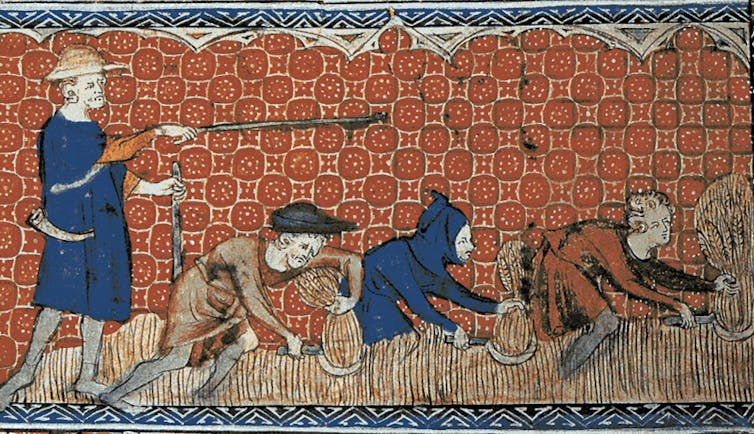
1. Work flexibly
In June, July and August, start work at the first light of dawn, advised the 14th-century shepherd, Jehan de Brie, author of Le Bon Berger (The Good Shepherd).
Work would begin and end earlier to avoid the worst heat of the day.Wikimedia
In fact, all three medieval estates – those who worked, prayed and fought – compressed their tasks to the cooler morning hours in the long summer days. Clergy adapted their services to fit a shorter night and longer day and after Corpus Christi (June) their worship year wound down. Knighthood curbed its taste for tournaments. They would never lift a lance in August.
2. Wear the right hat
Although hardly a habit unique to the middle ages, it is only in the past half-century or so that the hat has lost its status as a staple, everyday item.
Hats were worn daily for practical as well as social reasons in European society.
Medieval images, manuscript illuminations, murals and panel paintings, gesture at the endless variety of shaped hats, soft caps and hoods they reached for as a matter of course. For high summer, the half-metre brim of a hat like the Swedish Lappvattnett hat may have been the norm.
3. Eat to lower body temperature
In the unrefrigerated world of the middle ages, food could still be cool. Salad leaves (known then as salat) were preferred because they were palatable and digestable in the heat.
Fish and meat dishes were cooled down for the season by being doused with verjuice (pressed, unripe grapes), vinegar and perhaps even pomegranate juice.
4. Try wild swimming
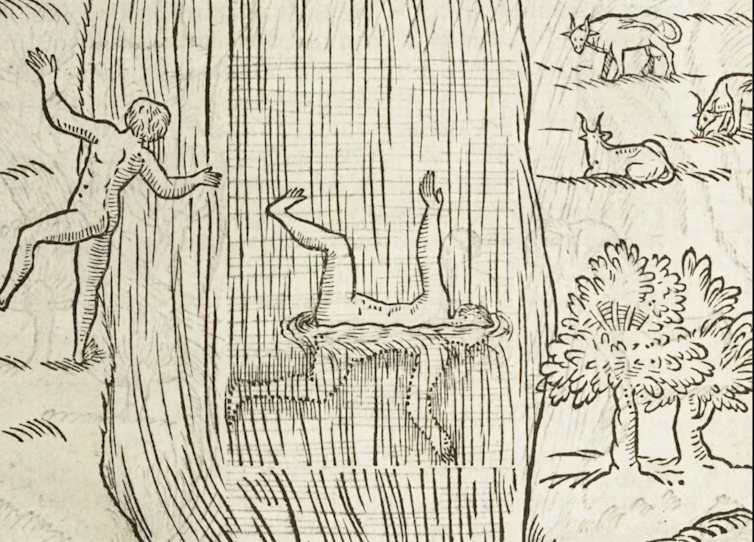
Swimming was an increasingly common, communal recreation in later medieval Europe. When monasteries allowed their inmates periods of downtime, besides blood-letting, they encouraged river and sea swimming for health, hygiene and general fitness.
A woodcut fro Everard Digby’s book on swimming.
In late medieval European cities crowded with tens of thousands, the breadth and depth of the Danube, Rhine, Seine and Tiber were an essential lifeline. The medieval theologian Everard Digby’s manual on the Art of Swimming, first published in 1587, described what may have long been a common sight – leaping and diving through the water “just like the summer’s roach”.
5. Use aftersun
Look after those burns. The monks of Citeaux Abbey were chronicled gathering herbs and roots in summer to salve their “perished skin”.
A 10th-century book of remedies, Bald’s Leechbook , recommended stalks of ivy sauteed in butter to apply to burns. Later, the recommendation was rosewater distilled from the flower’s petals.
Today we would say a bottle of aftersun or aloe gel will do.
6. Flee
When Emperor Charles V (king of Sicily and Naples from 1516 to 1554) found himself in a sweltering Rome with his young children, who were struggling in the rising temperatures, he made the household leave the city. High society generally left city palazzos to go up country and into shadier climes.
The author Giovanni Boccaccio recalled in his Decameron how the “dames of the city fly off” in summer to their country houses. King Richard II
(1377 until 1399) of England built a summer house at Sheen Palace (now Richmond palace) on the banks of the Thames to escape the close climate of the capital.
Even round-the-clock monastic institutions sometimes broke up and decamped to outlying country priories. Of course, it was rarely an option for those beneath them on the social scale.
James Clark, Professor of Medieval History, University of Exeter
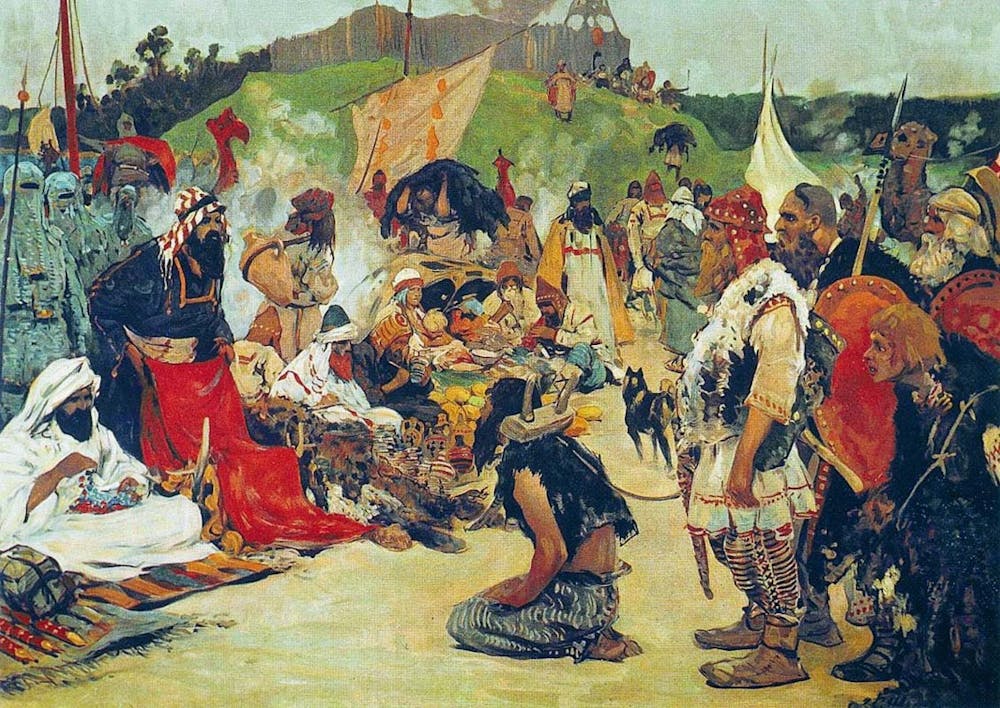
The Viking era, circa 750 to 1050, is described as an “age of silver”. This form of wealth was so desired its acquisition drove their expansion out of Scandinavia.Painting (above) "Overseas Guests" by Nicholas Roerich, 1901.
By Jane Kershaw, University of Oxford
In the archaeology galleries of the Yorkshire Museum, an incredible Viking silver neck-ring takes centre stage. The ring is made of four ropes of twisted rods hammer-welded together at each end, its terminals tapering into scrolled S-shaped hooks for fastening behind the neck. Weighing over half a kilo, it makes a less-than-subtle statement about the wealth and status of its Viking owner some 1,100 years ago.
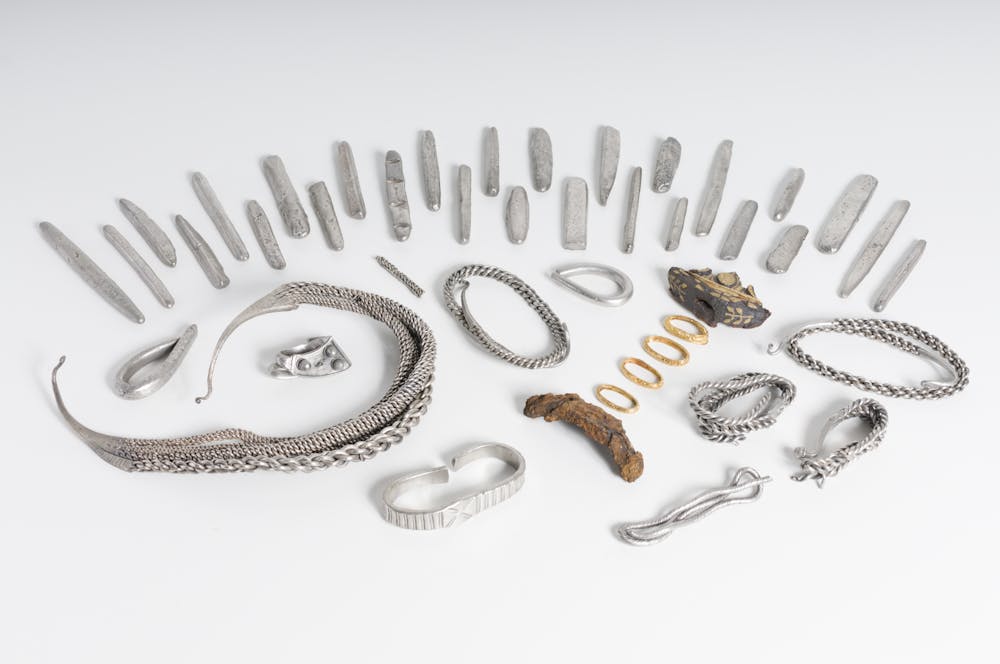
The neck-ring was part of a large silver and gold hoard found in 2012 by metal detectorists Stuart Campbell and Steve Caswell near Bedale in North Yorkshire. As the first precious object out of the ground, it was initially mistaken by Campbell for a discarded power cable.
Six years later, I got the chance to analyse the Bedale hoard, as it is now known, for its isotopes and trace elements. Alongside the neck-ring and a gold Anglo-Saxon sword pommel (probably acquired in England by these Viking raiders), the hoard contained a spectrum of cast-silver artefacts spanning the Viking age: Irish-Scandinavian artefacts from Dublin, rings from southern Scandinavia, and many cigar-shaped bars or ingots that could have been cast anywhere.
As an archaeologist investigating the historical secrets held by jewellery such as this, picking up these heavy objects and turning them over in my hands was a visceral experience. I felt connected with the desires, ambition and sheer force of these invaders from the north who had wreaked havoc on communities in northern England around AD900.
Indeed, the entire Viking age (circa 750-1050) is often described as an “age of silver”. This form of wealth was so desired that its acquisition was a primary driver of the expansion out of Scandinavia that the Vikings are most famed for. To acquire it, they were prepared to risk their own lives – and take those of many others.
The story of the Bedale hoard’s discovery. Video by the Yorkshire Museum.
Tens of thousands of silver objects and coins are known from hoards and settlements across the Scandinavian homelands of Norway, Denmark and Sweden, as well as far overseas – from England to Russia and beyond. The study of this silver’s origins opens a window on the vast web of connections these warrior-traders established – a study invigorated in recent years by scientific techniques drawn from geochemistry.
Now, our analysis of the Bedale hoard and other Viking valuables promises to change the story of when their fellow-Scandinavians began travelling thousands of miles to the east to secure the silver that so captivated them.
The origins of these ‘violent chancers’
The word “Viking” comes from the Old Norse víkingr, meaning someone who participated in a sea raid or military expedition. The seeds of the outburst of piracy and overseas expansion that characterised the Viking age were sown in the 5th and 6th centuries, following the demise of the Roman empire.
While Scandinavia was never actually part of the Roman empire, its fall severed important trade links and led to factional fighting. In addition, volcanic eruptions in the mid-6th century induced prolonged climatic cooling, leading to crop failure and famine. Together, these events fractured Scandinavian society: archaeologists can point to abandoned settlements and cultivation fields as evidence for community displacement and decline.
There was also a striking absence of silver in the region at this time, despite Scandinavia possessing native silver ores. While Roman silver plate and coin had previously reached Scandinavia and been melted down to make huge, stunning “relief” brooches worn by women, this flow of silver had declined sharply by the 6th century. In the following century, most jewellery was made of copper alloy – silver wasn’t being mined, and in this overwhelmingly agrarian society, precious metal was an unnecessary luxury.
In Scandinavia, where farming was challenging due to short summers and long harsh winters, wealth and power lay in good farming land and cattle – with payments typically made in butter, cloth, horses, sheep, hides and iron. As archaeologist Dagfinn Skre explains:
In an economy in which the supply of necessities was threatened, a man who had his moveable wealth in cows … would survive, but one who had it invested in metal would die. His metal would be close to worthless – for who would exchange their cows, butter or grain for metal in times of famine?
Yet out of this period of domestic struggle, a new and ambitious elite emerged in Scandinavia, particularly around the fjords of Norway and in the central Mälaren valley in Sweden – fertile regions which afforded access to both inland resources and coastal waterways.
Dubbed “violent chancers” by historian Guy Halsall, they seized abandoned land and valuable resources such as tar, furs and iron for weapons. They developed multiple, competing chiefdoms which they defended through a martial culture propped up by lavish consumption, trade and violence.
Archaeologists can point to tangible survivals of this culture: luxury imports such as glass claw beakers, elaborately furnished burials under huge mounds, monumental halls and full-on military kits. These warriors had shields decorated with bird-of-prey figures, crested helmets covered with silver foils, and swords with pommels covered in gold and garnets. They were not to be messed with.
Their success, coupled with these coastal people’s refined tradition of boat-building, enabled them to build and kit out fleets of ships. Surviving examples indicate these were long and narrow, with hulls made of overlapping (clinker) planking and shallow keels suitable for use in creeks, estuaries and beach landings. At first propelled by oar, the later adoption of sails enabled these ships to undertake long sea crossings.
In the late-8th century, Scandinavians began launching violent seaborne attacks on centres of wealth in neighbouring countries – first the coastal towns, monasteries and churches of modern-day Britain, Ireland and France, then later expanding their raids into Germany and Spain, and as far south as the north coast of Morocco. These centres of population provided human capital for the Viking slave trade, while enriching the invaders with portable wealth in the form of liturgical plates and reliquaries (from monasteries), silver coin and other high-status artefacts.
A raid on the north-east England island monastery of Lindisfarne in 793 – the first documented attack in the west – was probably launched from Norway. Its precise targeting suggests the raiders were well-informed about their destination, and no doubt attracted by stories of the riches held there. Writing afterwards, York cleric Alcuin described how the church had been “spattered with the blood of the priests of God, stripped of all its furnishing, exposed to the plundering of pagans”.
Alcuin blamed the attacks on his community’s “fornications, adulteries and incest” which have “poured over the land … even against the handmaids dedicated to God” – that is, nuns. The Vikings had made off not just with church treasure, but had also led away youths “into captivity”.
The capture of slaves was a common tactic. Some, like the boys from Lindisfarne, might have ended their days in Scandinavia or have been sold on at slave markets. But often, they were ransomed back to their communities for cash. After Vikings captured the abbot of St Denis in 858, for example, church treasuries “were drained dry” in order to meet their ransom demands of nearly 700lb of gold and 3,250lb of silver. “But even all this was far from being enough,” lamented the period’s chronicler Prudentius, bishop of Troyes.
The Viking pattern of raiding, looting and slaving is a dominant theme of 9th-century annals from Ireland, England and the Carolingian continent (spanning much of modern-day western Europe). In 842, Vikings made a surprise early-morning attack on the trading port of Quentovic in modern-day France. “They plundered it and laid waste,” recorded Prudentius, leaving “nothing in it except those buildings which they had been paid to spare”.
Accounts such as these record massive sums of silver extracted by the Vikings or offered as protection money. The extent of Viking accumulation of silver is staggering: the annals suggest that over the 9th century, the total loot in Viking hands amounted to 30,000lb of silver – or 7 million Carolingian pennies.
This stock is likely to have provided a stimulus to the economic development of nascent towns such as York and Lincoln in Scandinavian-settled areas of England, which are thought to have been more economically buoyant than their counterparts in “English” England.
Why did the Vikings come to value silver so highly? While the ownership of land and livestock was determined by strict laws of inheritance, silver could be obtained independently and with little resource investment, bypassing these normal routes of advancement. In this sense, silver embodied a new kind of dynamism coinciding with a different mode of behaviour.
These “nouveau rich” Vikings could not necessarily buy land with silver, but it gave them status – enabling people without inherited assets to acquire, and pass on, wealth. While the division of farmland and cattle upon marriage or death could be tricky, silver was ideally suited to such payments.
To these new generations of Scandinavians, silver became a standard of value that could guarantee investments, settle disputes and underwrite inheritance claims. It could be used to cement relationships – acting, as archaeologist Soren Sindbaek puts it, as a “virtual social glue”.
Silver analysis leads to a staggering result
But as well as value, silver stores information in its chemical composition that can reveal where it came from – something I have investigated as head of a research team over the last five years. We have analysed hundreds of silver Viking-age objects including from the Bedale hoard, with its rich mixture of rings and ingots cast by Scandinavians.
To make the hoard’s massive twisted silver neck-ring, for example, Viking metalcasters would have melted down numerous silver coins or small pieces of deliberately cut “hacksilver”. Once melted, the silver was cast into ingots, then gently hammered into long rods which were heated and twisted together to form the neck-ring.
The Viking hoard dating 850-950 found near Bedale, North Yorkshire, in October 2012.York Museums Trust via Wikimedia, CC BY-NC-SA
However, this process masked the original sources of that silver. The only way to tell where it came from would require techniques from geochemistry – so I took the objects to the British Geological Survey’s laboratory in the suburbs of Nottingham, where isotope scientist Jane Evans drilled tiny samples from each silver object to measure them for lead isotopes.
Just like the isotopes (of oxygen, strontium and sulphur) that are laid down in bone and teeth – from which we can trace people’s childhood origins – isotopes of lead can be used to trace silver back to its source. Most silver ores contain trace amounts of lead, the four stable isotopes of which vary according to the ore’s geological age and composition. These lead isotopes give each ore a “fingerprint”, which carries over into silver coins and other artefacts made from it.
Given the location of the Bedale hoard in North Yorkshire, I was confident that much of the silver would have come from local Anglo-Saxon and also Carolingian sources in mainland western Europe. In England, the Vikings started to settle from around 865. How they did so – whether by seizing land, purchasing it, or settling previously uninhabited areas – isn’t entirely clear, but the loot seized during their raids must have helped the process.
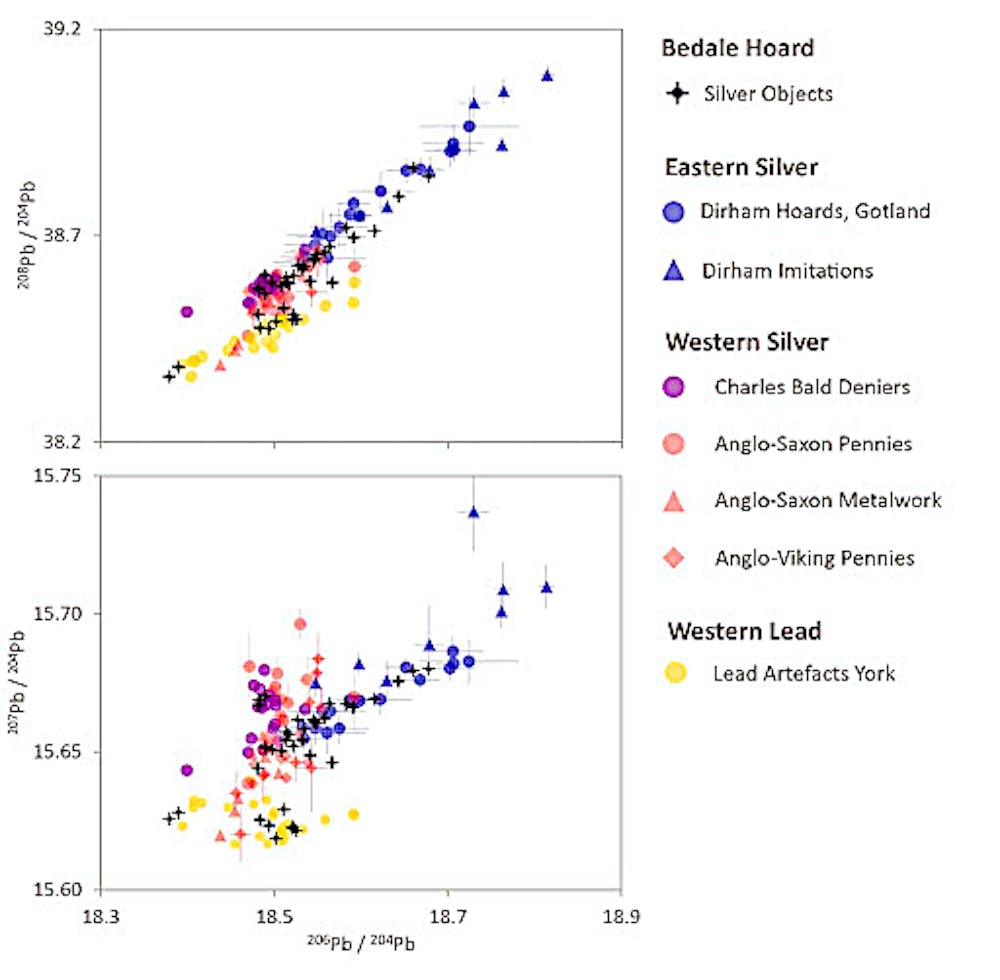
Plotting the ratios of the lead isotopes in the Bedale hoard for the first time, many of the results were as expected: several silver objects matched the ratios of Anglo-Saxon and Carolingian coinage, and other objects had been refined to raise their silver content prior to casting, using local lead in the process of cupellation.
Geochemical analysis of Bedale hoard items
Charts comparing lead isotope ratios of items in the Bedale hoard ((black crosses)) with possible sources of these silver elements. The nine ingots plot closely with Islamic sources of silver (in blue).Jane Kershaw, CC BY-NC-SA
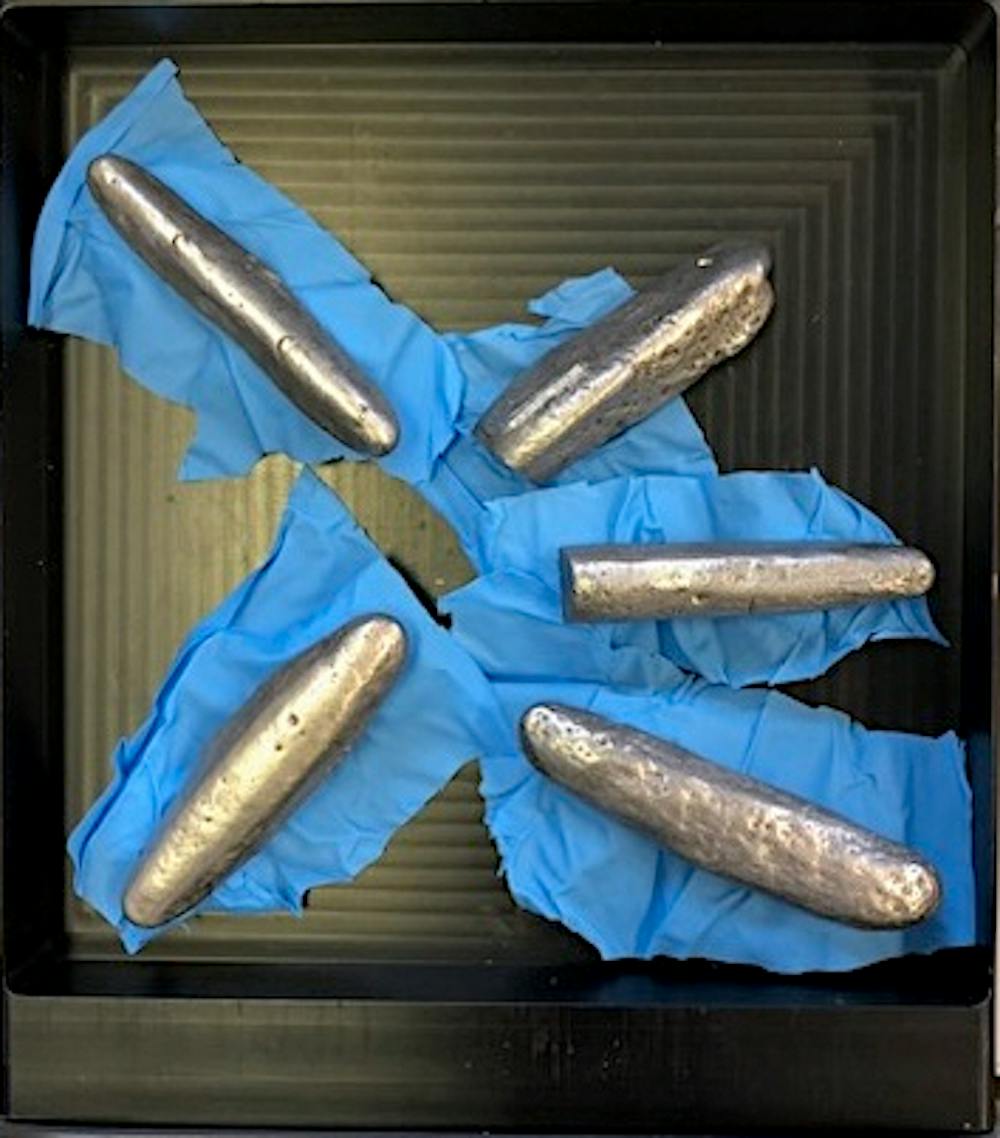
But while many of the artefacts in the Bedale hoard yielded predictable results, a group of nine ingots stood out. Rather than matching western silver sources or local lead, they had the same isotope ratios as the Islamic currency of dirhams.
Dirhams minted between AD750 and 900 by the Umayyads and Abbasids, in what is today Iran and Iraq, were a particularly close match. Two of these ingots were marked with a cross, although whether this carried Christian meaning or was simply a way of marking out ownership is unclear. Either way, these massive ingots must have been cast in Scandinavia from Islamic silver dirhams and brought over to England in Viking hands, before being buried in North Yorkshire.
This result is staggering. The names of villages around Bedale like Snape and Newton-le-Willows sound very far from Mesopotamia – yet the Bedale hoard contained a substantial component of silver minted in Baghdad, Tehran and Isfahan.
These results have made us question the timing of the Viking age’s eastern expansion. While Islamic dirhams are plentiful in Scandinavia, they predominantly date to the 10th century. However, our analysis suggests that dirhams were already arriving in Scandinavia in the 9th century in much larger quantities than previously thought – with many being melted down as a raw material for casting.
To understand how this happened, we need to meet the Scandinavians who looked east rather than west in search of silver and other riches.
Who were the Scandinavians who went east?
While the Viking raids on western Europe are best-known thanks to the many surviving written accounts, some of their fellow-Scandinavians – largely drawn from modern-day Sweden – headed east, establishing riverine, trade-based settlements in what is now Russia and Ukraine.
The route led across the Baltic Sea and Gulf of Finland into northern Russia, transporting furs and slaves from northern Europe to the markets of the Islamic Caliphate. Finds of dirhams in Scandinavia represent the profit from this trade and show that it, too, had silver at its heart.
Over time, these Scandinavians adapted to life on the eastern waterways, adopting some cultural practices from local people such as the nomadic Khazars. The 10th-century diplomat, Ahmad ibn Fadlan, gave a frank description of this new community of traders – known as Rus rather than Vikings – who he met on the River Volga in northern Russia:
They are the filthiest of God’s creatures. They do not clean themselves after urinating or defecating, nor do they wash themselves after having sex …They are like wandering asses.
In 921, Ibn Fadlan had been sent by the Abbasid caliph, al-Muqtadir, as part of an embassy to the king of the Volga Bulgars, located near the modern town of Kazan in Tartastan, Russia. His travelogue-style account, or risāla, of that journey has become famous for the many eyewitness accounts of people he met along the way – including the Rus from northern Europe, whom he met as they traded with merchants from the Islamic empire at the market of Bulgar on the River Volga, roughly midway between Scandinavia and Baghdad.
The Rus people’s long and difficult journey from Scandinavia would have taken several months, involving multiple rivers and portages – when their boats had to be dragged across land. They traversed boreal forest and the Eurasia steppe, which was populated by various nomadic tribes. In this landscape, the only option was to travel by river – or, in winter, to use the river as an ice highway, substituting boats for sledges. But for the Rus, travelling this perilous eastern route, the Austrvegr, was worth the risk.
Painting of trade negotiations between Rus traders and Eastern Slav locals in the 10th century, by Russian artist Sergey Ivanov (1909).Wikimedia Commons
According to Ibn Fadlan, the Rus acted as middlemen, acquiring furs and slaves from hunter societies in forested areas and organising their shipment down river via trading posts that later developed into permanent settlements. The goods were sent to major markets such as Itil (on the Caspian Sea) and Bulgar, where they would be purchased by merchants from the caliphate.
What the Rus wanted in return for slaves and furs was dirhams: the fine silver coins, weighing roughly 3g each, which made up the currency of the Islamic Caliphate. The early 10th-century writer, Ahmad ibn Rustah, explained how the Rus “earn their living by trading in sable, grey squirrel and other furs. They sell them for silver coins which they set in belts and wear around their waist.”
Ibn Fadlan’s highly detailed travelogue explains that once a trader amassed 10,000 dirhams, he melted them down to create a neck-ring for his wife. After 20,000 dirhams, he made two. This was no doubt an exaggeration – such a neck-ring would weigh 65lb of silver – but the notion that a smallish group of traders acquired tens of thousands of silver dirhams is supported by archaeology.
For these Rus “traders”, just as important as the fur trade was the trade in enslaved people, who seem mainly to have been captured from the Slavic lands and what is now northern Russia, rather than western Europe. Scholars sometimes describe the Austrvegr as a trading route, but human trafficking can hardly be described as “trade” in the mercantile way that we understand it today. It was based on coercion and violence – the terrorising nature of Viking activity in the west was replicated in the east.
The Rus “treat their slaves well and dress them suitably”, Ibn Rusta wrote, “because for them they are an article of trade”. Yet it’s also clear that female slaves were exploited for sex. These reports underscore the grim reality of the Rus “trade” – that their insatiable quest for silver entailed human suffering.
Astonishingly, some 400,000 dirhams survive in Scandinavia and the Baltic, making the dirham the most common archaeological find type for the Viking age. However, most of these coins date to the first half of the 10th century.
Yet according to our analysis of the Bedale hoard, rather than the Viking age “starting” in the west, the eastern and western expansions may have happened in parallel from the end of the 8th century – with the wealth of the east a prime motivator of the Viking movement out of Scandinavia.
Today, in some of the place-names near Bedale in North Yorkshire, we see evidence of Scandinavian settlement: Aiskew is Old Norse for “Oak Wood”, and Firby means “Frith’s village”. But now we also have evidence of a connection between the Bedale hoard and Rus traders bringing silver back to Scandinavia from their exploits in the east – up to a century earlier than had been thought.
Laser analysis brings new discoveries
In our analysis of the Bedale hoard, lead isotopes alone weren’t enough to draw definitive conclusions. We needed additional data to confirm the Islamic origin of the nine ingots.
Not only do lead isotopes differ between source ores – so do trace elements. Gold and bismuth levels are especially helpful in evaluating the origin of silver, because, unlike other elements, they do not change when silver is melted down.
After digesting the results of the lead isotopes, I returned to the suburbs of Nottingham. With Simon Chenery, we put the Bedale hoard objects under an excimer laser (a type of ultraviolet laser), ablating tiny amounts of silver in order to record the levels of trace elements. This time, thrillingly, the results came through in real time.
They showed, for the Islamic-looking ingots, the telltale pattern of low gold that is characteristic of Abbasid silver. Abbasid dirhams of this date typically have gold levels below 0.4%, reflecting the low-gold character of nearby silver mines in the Taurus mountains, whereas gold levels in coins from western Europe are higher – around 1% in the late 9th century.
Ingots in the tray ready for laser ablation.Jane Kershaw, CC BY-SA
We discovered, too, that other artefacts were probably made from a mix of both western and eastern silver sources. This was true of the massive silver neck-ring as well as a smaller neck-ring from the hoard. Indeed, these two items appear to have been made from the same silver stock, suggesting that they travelled from their source to Bedale together.
While both could have been made in Scandinavia, the contribution of western silver raises the possibility that they were produced locally in Yorkshire, by metal casters with access to both distant, Islamic dirhams and local, Anglo-Saxon silver.
Our analysis shows the Islamic contribution to the Bedale hoard is more significant than we would have expected for a Viking hoard from England. In all, the nine ingots weigh 715g, equivalent to around 240 dirhams. And taking into account the Islamic contribution to the “mixed” silver artefacts, Islamic silver comprises around a third of the total weight of silver from the hoard (weighing around 3,700g).
Clearly, the Vikings were not only extracting silver from areas they raided and conquered, they were also bringing it in via their long-distance trade networks in the east. This result reveals the unexpected connectedness of the Vikings’ eastern and western expansions. Far from being separate phenomena, the profits of one directly fed into the activities of the other. Gains made from the Austrvegr may have enabled a group of Scandinavians to launch raids to the west and acquire further wealth and land.
In the west, these raids lasted for around 70 years from the late 8th century, spanning two or three generations. But eventually, the Vikings decided to settle. In northern England, where Bedale is located, they proceeded “to plough and to support themselves”, according to the Anglo-Saxon Chronicle entry for 876 AD. Finds of female Scandinavian dress items from England suggest that whole families, not just retired warriors, settled there.
Many questions remain about the nature of this settlement – including whether the raiders-turned-settlers lived separately from or with the native Anglo-Saxon population, and how the settlement process was brokered. But the former Vikings and their families appear to have integrated relatively quickly, adopting Christian forms of burial, developing craft industries in towns, and embracing coinage as a means of exchange. Among the settled Scandinavian population, the violence ceased.
Silver remained an important medium for displaying values and even identities. From around 900, new Anglo-Scandinavian rulers minted their own coinage – sometimes preserving traditional features familiar to Anglo-Saxons, but also adding new aspects that proclaimed a Scandinavian background. Coins minted by the new rulers of York, a focus of Scandinavian settlement in northern England, could have a Christian cross on one side and a Thor’s hammer – an overt pagan symbol – on the other.
These Anglo-Scandinavian coins were in use across Scandinavian-settled regions of England and are testimony to the continued importance of silver to the Viking economy – now channelled into a form that was more regulated and acceptable to the local Anglo-Saxon community. Geochemical analysis of the silver in these coins also reveals glimpses of this process of assimilation. Our investigation of a handful of examples, using the same techniques of lead isotope and trace element analysis, suggests they were made mainly with Anglo-Saxon silver – but again with a modest contribution from Islamic dirhams.
The end of the eastern adventure
The geochemical analysis of silver helps reveal the reasons for the extraordinary expansion of the Vikings and their fellow Scandinavians – including pointing to the wealth gained in eastern markets as a major (and hitherto neglected) “pull” factor. To a greater degree than has traditionally been acknowledged, eastern silver travelled across the Scandinavian world of the Viking age.
The huge number of Samanid dirhams found in Scandinavia point to the 930s-940s as the most fruitful decades for the Scandinavian travellers’ trade with the east. The Rus’s slave and fur trade continued until around 950 – and silver analysis again helps to explain why it came to a fairly sudden end. Analysis of the silver content of dirhams shows their fineness declined sharply from the 940s and 950s – a reflection, no doubt, of the drying up of silver mines in Central Asia.
It did not take long for Vikings to seek out silver sources closer to home. They turned to coins from the area of modern-day Germany, struck with silver from the newly-exploited Harz mountains, which they obtained mainly through trade. The decline in the silver content of dirhams thus led to a major reconfiguration of Scandinavian trade routes.
From this point on, long-distance trade with the east declined significantly. The Vikings instead turned again to the west, establishing trade links with England and Germany. In the late 10th century, increasingly powerful Scandinavian kings also launched new seaborne raids, exploiting the weakness of English kings such as Æthelred II “the Unready” (978–1016) and initiating what has become known as the “second Viking age” in England.
These raids, launched from around 980, were bigger, more centrally organised, and successful. The Vikings obtained significant quantities of “Danegeld”: protection payments made in coin. Ultimately, in 1016, the Danish king Cnut established himself on the English throne. The nature of the relationship between England and Scandinavia during this period is also being explored through silver, in a project on coinage from the recently-discovered Lenborough hoard.
If the pattern identified for the Bedale hoard plays out across other Viking hoards, it will prompt a major re-evaluation of the movements of the earliest Scandinavian warrior-traders. As part of the same project, we have been analysing Viking silver hoards of a similar 9th-century date from Sweden and Denmark, the Carolingian continent, southern Scotland and the west coast of England. Preliminary results suggest a regional pattern, but with Islamic silver appearing to be dominant in many cases.
What’s clear is that in the 9th century, the Vikings were already awash in Islamic silver. Meanwhile, more undiscovered treasures like that found in Bedale lie quietly underground, waiting to reveal their secrets.
Jane Kershaw, Gad Rausing Associate Professor of Viking Age Archaeology, University of Oxford
Daniel Craig pictured above as James Bond; will the new film be inspired by cutting-edge, real-world technologies or turn away from the era of AI to standout?
By Christopher Holliday, King's College London
Development of a new James Bond film is underway at Amazon Studios, with the creator of Peaky Blinders, Steven Knight, now attached to write the screenplay, which will be directed by Denis Villeneuve.
The pair have given little away about what to expect from Bond 26. Knight said he wanted to do something “the same but different”, while Villeneuve said he would “honour the tradition” of the franchise. But a look back at how the films have dealt with key elements of Bond shows that following tradition can mean going in many different ways.
Take Bond’s toolbag of gadgets, which have been a part of the James Bond movies since their debut in the 1960s. Over the decades, the films have both leaned into and shifted away from the allure of hi-tech gadgetry in ways that plot key turning points in the franchise.
These peaks and troughs reflect what’s going on in the wider world as well as factors such as the influence of other successful film franchises. So with AI on the minds of many right now, the new film could embrace contemporary themes of technology. But re-booting the franchise when a new lead actor is cast is also often associated with a grittier or “back to basics” approach.
The first few Bond films starring Sean Connery, including Dr No (1962), From Russia With Love, and Goldfinger (1964) feature a smattering of spy technology. But by You Only Live Twice (1967), producers had opted for a space capsule hijack narrative – reflecting the influence of the US-Soviet space race – and a villain’s lair in a hollowed-out volcano.
However, the next entry – On Her Majesty’s Secret Service (1969) centred largely on the emotional realism of Bond’s (George Lazenby) courtship and subsequent marriage to Tracy di Vicenzo (Diana Rigg). The lesser focus on technology coincided with a new Bond actor – a pattern to be frequently repeated later on in the franchise. But for other reasons, the shift in tone was, perhaps, to be expected.
Goldfinger: Q introduces Bond to his Aston Martin.
Bond author Ian Fleming was writing On Her Majesty’s Secret Service at his holiday home – Goldeneye – in Jamaica, while Dr No was being filmed nearby. The book was published on April 1, 1963, the day From Russia With Love began filming (the film was released in October that year). The less gadget-focused approach of On Her Majesty’s Secret Service could be seen as a possible jab by Fleming at what he saw as the cinematic Bond’s growing overreliance on the latest tech.
Journeying back through the franchise, it is not hard to find instances where moments of technological excess are countered almost immediately by a more pared down, character-centred set of priorities.
After On Her Majesty’s Secret Service, Connery returned for one further Eon Productions film, Diamonds Are Forever (1971), which, like You Only Live Twice, featured a space-themed narrative. Live And Let Die (1973), Roger Moore’s debut as Bond, is somewhat more down to Earth and was the first film not to feature Bond’s gadgetmaster Q (who is referred to as Major Boothroyd in Dr No).
But a growing reliance on technology can be seen during the 70s Moore films, culminating with Moonraker (1979) – which was heavily influenced by Star Wars (1977) – in which Bond goes into space.
Moore’s follow-up, For Your Eyes Only (1981), was – as that film’s director John Glen noted – a film that went “back to the grass roots of Bond.” The global economic recession that took place between 1980 and 1982 certainly helped support this shift in tone.
For Your Eyes Only had a lower budget than Moonraker, so the filmmakers had to act in a similar way to their leading character, who made innovative use in the film of his shoelaces to climb up a rope on a sheer rock face in Greece.
The last few Roger Moore films have examples of Bond’s complex connection to technology, such as the computer microchip narrative of Moore’s final film A View to a Kill. But the next film, The Living Daylights (1987), was a return to the grittier Bond of the novels – with a focus on classic spycraft. From an action-packed opening in Gibraltar, the narrative moves to Bratislava where Dalton helps a KGB General defect to the west.
When Dalton departed after Licence to Kill (1989), which shows the influence of big-budget 80s Hollywood action movies, the series’ return after a six-year hiatus brought Bond into the information age. The cyberterrorist narrative of GoldenEye (1995), Pierce Brosnan’s debut as Bond, is fully indebted to a broader curiosity surrounding emerging internet sub-cultures.
The Living Daylights opening scene (official 007 YouTube)
Brosnan’s final outing, Die Another Day (2002) featured an Aston Martin that could turn invisible, which critics and audiences dismissed as a series nadir. The post-9/11 climate of protector narratives in defence of national security featured an altogether grittier action cinema counting Jason Bourne as its most popular hero. Die Another Day’s invisible Aston Martin and the indelible image of a computer-generated Bond surfing amid digital icebergs did not quite align with this state of post-millennial geopolitics.
Enter Daniel Craig, and the franchise’s emphatic declaration that it was going to do things for real, per the title of a documentary on Craig’s debut Casino Royale (2006). This was a statement of intent, anchored not just to a reduction in computer-generated imagery (CGI) behind-the-scenes, but equally by a turn away from the kinds of excessive technological wizardry that defined earlier instalments.
The absence of Q from Craig’s debut Casino Royale (2006) for the first time since Live and Let Die appeared to confirm a more “back to basics” feel. When the character did finally appear in Craig’s third film Skyfall (2012), Q (now played by Ben Whishaw) remarks to Bond: “Were you expecting an exploding pen? We don’t really go in for that anymore.”
Die Another Day trailer.
With another reboot on the way, the question now is whether the new film will draw inspiration from real-world technologies and push once more at the limits of technical innovation. Perhaps Villeneuve will exploit his science-fiction credentials finetuned in Arrival (2016), Blade Runner 2049 (2017) and his successful Dune films (2021-2024).
But given how contemporary cultural landscape is awash with the threat of AI, maybe the franchise does need to beat a hasty retreat from technology in order to stand out. Either way the filmakers will be able to argue they are sticking to tradition.
Christopher Holliday, Senior Lecturer in Liberal Arts and Visual Cultures Education, Department of Interdisciplinary Humanities, King's College London