Friday, 12 December 2025

A Brief History of Mulled Wine: From Health Tonic to Festive Treat

    Artsiom Lebedzeu/Alamy
By Sara Read

When frost sparkles in the morning and our breath is visible as we venture outside, thoughts turn to winter warming treats like mulled wine – a drink full of ingredients that have become synonymous with Christmas.

Mulled wine is made by adding spices such as cinnamon, cloves, ginger, mace and nutmeg to sweetened red wine, which is then warmed gently. Across Europe and Scandinavia, it can be purchased in many pubs, bars and festive markets – while supermarket shelves groan with bottles of readymade mulled wines for you to heat at home.

There are many different English recipes out there, including some dating back to the 14th century – from a collection of manuscripts that later became known as The Forme of Cury. The beverage made by following this recipe would certainly have packed a punch, as it contains several spices from the ginger family including galangal, in addition to the more familiar ones.

And before wine was known as mulled, drinking wine flavoured with spices has a long history. There is a mention of drinking spiced wine in the biblical poem the Song of Solomon, which states: “I would give you spiced wine to drink.”

It is thought that spice-infused wine was introduced to Britain by the Romans. An older name for it was “hippocras”, although this was mainly taken as a health tonic – made from spice-infused red or white wine and taken hot or cold.

A man drinking wine.
An illustration from a medieval manuscript showing ‘ypocras’ being made. Wikimedia

In The Merchant’s Tale from Geoffrey Chaucer’s Canterbury Tales (1392), the wealthy, elderly knight January takes “ypocras, clarre, and vernage / Of spices hote, to encrese his corrage” (hypocras, clary, and vernage / of spices hot to increase his courage). January sups these three types of spiced wine to boost his virility on his wedding night for his young bride, May.

Diarist and civil servant Samuel Pepys also mentions taking “half-a-pint of mulled sack” – a sweetened Spanish wine – in an almost medicinal way to comfort himself in the middle of a working morning in March 1668, when things had been going wrong for him.

The name mulled wine comes from the Old English mulse – an archaic name for any drink made of honey mixed with water or wine, derived from the Latin word for honey (mel) and still used in modern Welsh as mêl. From mulse we get “musled”, which was used to describe anything that has been “mingled with honey”.

Before the growth of the global sugar trade, honey was the main way that food and drink was sweetened. Vin chaud, the French equivalent of mulled wine, is traditionally sweetened with honey. England imported spiced wine from Montpellier in large quantities from the 13th century, but only those of social status, like Chaucer’s knight January, would have been able to indulge in those days.

Warm sweet and spiced wine continued to be drunk for health and enjoyment throughout the centuries. But in the 18th century, mulled wine evolved again, as reflected in a recipe in Elizabeth Raffald’s The Experienced English House-keeper (1769) for a warm drink thickened with egg yolks:

Grate half a nutmeg into a pint of wine and sweeten to your taste with loaf sugar. Set it over the fire. When it boils, take it off to cool.

Beat the yolks of four eggs exceeding well, add to them a little cold wine, then mix them carefully with your hot wine a little at a time. Pour this backwards and forwards several times till it looks fine and bright.

Set it on the fire and heat a little at a time till it is quite hot and pretty thick, and pour it backwards and forwards several times.

Send it in chocolate cups and serve it up with dry toast, cut in long narrow pieces.

The result of this method is a frothy, velvety smooth confection, enjoyed with dipping toast or biscuits.

Our ancestors didn’t associate mulled wines with Christmas, so it seems likely that the pairing was popularised by Charles Dicken’s 1843 novella A Christmas Carol – like so much of what we now regard as a traditional Christmas.

After Mr Scrooge has seen the error of his miserly ways, he says to Bob Cratchit: “We will discuss your affairs this very afternoon, over a Christmas bowl of Smoking Bishop, Bob!” Smoking Bishop is a recipe for mulled wine that combines port in the wine and uses dried oranges for an added flavour note. The smoke refers to the steam rising from this hot drink.

So this year, as you cup your hands around the warm mug and inhale the fragrant steam coming off your mulled wine, think of the long history you are a part of.

The ConversationSara Read, Lecturer in English, Loughborough University

Subscribe to support our independent and original journalism, photography, artwork and film.

Thursday, 11 December 2025

Frank Gehry, the Architect of the Unconventional, the Accidental, and the Inspiring

The sinuous forms of Frank Gehry's Walt Disney Concert Hall in Los Angeles. Photograph: Sean Pavone/Getty Images. Cover picture of the architect's Guggenheim Museum and Bilbao River. Photograph: Maremagnum/Getty Images.

By Michael I. Ostwald

Architect Frank Gehry in his studio
with models of his designs. 
In April 2005, The Simpsons featured an episode where Marge, embarrassed by her hometown’s reputation for being uneducated and uncultured, invites a world-famous architect to design a new concert hall for the city.

The episode cuts to the architect, Frank Gehry (playing himself), outside his house in Santa Monica, receiving Marge’s letter. 

He is frustrated by the request and crumples the letter, throwing it to the ground. Looking down, the creased and ragged paper inspires him, and the episode cuts to a model of his concert hall for Springfield, which copies the shape of the crumpled letter. 

By building Gehry’s design, the people of Springfield hoped to send a signal to the world that a new era of culture had arrived. As it often did, this episode of The Simpsons references a real-life phenomenon, which Gehry was credited with triggering, the “Bilbao effect”.

In 1991, the city of Bilbao in northern Spain sought to enhance its economic and cultural standing by establishing a major arts centre. Gehry was commissioned to design the Bilbao Guggenheim, proposing a 57-metre-high building, a spiralling vortex of titanium and glass, along the banks of the Nervión River

Using software developed for aerospace industries, Gehry designed a striking, photogenic building, sharply contrasting with the city’s traditional stone and masonry streetscapes.

Finished in 1997, the response to Gehry’s building was overwhelming. Bilbao was transformed into an international tourist destination, revitalising the city and boosting its cultural credentials and economic prospects. As a result, many cities tried to reproduce the so-called “Bilbao effect” by combining iconic architecture and the arts to encourage a cultural renaissance.

Gehry, who has died at 96, leaves a powerful legacy, visible in many major cities, in the media, in galleries and in popular culture.

Mist rises off the river in front of a brilliant glass  and metal building.
Guggenheim Museum, Avenida Abandoibarra, Bilbao, Spain. Elizabeth Hanchett/Unsplash

An architect’s life

Gehry was born Frank Owen Goldberg in Toronto, Canada, in 1929 and emigrated to Los Angeles in the late 1940s, where he changed his surname to Gehry. He studied architecture and urban planning and established a successful commercial practice in 1962.

It wasn’t until the late 1970s, when he began experimenting with alterations and additions to his own house, that he began to develop his signature approach to architecture. An approach that was both visionary and confronting.

The house looks like a work-in-progress.
Gehry and his son, Alejandro, in the yard in front of his self-designed home, Santa Monica, California, January 1980. Susan Wood/Getty Images

In 1977, Gehry purchased a colonial bungalow on a typical suburban street in Santa Monica. Soon after, he began peeling back its cladding and exposing its structural frame. He added a jumble of plywood panels, corrugated metal walls, and chain-link fencing, giving the impression of a house in a perpetual state of demolition or reconstruction.

Its fragmented, unfinished expression offended the neighbours but also led to his being exhibited in the landmark 1988 Museum of Modern Art’s Deconstructivist Architecture show.

At this event, Gehry’s house was featured alongside a range of subversive, anti-establishment works, catapulting him to international fame.

The Walt Disney Concert Hall, Los Angeles, California, United States of America. Tim Cheung/Unsplash

Unlike other architects featured in the exhibition – such as Coop Himmelblau, Rem Koolhaas and Daniel Libeskind – Gehry was not driven by a political or philosophical stance. Instead, he was interested in how people would react to the experience of architecture.

It was only after the Bilbao Guggenheim was completed that the world could see this vision.

Throughout the 2000s, Gehry completed a range of significant buildings, led by the Walt Disney Concert Hall (2003) in Los Angeles, which has a similar style to the Bilbao Guggenheim.

Gehry’s Museum of Pop Culture (2000) in Seattle is a composition of anodised purple, gold, silver and sky-blue forms, resembling the remnants of a smashed electric guitar.

A silver, pink and blue building.
Museum of Pop Culture, Seattle, Washington, United States of America. Getty Images

The Marqués de Riscal Vineyard Hotel (2006) in Elciego, Spain, features steel ribbons in Burgundy-pink and Verdelho-gold. The Louis Vuitton Foundation (2014) in Paris has 12 large glass sails, swirling around an “iceberg” of concrete panels.

Gehry only completed one building in Australia, the Dr Chau Chak Wing Building (2014) in Sydney. Its design, an undulating form clad in custom-made bricks, was inspired by a crumpled brown paper bag. Marge Simpson would have approved.

Recognition and reflection

The highest global honour an architect can receive is the Pritzker Prize, often called the “Nobel prize for architecture”. Gehry was awarded this prize in 1989, with the jury praising his “controversial, but always arresting body of work” which was “iconoclastic, rambunctious and impermanent”.

While the Pritzker Prize is often regarded as a capstone for a career, most of Gehry’s major works were completed after the award.

A building of metalic ribbons.
Tempranillo vines surround the hotel at Marqués de Riscal winery, Elciego, Spain. David Silverman/Getty Images

Gehry revelled in experimentation, taking artistic inspiration from complex natural forms and constructing them using advanced technology. Over the last three decades, his firm continued to produce architecture that was both strikingly sculptural and playfully whimsical.

He ultimately regretted appearing on The Simpsons, feeling it devalued the complex process he followed. His architecture was not random; an artist’s eye guided it, and a sculptor’s hand created it. It was not just any crumpled form, but the perfect one for each site and client.

He sometimes joked about completing his home in Santa Monica, even humorously ending his acceptance speech for the Pritzker Prize by saying he might use his prize money to do this. Today, on the corner of 22nd Street and Washington Avenue, partly shielded by trees, Gehry’s house remains forever a work in progress. Its uncompromising yet joyful presence has endured for almost 50 years.The Conversation

Michael J. Ostwald, Professor of Architectural Analytics, UNSW Sydney

Subscribe to support our independent and original journalism, photography, artwork and film.

Sunday, 7 December 2025

Art Deco at One Hundred: Why the Sleek Design Aesthetic of the ‘Machine Age’ Still Endures

Against a backdrop of geometric skyscrapers, Tamara de Lempicka's Portrait of Romana de la Salle, 1928. The painting sold at Sotheby's New York in 2022 for $14.1 million and was previously owned by German fashion designer Wolfgang Joop for more than 20 years. 
By Lynn Hilditch

In Paris in 1925, the French government initiated its ambitious International Exhibition of Modern Decorative and Industrial Arts with one specific goal – to showcase and celebrate the excellence of French modern design. This display of innovative ideas contributed to the rise of a ubiquitous design style that became known as art deco.

In Toulouse, France, the Art Deco facade of the 
Depeche du Midi newspaper, built in 1926 by 
architect Leon Jaussely in rue Alsace Lorraine.
Originally conceived in western Europe in the 1910s, art deco became dominant in the 1920s and flourished between the first and second world wars. In the US it was known as art moderne (or streamline moderne), a symbol of American interwar prosperity, optimism and luxury – the epitome of the “roaring twenties”.

Although known by various names, the term art deco (short for the French arts décoratifs) has been attributed to the Swiss-French architectural designer Le Corbusier. He harshly criticised the new style in his journal L’Esprit Nouveau,pithily claiming that “modern decoration has no decoration”. Likewise, historian Nikolaus Pevsner considered its “jazzy modernism” a perversion of true modernism.

The term was only confirmed in 1968 with the publication of Bevis Hillier’s book Art Deco of the 20s and 30s, which fortified the style’s name. Hillier described art deco as “the last of the total styles” affecting “everything, from skyscrapers and luxury liners to powder compacts, thermos flasks, lampposts and letterboxes”.

In America, art deco spanned the boom of 1920s and the bust of the Depression-ridden 1930s. F. Scott Fitzgerald’s novels The Beautiful and the Damned (1922) and The Great Gatsby (1925) reflected the style of the period: flappers and “sheiks” embracing the spirit of frivolity, liberation and hopefulness.

The “machine age” was in full swing, and technology was rapidly improving quality of life. The period saw the introduction of the industrialised printing press, radio, the first skyscrapers and modern transportation. There was a sense of excitement and expectancy in the air, a time of anticipating a future filled with promise and possibility.

A sense of style

Radio City Music Hall's lobby in New York 
opened in 1932. Brian Logan/Shutterstock 
Stylistically, art deco’s distinct machine aesthetic replaced the flowing, floral motifs of the earlier arts and crafts and art nouveau styles. This movement incorporated streamlined, geometric designs that expressed the speed, power and scale of modern technology.

Design influences came from the early 20th century art movements of cubism, futurism and constructivism as well as from the ancient exotic cultures of Egypt, Assyria and Persia.

Zig-zags, sunbursts and stylistic flowers became synonymous with the style, along with the use of bright colours (influenced by fauvism), strong rectilinear shapes and new materials such as aluminium, stainless steel, chrome and plastic. According to art deco expert Alastair Duncan: “for the first time, the straight line became a source of beauty.”

Art deco often conjures up images of delicate Lalique glassware or the vibrant abstract designs of British ceramicist Clarice Cliff. But despite its European origin, art deco is perhaps best defined by American architecture.

The soaring Art Deco "Wisdom" design above the
main entrance to the Rockefeller Centre in New York 
from the plaza, with its strong verticality in limestone.
The Chrysler Building, the Empire State Building and the Radio City Music Hall are among the most impressive examples with their sleek, linear appearance with stylised, often geometric ornamentation that transformed New York City into a futuristic modern metropolis. It is perhaps inevitable that art deco would influence film-making (Fritz Lang’s Metropolis, from 1927, for example) and later 20th-century design styles, like retrofuturism.

While painting is not closely associated with art deco, Tamara de Lempicka’s highly stylised portraits of aristocrats and socialites echoed the 1920s glamour and sophistication. Her work defined the role of “the new woman”, a term originally coined in the late-19th century, but also referring to a generation of free-spirited women with liberal interpretations of gender in the early 20th century.

Many of Lempicka’s paintings were of nudes with several set against a background of New York skyscrapers. The cubist influence in her work is also evident through her use of bold lines and geometric, angular shapes. Lempicka’s work increased in popularity during the late-1980s when a string of celebrities, including Jack Nicholson and Barbra Streisand, expressed their admiration for her work.

A signature example of Art Deco style,
Tamara de Lempicka's "Young Girl in
Green" (1927) at the Centre Pompidou.
Madonna, an avid collector of the artist who has admitted to owning enough Lempicka paintings to open a museum, referenced Lempicka’s unique aesthetic in her music videos for Open Your Heart (1987), Express Yourself (1989), Vogue (1990) and included projections of Lempicka’s paintings in her 2023-24 Celebration Tour.

Today, the art deco style remains relevant and desirable. In January 2025, Country and Town House magazine announced “art deco is back for 2025” in interior design.

Mercedes-Benz recently showcased its new Vision Iconic show car – its dramatic radiator grille designed to harken back to the “golden era of automotive design in the 1930s”. Jaguar also created a pink show car earlier this year, the advert for which referenced the art deco architecture of Miami Beach.

A century after its Parisian debut, the art deco movement continues to inspire with its modernity, elegance and freedom of form, creating a sense of nostalgia through juxtaposing perspectives from the past and present..

Lynn Hilditch, Lecturer in Fine Art and Design Praxis,. Liverpool Hope University

Subscribe to support our independent and original journalism, photography, artwork and film.

Friday, 5 December 2025

How a Medieval Oxford Friar Used Light and Colour to Find Out What Stars and Planets are Made Of

Fishacre would have been delighted to know that nearly 800 years after his discoveries, contemporary astronomy is using light and colour to show far flung stars and planets are all made from the same elements.


By William Crozier, Durham University

During the 1240s, Richard Fishacre, a Dominican friar at Oxford University, used his knowledge of light and colour to show that the stars and planets are made of the same elements found here on Earth. In so doing he challenged the scientific orthodoxy of his day and pre-empted the methods and discoveries of the 21st-century James Webb space telescope.

Following the Ancient Greek philosopher Aristotle, medieval physics affirmed that the stars and planets were made from a special celestial element – the famous “fifth element” (quinta essentia) or “quintessence”. Unlike the four elements found here on Earth (fire, water, earth and air), this “fifth element” is perfect and unchanging.

Fully transparent, it formed the basis of what were believed to be the nine concentric celestial “spheres” surrounding the Earth, as well as the various stars and planets attached to them. These, it was argued, were merely condensed versions of the “fifth element”, with each of the first seven spheres having its own planet, and the outermost eighth and ninth spheres containing the stars and heaven itself, respectively.

A Medieval chart of the nine 
concentric celestial 'spheres’ 
surrounding the earth. 
Oxford University

Colour, light and the stars

Lacking access to telescopes and rock samples, Fishacre – the first Dominican friar to teach theology at Oxford University – openly rejected the idea that the stars and planets were made from some special “fifth element”. In his opinion, they consisted of the same four elements found here.

His reason for asserting this position was his understanding of how colour and light behave.

Colour, Fishacre noted, is typically associated with opaque bodies. These, however, are always composite, meaning made up of two or more of the four terrestrial elements. When we look up at the stars and planets, however, we see that the light they emit often has a faint colour. Mars appears red, and Venus yellow, for example. This suggests, of course, that they are composite and thus made “ex quattuor elementis” – “out of the four elements”.

In Fishacre’s opinion the surest proof that the stars and planets were not made of some special “fifth element” came from the Moon. It has a very definite colour, and, crucially, every so often it eclipses the Sun. Were it made from the transparent fifth element – even a highly condensed version of it – then surely the Sun’s light would pass through it, just as it does a pane of glass. This, however, is not the case.

The Moon, Fishacre reasoned, must therefore be made of the same elements found on Earth. And if this was true of the Moon, which is the lowest celestial body, then it must also be true of all the other stars and planets.

The James Webb space 
telescope confirmed 
what Richard Fishacre 
claimed about the 
composition of stars.

A brave move

In arguing this, Fishacre knew that he was risking criticism. “If we posit this position,” he wrote, “then they, that crowd of Aristotelian know-it-alls (scioli aristoteli), will cry out and stone us”.

Sure enough, stones were thrown at Fishacre – and from high places. In 1250, his teaching was denounced at the University of Paris by St Bonaventure of Bagnoregio, a Franciscan friar who ridiculed in his lectures those “moderns” like Fishacre who foolishly questioned Aristotle’s teaching on the celestial fifth element.

Contemporary astrophysics has, of course, vindicated Fishacre’s position. The stars and planets are not made of some special fifth element, but rather from many of the same metals and elements found here on our home planet. The James Webb space telescope, for example, recently established that the atmosphere of the Neptune-like exoplanet TOI-421 b, some 244 light years away, contains high quantities of water and sulphur dioxide.

Remarkably, how the James Webb space telescope established this – a process known as transmission spectroscopy – is very similar, at least in principle, to the method which Fishacre employed. It detected subtle variations in the brightness and colour of the light emitted by TOI-421 b which could only be caused by water and sulphur dioxide.

Given how much criticism his claims received, Fishacre would no doubt have been delighted to know that nearly 800 years after his death, contemporary astronomy, just like him, is using light and colour to show that far flung stars and planets are all made from the same elements.

The ConversationWilliam Crozier, Duns Scotus Assistant Professor of Franciscan Studies, Durham University

Subscribe to support our independent and original journalism, photography, artwork and film.

Thursday, 4 December 2025

How a Gustav Klimt Portrait was Saved from the Nazis and its Contribution to a New Record Sale Price

Painted between 1914 and 1916, the painting played a role in Elizabeth Lederer's deception of the Nazis, after Austria was annexed in the 1930s. Cover picture of byFang SS26 collection. 
By Benedict Carpenter van Barthold

Gustav Klimt’s Portrait of Elisabeth Lederer has sold to an anonymous phone bidder for US$236.4 million (£180.88 million) at Sotheby’s New York. Only Leonardo Da Vinci’s Salvator Mundi has achieved a higher hammer price. For modern art, Klimt is the uncontested champion.

What’s more, this record was achieved despite a cooling global art market, and with Klimt lacking the universal household recognition of Da Vinci in much of the world.

The painting is valued so highly because it carries a deep personal and political history – and because the artist’s incredible skill once helped it serve as a life-saving disguise.

Standing over six-foot tall, the canvas depicts Elisabeth Lederer, daughter of Klimt’s most important patrons, August and Szerena Lederer. Painted between 1914 and 1916, it represents the artist’s late, ornamental style.

Elisabeth is swaddled in a billowing, diaphanous dress, nestled within a textured and ornamental pyramid, an implied Imperial dragon robe. The upper half of her torso is ensconced in an arc of stylised Chinese figures. The effect reminds me of a halo in an icon (religious images painted on wooden panels).

Black and white photo of a woman stood next to a life-size portrait
Elisabeth’s mother Szerena in her apartment in Vienna with the portrait. Wiki Commons

The setting is fantastical, abstracted, unreal, ornamental – above all, rich. Despite the jewel-like setting, Elisabeth’s face is painted with a striking, psychological realism. Her expression is detached, enigmatic, perhaps isolated. Her hands seem fretful.

It is hard not to project meaning with the benefit of hindsight, but she seems to gaze out from a world of immense Viennese wealth, a world unknowingly on the brink of annihilation.

The Lederers were a prominent Jewish family. After the 1938 Anschluss (the annexation of Austria by Nazi Germany), they faced persecution. The family scattered. But Elisabeth remained, divorced and isolated, in Vienna.

Classified as a Volljüdin (“full Jew”) under the Nazi regime’s antisemitic rule, she faced a likely death. In desperation, she circulated a rumour that she was the illegitimate child of Klimt, the Austrian and Aryan painter of her earlier portrait.

To aid this endeavour, her mother Szerena, who had fled to Budapest, swore an affidavit that Elisabeth’s biological father was not her Jewish husband, August, but Klimt, a notorious philanderer. The claim was not without plausibility. Klimt had a long personal relationship with the Lederer household. Elisabeth’s portrait is itself a document of this interest and closeness.

The Nazis, eager to reclaim Klimt’s genius for the Reich, accepted the fabrication. If Elisabeth was not a “full Jew” but instead a Mischling (half-Jewish), then the painting itself could be reclassified as an Aryan work of art. With Elisabeth’s desperate sleight of hand, both she and the painting were saved.

Aided by her former brother-in-law, a high-ranking Nazi official, Elisabeth was legally reclassified as illegitimate and “half-Aryan”. This lie successfully shielded her from the death camps, uniting art history, gossip and survival in a single legal document.

Klimt in a painter's gown
Klimt in 1914, the same year he began the portrait of Elisabeth. Wiki Commons

This deception also ensured the painting’s physical survival. The Lederer Klimts fell into two camps. The Jewish portraits were degenerate art, and were set aside to be sold. But the rest were considered important heritage. While the Nazis moved the bulk of the looted Lederer collection to the castle Schloss Immendorf for safekeeping, Elisabeth’s portrait remained in Vienna due to its newly contested “Aryan” status, in limbo. In May 1945, SS troops set fire to the Schloss, incinerating over a dozen Klimt masterpieces, including a painting of Elisabeth’s grandmother. But in Vienna, the painting of Elisabeth, and another of her mother, Szerena, survived. This brutal and arbitrary destruction is what makes Elisabeth’s painting such a statistical anomaly.

As one of only two full-length Klimt portraits remaining in private hands, its scarcity is near absolute. For collectors, this auction was an inelastic opportunity. On Tuesday November 18, if you wanted to own a major Klimt portrait, it was this one, or none.

The work’s post-war provenance further amplifies its value. The painting was restituted to Elisabeth’s brother Erich in 1948. In 1985, it was purchased by the cosmetics billionaire Leonard A. Lauder.

Unlike many investment-grade masterpieces that are sequestered in free ports, unseen and treated as financial assets, Lauder lived intimately with the work for 40 years, reportedly eating lunch beside it daily.

He frequently loaned it anonymously to major institutions, ensuring its visibility to art history and scholarship, but without testing its value on the market for four decades. Lauder’s loving stewardship added a premium, presenting the work not just as a commodity, but as a cherished, well-documented piece of cultural heritage.

Ultimately, the US$236.4 million price tag reflects a value proposition that transcends simple supply and demand. The anonymous buyer has acquired an object of extreme aesthetic power, but also a tangible relic of resilience. It is a painting saved by a daughter’s lie, a mother’s perjury, the vanity and cupidity of an odious regime, emerging intact from the wreckage of the second world war.

In a market characterised by hype and speculation, this sale rewards deep historical density and incredible technical prowess. Elisabeth’s portrait, which is both monumental and deeply personal, opens a window to the tragic heart of the 20th century.

This legacy should not be financialised, but it is disturbing to speculate to what extent its dark past is reflected in the hammer price. Let’s hope the new owner treats the work as lovingly as her previous custodian. The painting deserves to be shared with the world.

The ConversationBenedict Carpenter van Barthold, Lecturer, School of Art & Design, Nottingham Trent University

Subscribe to support our independent and original journalism, photography, artwork and film.

Wednesday, 3 December 2025

How Tom Stoppard Made Us All Philosophers: ‘It’s Wanting to Know that Makes Us Matter’

British playwright Tom Stoppard assumed his audience was as well read and inquisitive as he was. Photograph/ALAMY


By Fergus Edwards

Tom Stoppard was one of the most critically acclaimed and commercially successful playwrights of our age. He won his first Tony Award for Rosencrantz and Guildenstern Are Dead in 1968, and his last for Leopoldstadt in 2023.

Stoppard directing the film adaptation of his play
Rosencrantz and Guildenstern are Dead in 1990. 
His life was extraordinary. Born Tomáš Straussler in Zlín, Czechoslovakia, in 1937, his Jewish family fled Nazi occupation to India and then England. 

He chose to become a journalist rather than go to university, and became close friends with Nobel Prize winners, presidents – and Mick Jagger.

The wit and intellectual curiosity of Stoppard’s plays was so distinctive that “Stoppardian” entered the Oxford English Dictionary in 1978. Hermione Lee’s biography of him contains a cartoon with annoyed audience members hissing: “Look at the Jones’s pretending to get all the jokes in a Stoppard play.”

Stoppard just assumed his audience was as well read and inquisitive as he was.

Philosophy is the foundation

As Stoppard said to American theatre critic Mel Gussow in 1974,

most of the propositions I’m interested in have been kidnapped and dressed up by academic philosophy, but they are in fact the kind of proposition that would occur to any intelligent person in his bath.

Philosophy is the foundation of Stoppard’s plays. They cite Aquinas, Aristotle, Ayer, Bentham, Kant, Moore, Plato, Ramsey, Russell, Ryle and Zeno. One philosopher in Stoppard’s radio play Darkside (2013) is never sure if he is spelling Nietzsche correctly.

In 2003, the actor Simon Russell-Beale recalled to a National Theatre audience Stoppard introducing a cast to

2,000 years of philosophy in an hour – it was rather brilliant – just to explain what the debate was and why it was dramatically exciting.

Philosophy – but not before life

Stoppard’s interest in philosophy began in 1968. He wrote to a friend that he was

in a ridiculous philosophy\logic\math kick. I don’t know how I got into it, but you should see me […] following Wittgenstein through Tractatus Logico-Philosophicus.

The Austro-British philosopher Ludwig Wittgenstein (1889–1951) had a philosophy of philosophy. He argued lots of academic philosophy was literal nonsense. Some things we think are important are beyond words.

Stoppard saw theatre similarly, saying in a lecture to Canadian students in 1988 that “theatre is a curious equation in which language is merely one of the components”.

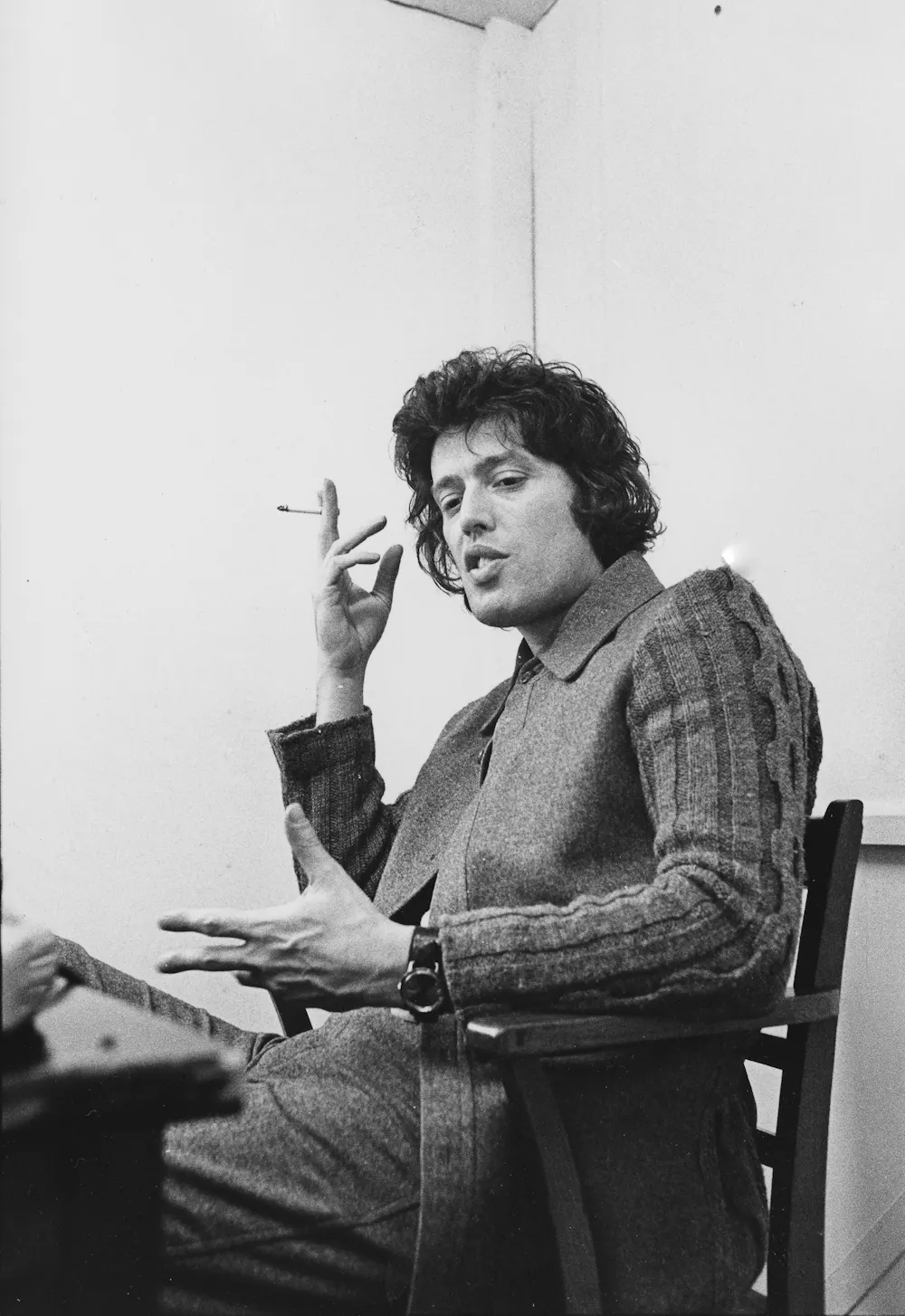
Stoppard  sitting at a table and smoking a cigarette.
Stoppard as a young playwright in 1972. Clive Barda/Radio Times/Getty Images

Stoppard wrote philosophers who tie themselves into cerebral knots failing to prove what they want to believe about God, morals or consciousness in plays such as Jumpers (1972), Rock ‘n’ Roll (2006) and The Hard Problem (2015).

One of Stoppard’s philosophers dictates a lecture in Jumpers, saying “to begin at the beginning: is God? (To SECRETARY). Leave a space”.

Stoppard’s plays sympathise with this forlorn desire to know until it leads characters to ignore other people. Action in the world is more important than the search for knowledge if there is a marriage to be saved, a dying wife to be cared for, or an adopted child to be found. Wittgenstein’s Lecture on Ethics is complex – but Stoppard’s plays show it in effect.

What we know, and how

In his TV play Professional Foul (1977), Stoppard sent philosophers to a conference in Prague. Scholarly debate was contained by totalitarian censorship. The professor of ethics at Cambridge University makes his call for action by riffing on Wittgenstein’s Tractatus: “Whereof we cannot speak, thereof we are by no means silent.”

Stoppard also staged lines from Wittgenstein’s Philosophical Investigations in Dogg’s Hamlet, Cahoot’s Macbeth (1979). Some characters speak English, others use the same words but with different meanings. The audience observes and learns this new nonsense language, laughing at its jokes. They understand the philosophy of language as Wittgenstein did: social conventions between people, not words pinned on things.

What we can know, and how, is crucial to Stoppard’s plays even when the immediate subject matter isn’t philosophy.

It might be quantum physics in Hapgood (1988) or chaos theory in Arcadia (1993); European history in The Coast of Utopia (2002) or contemporary politics in Rock ‘n’ Roll; individual consciousness in The Hard Problem or even whatever we might mean by “love” in The Real Thing (1982). The characters really do want to know. They debate and interrogate but never find definite answers.

As Hannah suggests in Arcadia:

It’s all trivial […] Comparing what we’re looking for misses the point. It’s wanting to know that makes us matter. Otherwise we’re going out the way we came in.

But there are jokes too. Arcadia opens in 1809 with a precocious 13-year-old girl asking her dashing 22-year-old tutor: “Septimus, what is carnal embrace?” before the tutor (originally played by a smoldering Rufus Sewell) pauses, and cautiously replies “Carnal embrace is the practice of throwing one’s arms around a side of beef”.

The audience erupted in laughter. I was one of them.

And as the play draws to a close, a waltz in 1809 happens in the same room as a waltz in the present. As the two dancing couples circle each other, Stoppard’s play suggests that what one person can share with another is more meaningful than justified true belief.

It is a beautiful, theatrical moment. And it is beyond words.The Conversation

Fergus Edwards, Lecturer in English, University of Tasmania

Subscribe to support our independent and original journalism, photography, artwork and film.

Monday, 1 December 2025

Purification and Holiness: How Ancient Greeks, Romans and Early Christians Used Olive Oil

Olive gathering, on an Ancient Greek amphora, circa 520 BC by the Antimenes Painter, in the black figure style
By Tamara Lewit, The University of Melbourne

Today, olive oil is often hailed as helping to protect against disease, but beliefs in its medicinal or even sacred properties date back millennia.

Olive oil was used for healing and purification and associated with important rituals from at least the second millennium BCE, in ways which still influence practices today.

A holy liquid

Mid 2nd millennium BCE texts from the capital of the Hittite empire (in what is now Turkey) describe the anointing of a newborn child and the mother to ward off the dangers of birth.

In ancient Syria the high priestess of the god Baal was initiated with an anointing of “fine oil of the temple”.

Mycenaean Bronze Age tablets from the palace of Pylos in what is now Greece record the making of special scented oil to be offered to the gods.

In the Hebrew scriptures, oil is used to to initiate priests and kings such as David and Solomon, and to sanctify ritual objects.

A preserver of health

Olive oil was used by Greeks and Romans for cleansing and healing.

Oiling while bathing was a vital part of health regimes. No visit to the baths was complete without rubbing your body with oil (in place of soap) and scraping it off with a metal tool called a strigil.

Roman author Pliny the Elder wrote:

There are two liquids that are especially agreeable to the human body: wine inside and oil outside […] but oil is an absolute necessity.

He recommended olive oil as a cure for nettle stings and a base for many medicinal herbs.

Celsus, a Greek medical writer of the second century CE Roman Empire, advised:

If an exhausted person is bordering on a fever, they should immerse themselves […] in warm water to which a little oil has been added and then gently rub the whole body […] with oil.

Another medical writer Soranus says to anoint a newborn with olive oil, as had the Hittites 1,500 years earlier.

A recent study has shown that perfumed oil was used in Greco-Roman offerings to deities, and for the ritual anointing of statues.

Olive oil and Christianity

When Christianity developed in the later Roman Empire, the Greek term Christos was used as a translation of the Hebrew word messiah, meaning “one anointed with sacred oil”. This was the origin of the words Christian and Christ.

Scented and blessed olive oil called a chrism was used for sanctification and purification.

A church council of 381 CE records that:

Those who […] are being saved from the heretics […] are first anointed with holy chrism on the forehead, eyes, nostrils, mouth and ears […] and then we baptise them.

Such perfumed olive oil was (and indeed still is) used to sanctify liturgical objects such as chalices, in rituals such as the ordination of priests, before baptism, and to anoint the sick.

A child is annointed with oil during a Catholic ceremony.
Oil is still used in religious rituals today. Photo by Matt McClain/The Washington Post via Getty Images

Churches were lit by a new type of lamp called a polycandelon, which had multiple glass bowls filled with scented olive oil, as well as lamps made in symbolic shapes such as a dove, crown or boat. These symbolised the light of God and contributed a heavenly fragrance.

The oil from saints’ tombs and sacred places was reputed to bring about healing miracles. Reliquaries containing the remains of saints had special holes for oil to be poured in and then dispensed.

This and the scented oil from lamps at martyrs’ shrines was used to anoint the sick.

A ninth century text describes how at Saint Menas’ tomb in Egypt:

a lamp before the grave […] burned day and night and was filled with fragrant oil. And when anyone took of this lamp oil […] and rubbed a sick person with it the sick person was healed.

Pilgrims who visited holy sites collected such oil in flasks, hoping to take home its healing power.

Ampulla (Flask) of Saint Menas
Pilgrims used flasks like this to carry oil from the pilgrimage site of Saint Menas. Rogers Fund, 1927/The Met

The early Church not only used olive oil, but also produced it.

Sixth century and later monastic and church archives record gifts of olive groves and enslaved workers to ecclesiastical and monastic estates.

This is confirmed by my own recent research into archaeological finds of oil production remains in episcopal complexes, annexes attached to churches, and in monasteries.

Christian symbols appear on the seals of oil transport containers from a fourth century CE shipwreck recently found off the coast of Mallorca.

Their painted inscriptions identify the contents as a special “sweet oil”, perhaps produced at monasteries in southern Spain and marketed for ritual and healing use.

Olive oil today

Ancient uses of olive oil for rituals of initiation, sanctification and healing have a modern legacy.

In 2023, oil for the coronation of Charles III was harvested from groves on the Mount of Olives, processed at local monasteries and blessed by archbishops in Jerusalem.

The anointing ritual continued a tradition derived from early medieval coronations of the first English kings, in turn modelled on that of the ancient King Solomon .

Olive oil is still used in Christian sacraments, the consecration of churches, and anointing of the sick.

Beautiful to taste, touch, see and smell, olive oil has had a special significance in human history. Its uses today have grown from the roots of a long tradition.The Conversation

Tamara Lewit, Honorary Fellow, School of Historical and Philosophical Studies, The University of Melbourne

Subscribe to support our independent and original journalism, photography, artwork and film.