Sunday, 8 March 2026

Are the Costumes for Wuthering Heights Accurate? No. Are they Magnificent? Absolutely Yes

Margot Robbie's Cathy in a black and white gown inspired by a Winterhalter painting. Photograph: Joap Buitendijk. 

By Emily Brayshaw

Even before the film’s release, the costumes for Emerald Fennell’s Wuthering Heights caused controversy. Wuthering Heights was first published in 1847 and the story switches back and forth in time between 1801 and the 1770s. But Cathy’s wedding dress references an entirely different era, inspired by a 1951 Charles James haute couture gown. Cathy also appears to be wrapped in cellophane – a material first invented in 1908 – on her wedding night.

These costumes were designed by Jacqueline Durran, who previously won Oscars and BAFTAs for costume design for Anna Karenina (2012) and Little Women (2019), and a third BAFTA for Vera Drake (2005).

Some costume experts have panned Durran’s costumes as anachronistic and visually incoherent. But Vogue described them as “wild and wonderful”. So who’s right?

Designing for film

Costume design is a collaboration; the designer works closely with the director and other production creatives to make a world and bring a story to life.

Costumes must make narrative sense within the world a director is building and communicate the character’s personality and story in each scene.

Often, costumes can seem so natural to a character and their world that you don’t even notice them, like Kathleen Detoro’s designs on Breaking Bad (2008–13).

Costumes can also be scene-stealers because displays of fashion and dress are part of the plot, like Durran’s costumes for Barbie (2023), or Patricia Field’s costumes for Sex and the City (1998–2004).

In Wuthering Heights, Cathy (Margot Robbie) has 50 different costumes, many featuring vintage Chanel jewellery. Other times, she is in ultra shiny, synthetic, plasticised contemporary fabric – such as a black gown that resembles an oil slick.

Production image: Cathy in a white wedding dress and veil.
Cathy’s wedding dress would be more at home in the 20th century than the 18th. Photo Courtesy Warner Bros. Pictures

Heathcliff (Jacob Elordi) has fewer changes, more in keeping with Georgian dress, with his costuming riffing on the cinematic trope of the bad-boy Byronic hero.

With every character, the costumes have a life of their own.

This is not unusual for cinematic adaptations of classic literature, which have featured glamorous, luxurious costumes to attract audiences since the beginning of film history, like Georges Méliès’s Cinderella (1899) and Cecil B. DeMille’s Male or Female (1919).

Designing Wuthering Heights

Fennell’s world of Wuthering Heights is built on a collection of images and cinematic references that span time and space to show the love story is universal.

Fennell also wanted to “make something really disturbing and sexy and nightmarish” rather than faithfully recreating the book.

To do this, she accumulated a huge number of visual references and collaborated with Durran to see how and where these could fit into the film.

Cathy and Edgar sit on a couch. Cathy wears very contemporary sunglasses.
The film draws on 500 years of art and fashion influences. Photo Courtesy Warner Bros. Pictures

Instead of historically accurate costuming, Durran and Fennell created a world of stylised costumes inspired by 500 years of historical dress, contemporary fashions, images from fairy tales and popular culture, and old Hollywood technicolor films from the 1930s to the 1960s, particularly Gone With the Wind (1939) and The Wizard of Oz (1939).

This is part of a broader costuming trend rejecting complete historical accuracy when re-imagining historical eras on screen, such as the alternative Regency world of Bridgerton (2020–) and Guillermo del Toro’s Frankenstein (2025).

‘A collection of memoranda’

After Cathy dies in the book Heathcliff says, “The entire world is a dreadful collection of memoranda that she did exist, and that I have lost her”.

Motifs of hair, skin, bone and teeth are found throughout the film and speak to the physical, visceral nature of Heathcliff and Cathy’s passion. This echoes historical trends for mourning jewellery that featured hair, bones and teeth of deceased loved ones, and foreshadows the film’s ending.

Cathy’s jewellery is her armour. After she marries Edgar Linton (Shazad Latif), her jewellery signals her newfound wealth and security. The majority of Cathy’s costumes are black, white and red, echoing the interiors of her old and new homes, Wuthering Heights and Thrushcross Grange.

Cathy demands Nelly (Hong Chau) tighten her bridal corset, echoing the scars on Heathcliff’s back from a beating he sustained as a child when defending her. But this tightening also signals she is trapped in a loveless cage.

Production image: Heathcliff on a horse
Heathcliff’s costuming riffs off the cinematic trope of the bad-boy Byronic hero. Photo Courtesy Warner Bros. Pictures

Edgar, the nouveau-riche textile merchant, wears suits with a period silhouette but made in contemporary, shiny fabrics; his spoilt, unhinged sister Isabella (Alison Oliver) wears tacky, frilly beribboned gowns and accessories; Heathcliff transforms from rough brute in farming clothes to rakish, Regency-style dandy with a gold tooth.

Not all of the costuming choices work. Cathy’s dirndl-style gowns are more Oktoberfest than “moorcore”. Unlike Cathy’s other costumes which aren’t historically accurate, but are still based on a bygone time, I found the dirndl gowns too similar to a style of traditional dress still worn in Bavaria, Austria and Switzerland, taking us away from the historical fantasy world of Wuthering Heights.

Let it sweep you away

While some will criticise the bold costuming choices, the beauty and skill of Durran’s work on Wuthering Heights are undeniable.

We should embrace Durran’s costumes and their blend of romantic, historical silhouettes and imagery with glossy, gauzy fabrics and sexy, contemporary, high fashion looks.

Production image: Heathcliff and Cathy in mourning blacks.
The costumes aren’t quite historically accurate – but they’re sumptuous. Photo Courtesy Warner Bros. Pictures

Don’t look for historical accuracy in Fennell’s Wuthering Heights. That will lead to disappointment. Instead, let the sensual, opulent costumes, the brash, bold scenography and the chemistry between Robbie and Elordi sweep you away to a sumptuous, imaginary world.The Conversation

Emily Brayshaw, Honorary Research Fellow, School of Design, University of Technology Sydney

Subscribe to support our independent and original journalism, photography, artwork and film.

Friday, 6 March 2026

How Self-Taught, Self-Made Mavericks Vivienne Westwood and Rei Kawakubo Redefined Punk

Rihanna wearing Commes des Garcons by Rai Kawakubo at The Met Gala in 2017. Photograph: Francois Durand/Getty 

By Sasha Grishin

Vivienne Westwood and Rei Kawakubo are two fashion designers who redefined “the look” of fashion on the street from the 1970s onwards.

They were born a year apart in the early 1940s, one in Derbyshire in England, the other in Tokyo in Japan. They were both largely self-taught, self-made mavericks who contributed to, and redefined, the punk scene in the 60s and 70s. Their use of unconventional materials and designs shocked the fashion establishment and helped to establish alternative realities of accepted dress codes.

The great achievement of many revolutionary National Gallery of Victoria exhibitions is the strategy of juxtaposing two vibrant artistic personalities, whereby a new and unexpected reality is created that allows us to establish a fresh perspective.

A model in a white dress with blue figures on it.
World’s End, London (fashion house), Vivienne Westwood (designer), Malcolm McLaren (designer), outfit from the Savage collection, spring–summer 1982. Pillar Hall, Olympia, October 22 1981. Photo © Robyn Beeche

Westwood and Kawakubo are household names in the fashion industry. But by bringing them together and clustering their works under five thematic categories, new insights appear.

It is a spectacular selection of over 140 key and signature pieces drawn from the growing holdings of the NGV supplemented with strategic loans from the Metropolitan Museum of Art, New York; The Victoria & Albert Museum, London; Palais Galliera, Paris; the Vivienne Westwood archive; and the National Gallery of Australia, among others.

Punk and provocation

Westwood, subsequently Dame Vivienne Isabel Westwood, initially in collaboration with Malcolm McLaren of Sex Pistols fame, helped to mould and dress the London punk scene.

For her, dress was never ideologically neutral but a lightning rod for social change.

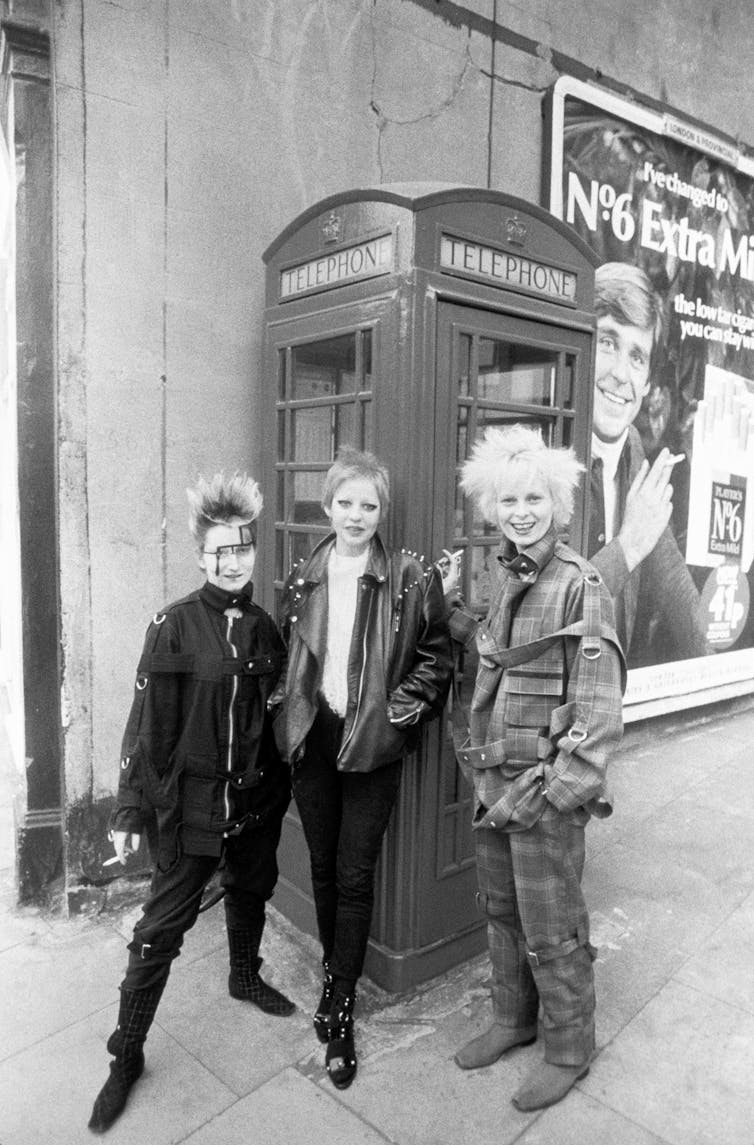
Black and white photo of three women in front of a London telephone booth.
Vivienne Westwood (right) with the model Jordan (Pamela Rooke) and another punk, London, 12 April 1977. Photo © Tim Jenkins / WWD / Penske Media via Getty Images

Pornographic slogans, emblems anchored in fetish practices and sadomasochism, and dresses made of plastics and supplemented with safety pins and chains subverted the comfortable status quo and allowed her fashion sense to penetrate into the middle classes.

What was once outrageous became something daringly respectable.

Kawakubo was born into an academic family and came to fashion design when making her own clothing in the 1960s under the label Comme des Garçons (“like the boys”) in Tokyo.

Conceived as anti-fashion, sober and severe, she made largely monochrome garments – black, dark grey and white – for women, with frayed, unfinished edges, holes and asymmetric shapes.

A men’s line was added in 1978. The number of outlets in Japan grew into the hundreds. Later, her designs established a strong presence in Paris.

The themes that bring the two fashion designers together in this exhibition include the opening section, Punk and Provocation. Both designers drew on the ethos of punk with its desire for change and the rejection of old ways.

Breaking orthodoxies

A second section is termed Rupture for the conscious desire to break with convention, whether it be Westwood’s Nostalgia of Mud collection of 1983 or Kawakubo’s Not Making Clothes collection of 2014.

There is a strongly expressed desire to break with the prevailing orthodoxies.

A model in a brown dress.
World’s End, London (fashion house), Vivienne Westwood (designer), Malcolm McLaren (designer) Outfit from the Nostalgia of Mud collection, autumn–winter 1982–83. Pillar Hall, Olympia, London, 24 March 1982. Photo © Robyn Beeche

A third section, Reinvention, hints at a postmodernist predilection of both artists to delve into traditions of art history and from unexpected sources, such as Rococo paintings, revive elements from tailoring traditions, ruffles and frills.

Although both artists are rule breakers, they do not act from a position of ignorance. It is from a detailed, and at times pedantic, knowledge of garments from the past.

A model in a red hat and a structural grey coat.
Comme des Garçons, Tokyo (fashion house), Rei Kawakubo (designer) Look 2, from the Smaller is Stronger collection, autumn–winter 2025. Paris, 8 March 2025. Image © Comme des Garçons. Model: Mirre Sonders

In the late 1980s, Westwood revived English tweeds and Scottish tartans. Kawakubo drew on the basics of traditional tailoring in menswear and applied it to unorthodox patterns and materials in her garments for women.

The ‘ideal’ body

A fourth section, The Body: Freedom and Restraints, perhaps most problematically challenges the conventions of idealised female beauty and the objectification of the female body.

It is argued in the exhibition that Westwood’s Erotic Zones collection (1995), and Kawakubo’s The Future of Silhouette (2017–18), may be viewed as attempts to redefine the female body.

Parker in a wedding dress.
Sarah Jessica Parker wearing a Vivienne Westwood wedding gown on the set of Sex and the City: The Movie, New York City, October 12 2007. Photo © James Devaney / WireImage via Getty Images

Kawakubo’s Body meets dress-Dress meets body collection, presented in 1996, systematically interrogates boundaries between bodies and garments. Westwood, at a similar time, played with padding and compression in her designs to question the ideals of a sexual, “ideal” body.

The final section of the exhibition is appropriately termed The Power of Clothes. This returns us to the recurring theme of employing fashion to make a statement concerning social change, whether this be the punk revolution or protests connected with climate change.

Mannequins in various outfits.
Installation view of Westwood | Kawakubo on display from 7 December 2025 to 19 April 2026, at NGV International, Melbourne. Vivienne Westwood Look 19, Jacket, shirt, knickers, bum pad, leggings, hat, crop, boots, 1994 and Look 34 Cape, shirt, corset, and boots and hat 1994 and Look 78, Dress, bum pad and shoes, 1994 from the On Liberty collection, 1994-1995. Courtesy of Vivienne Westwood Heritage. Photo: Sean Fennessy

Through their work, both Westwood and Kawakubo argue fashion is a political act and make broader social statements through their garments, particularly women’s wear.

Both fashion designers were prominent polemicists. As quoted in the exhibition, Westwood in 2011 declared,

I can use fashion as a medium to express my ideas to fight for a better world.

Kawakubo is quoted as saying in 2016,

Society needs something new, something with the power to provide stimulus and the drive to move us forward […] Maybe fashion alone is not enough to change our world, but I consider it my mission to keep pushing and to continue to propose new ideas.

This exhibition will be seen as historically significant and it is accompanied with a weighty catalogue. The NGV has established major collections of over 400 pieces of Westwood’s and Kawakubo’s work that lays the foundation for any further serious exploration of fashion from this period anywhere in the world.

Westwood | Kawakubo is at the National Gallery of Victoria until April 19.The Conversation

Sasha Grishin, Adjunct Professor of Art History, Australian National University

Subscribe to support our independent and original journalism, photography, artwork and film.

Thursday, 5 March 2026

Paris Fashion Week: Monochrome as Manifesto, Démoo Debuts New AW26/27 Menswear Collection

Backstage at Démoo in Paris, soulful expressions enhanced the poetic, monochromatic mood of the new collection. Photograph (above) and cover picture by Andrea Heinsohn for DAM 


At Paris Fashion Week, Démoo’s Autumn-Winter 2026/2027 presentation marked a new chapter for the Seoul design house, as Choon Moo Park advanced her pared-back aesthetic into a dialogue between womenswear and menswear. The collection distilled the brand’s four-decade commitment to architectural tailoring, tonal discipline and the expressive power of black. Story by Jeanne-Marie Cilento. Photography by Andrea Heinsohn

In Paris, cellist Lisa Strauss created 
atmospheric music for the runway show.
ON a grey Paris Tuesday morning in the Marais, Parisian press, international editors and buyers threaded their way down Rue de Turenne toward Galerie Ellia, where Démoo presented its Autumn/Winter 2026 collection. 

Outside, the walls of the gallery are surrounded by vivid street art, yet inside the space is raw, white, almost ascetic. It proved an apt background for the new show titled Connected. Under the direction of founder Park Choon-moo and now stewarded alongside her son Yoon-Mo Choi, the show unfolded.

A live performance by cellist Lisa Strauss accompanied the show, her resonant phrasing underscoring the collection’s meditative cadence. As guests filtered into the gallery, there was a sense of anticipation about the new collection and the addition of menswear to the label.

And the major shift this season for the label was the formal introduction of a masculine line. Rather than carving out a parallel masculine universe, Park staged an interdependence. Men’s coats echoed the long, architectural lines of the women’s tailoring; women’s trousers borrowed the severity and ease of men’s suiting. The runway suggested a continuum, siblings rather than opposites.

Park, who founded Démoo on Seoul in 1988, has long occupied a singular position within Korean fashion. Decades before Seoul’s designers became fixtures on European schedules, she was refining a vocabulary of disciplined silhouettes and tonal restraint. Her reputation as a pioneer of Korean avant-garde design precedes her Paris return.

Rather than carve out a parallel masculine universe for her new menswear line, Park Choon-moo created an interdependence with women’s tailoring 

Black was back in Milan & Paris
 this season, but has long been a
staple in Démoo's collections. 
The designer's signature black, formed the gravitational centre of the collection and captured this season's monochrome zeitgeist in Milan and Paris. But it was not monolithic. Matte wool absorbed the light; lacquered leather reflected it; sheer knits revealed the negative space beneath. 

Charcoal and off-white appeared sparingly, like breaths between sentences. The interplay of opacity and translucency created a subtle choreography as models crossed paths, reinforcing the theme without theatrics.

Cut was paramount. Jackets curved away before tapering down with architectural precision. Sleeves were elongated, sometimes pooling at the wrist, sometimes sliced open to reveal a flicker of lining. 

Trousers fell in clean vertical planes, interrupted only by a deliberate seam or a suspended panel. Even denim, introduced in several looks, was treated with restraint, washed to a depth that maintained the collection’s tonal integrity.

In an era calibrated for viral moments, Park continues to design in a way that is both thoughtful, poetic and avant-garde. Paris, famously unforgiving, has little patience for tentative statements. Démoo instead offered a composed, assured collection, showing how reduction can be radical, that black can be expansive, and that 'connection' as a concept works.

Scroll down to see highlights from Démoo's AW26/27 show in Paris and exclusive pictures backstage 


Backstage at the Démoo AW26/27 show during Paris Fashion Week 


Subscribe to support our independent and original journalism, photography, artwork and film.