Thursday, 6 November 2025

Condé Nast Magazines Ban Fur After Decades of Protest. Is it a Turning Point or Another Fashion Fad?

Is Conde Nast's decision not to use fur in its magazines' editorial campaigns a tipping point or a fashion fad? 

By Rachel Lamarche-Beauchesne

For decades, animal rights activists, campaigners and ethical designers have.: fought to strip fur fashion of its glamour and expose the cruelty behind it.

From bold celebrity-led protests to quiet shifts in consumer values, these efforts have slowly reshaped the fashion landscape.

Now, one of the industry’s most influential gatekeepers, Condé Nast – publisher of Vogue, Vanity Fair and Glamour – has announced it will no longer feature “new animal fur in editorial content or advertising” across its titles.

The decision, which includes exceptions for what are outlined as “byproducts of subsistence and Indigenous practices”, marks a symbolic turning point within the fashion media landscape due to Condé Nast’s global reach.

It is especially significant given Vogue’s legacy in glamorising fur and its historically unwavering support under former editor-in-chief Anna Wintour, one of fur’s most powerful advocates in fashion media and a long-time target of the anti-fur movement.

Wintour remains involved at Condé Nast in the role of chief content officer, and as Vogue’s global editorial director.

Anti-fur campaigns

The announcement by Condé Nast follows a nine-month campaign led by the Coalition to Abolish the Fur Trade. This activist group staged more than a hundred protests targeting Condé Nast executives, editors and affiliated businesses.

Demonstrations ranged from picketing outside the homes of Vogue editors to disruptive actions inside stores linked to Condé Nast through board affiliations.

Individuals demonstrate against Vogue's use of fur.
Demonstrators protesting against Vogue’s use of fur earlier this year. Coalition to Abolish the Fur Trade/Alastair Mckimm

While this campaign undoubtedly influenced the publisher’s decision, it was likely the culmination of anti-fur advocacy dating back to the early 20th century.

The long tail of the movement

Animal rights activism in fashion can be traced back to the late 19th century, when the feather trade decimated bird populations and led to the extinction of species prized for their plumage.

Anti-fur activism followed. It gained momentum in the 1970s, and with the founding of the People for the Ethical Treatment of Animals (PETA) in 1980.

Through high-profile campaigns exposing the cruelty of fur farms, PETA enlisted celebrities and models to pose nude in its iconic “I’d rather go naked than wear fur” ads.

These efforts led to tangible change. Calvin Klein dropped fur in 1994, citing animal advocacy. Since then, fur-free policies have become a relatively easy win for brands navigating the increasingly complex ethics of animal materials.

TV personality Khloe Kardashian unveils her PETA ‘Fur? I’d Rather Go Naked’ billboard on December 10 2008, in Los Angeles. Charley Gallay/Getty Images

A new standard for luxury fashion

Several US states have banned fur sales, and fur farming is now outlawed in countries including the United Kingdom, Netherlands, Austria, Italy and Norway.

Condé Nast’s new position places it alongside other media and fashion leaders. Elle magazine went fur-free in 2021. Major luxury brands such as Max Mara, Burberry, Chanel, Prada, Valentino and Versace have adopted similar policies, as have retailers including David Jones (Australia), Macy’s (US), Nordstrom (US), Saks Fifth Avenue (US) and Hudson’s Bay (Canada).

In 2022, French luxury conglomerate Kering also committed to a fur-free policy across its brand portfolio.

The largest remaining holdout is LVMH (Moët Hennessy Louis Vuitton SE) – the parent company of Dior and Fendi – which faces mounting pressure to follow suit.

The fur paradox

Despite these shifts, fur remains a fascination within fashion, and periodic revivals are still celebrated in the press.

TikTok’s 2024 “mob wives” aesthetic, featuring oversized fur coats and animal prints, sparked a return of fur on winter runways. Singer Sabrina Carpenter even wore a special edition Louis Vuitton fox fur coat on the day of the Met Gala.

This paradox reflects fashion’s cyclical and often contradictory nature. Faux fur and faux shearling are increasingly used to replicate the luxury aesthetic without the ethical baggage. Yet debates about the environmental impact of synthetic fur complicate this narrative.

What’s next?

Condé Nast’s fur-free stance comes at a time when many fashion brands are rethinking or rolling back their sustainability commitments.

Some industry observers worry climate goals are being deprioritised. Ralph Lauren, for instance, has dropped its net-zero emissions target. Also, the Vestiaire Collective, a platform for pre-loved luxury item resale, has started monetising its activities by selling carbon credits, demonstrating the difficulty of navigating current market conditions.

Still, there are signs of progress. Stella McCartney’s Summer 2025 Paris Fashion Week show featured feather alternatives made of plant-based materials.

This year also marked the first Australian Fashion Week in which fur, feathers and exotic leathers were banned from catwalks.

Animal rights advocates, such as Collective Fashion Justice founder Emma Hakansson, continue to push for the industry to reduce its use of leather, wool and other animal-derived material.

This space is dynamic and evolving. Whether Condé Nast’s decision is a tipping point, or another fashion fad, remains to be seen.The Conversation

Rachel Lamarche-Beauchesne, Senior Lecturer in Fashion Enterprise, Torrens University Australia

Subscribe to support our independent and original journalism, photography, artwork and film.

Sunday, 2 November 2025

Five Unusual Ways to Make Buildings Greener (Literally)

Belgian architect Luc Schuiten's vision of the 'Vegetal City'. Luc Schuiten. 
By Paul Dobraszczyk

Buildings adorned with plants are an increasingly familiar sight in cities worldwide. These “green walls” are generally created using metal frames that support plastic plates, onto which pre-grown plants are inserted. These plants are able to survive without soil because they’re sustained by nutrient-packed rolls of felt and artificial sprinklers.

Some are fabulously rich tapestries of luxuriant vegetation, like French botanist Patrick Blanc’s coating of part of the Athenaeum hotel in London. Here, small shrubs sprout from an almost tropical green wall, with an abundance of mosses and ferns. In summer, butterflies peruse the flowers. All this next to Piccadilly, one of the busiest streets in central London.

Others are objects of ridicule: the sadly common outcome of poor design and a lack of maintenance (all green walls need careful planning and a great deal of care). If they’re not carefully tended, green walls will quickly turn into brown ones, with the plastic supports all too visible beneath the dying plants.

But there are many others ways of integrating plants into buildings beyond simply trying to grow them on walls. Here are five examples that straddle the mundane and the marvellous.

A wall with a metal grid and dying plants.
A wilted green wall in Tokyo, Japan. Wikimedia Images, CC BY

Growing buildings

German architectural practice Baubotanik (a word that means “botanic building”) has taken the radical step of creating buildings that flout the conventional idea of architecture as static and inert. After all, plants grow – they are living organisms.

Baubotanik uses pre-grown trees to create multi-storey structures, with trees replacing the conventional steel girders of most tall buildings. Its Plane-Tree-Cube in Nagold, begun in 2012, is made of plane trees supported on a steel scaffold, with a built-in irrigation system to water the trees until they’re large enough for the steel to be removed.

A square-framed building composed of a metal lattice and growing plants.
Baubotanik’s Plan-Tree-Cube is intended to grow into a usable structure. Baubotanik

It’ll probably be another ten years before this structure is ready to be used, but as what? It’s hard to imagine making a home in such an unruly structure, let alone plugging in your internet or other electrical appliances.

Building in trees

Baubotanik takes grafting, an age-old horticultural technique, and uses it to create structural frames for buildings. Grafting joins the tissue of plants so that they can grow together (it’s most commonly used in the cultivation of fruit trees).

As the architects themselves acknowledge, there are many interesting historical precedents, such as the Lindenbaum concentrated in a small region of rural Germany in northwestern Bavaria.

These are accessible platforms built into large lime (linden) trees to accommodate dancers in a yearly ritual known as the Tanzlinden (“dance linden”), which originated in the middle of the 17th century and still happen in early September.

In the surviving Lindenbaum in the small village of Peesten (one of around 12 that are still around), a stone stairwell spirals up to the wooden platform built inside the tree: dancing happens on this platform, while musicians provide accompaniment beneath.

A curved stone staircase leading into a structure obscured by a tree growing around it.
Lindenbaum in Peesten, Germany. Wikimedia Images, CC BY

Weaving buildings

It’s possible to take this practice of integrating buildings and trees one step further and imagine whole cities redesigned in this way. This has been the lifelong preoccupation of Belgian architect Luc Schuiten, particularly in his speculative drawings of “vegetal cities”.

These are urban environments in which the branches of trees and the stems of climbing plants have become completely enmeshed with buildings made of steel and glass. One of his designs, called Habitarbres, imagines a house constructed within a living tree. The structure would flex as the tree grows, while hot-air pipes and other infrastructure would be embedded in the trunk. It’s an attempt to envisage how the infrastructure of our buildings – pipes, wire, cables and the like – can be accommodated in a living structure with its own vascular network.

An artist's sketch of a house built around the main body of a tree.
With Habitarbes, Schuiten proposes a house built within a living tree. Luc Schuiten

It’s a speculative proposal, but perhaps not so different from a common building type normally associated with enterprising children, namely treehouses. Schuiten is merely taking a human desire – to live in a tree – and suggesting how it might be squared with our equally strong desire for comfort.

Architecture as compost

When plants die and decay they create the conditions for the next cycle of vegetal growth; they are sustainable in a way that the vast majority of our buildings are not. While there is a drive to recycle existing building materials (metals and plastics mostly), it’s another thing entirely to make buildings truly regenerative.

Martin Miller and Caroline O’Donnell’s “Primitive Hut” project from 2017 created a building that does just this. They made a wooden lattice structure to support the growth of four red maple saplings. Another lattice decomposed over time, providing food for the growing trees. Eventually the whole structure was overwhelmed by the trees.

A shed-like building composed of a lattice and trees.
Martin Miller and Caroline O’ Donnell’s ‘Primitive Hut’. OMG!

In calling this a primitive hut, the architects questioned how western architectural thinking tends to see indigenous architecture as both an origin point and a model for more sustainable forms of construction. It asks whether the industrial technologies that dominate construction in the global north should be more informed by architects that have continued to build with natural and compostable materials for centuries.

Letting be

It’s worth remembering that we don’t have to design green buildings; given enough time, they will happen anyway.

Roof slates sandwiched together with moss.
Moss on the roof of the Sandringham estate’s visitors’ centre in Norfolk, eastern England. Wikimedia Images, CC BY

The sloping roof of my house, directly below the window where I’m writing this article, is gradually acquiring its own green patina of lichen and moss. The roof is old and I’ve been told it needs to be replaced soon. A cloud of spores and seeds peppers this and every single roof every day with the prospect of new life.

Without any human intervention whatsoever, this process of vegetal succession can produce a complex ecosystem of not only plant but also animal life (from microbes to insects). That architects so rarely call such a surface “green” betrays something that’s deep-seated in ideas about green design. For it is precisely the absence of human control that allows vegetation to colonise a building; there is, in effect no design involved at all – unless, of course, we accept that plants have designs of their own.

Paul Dobraszczyk, Lecturer in Architecture, UCL

Subscribe to support our independent and original journalism, photography, artwork and film.

Saturday, 1 November 2025

Sotheby’s Paris Breaks French Record with €89.7 Million Sales; Modigliani Work Tops at €27 Million

Amedeo Modigliani's Elvire en buste (1918-19) sold for a record-breaking 27 million euros in Paris. 

Paris has once again asserted its growing dominance in the global art market. During Art Basel week, Sotheby’s Paris shattered its own record with a combined total of €89.7 million across its Modernités and Surrealism and Its Legacy auctions, the highest result ever achieved by the auction house in France. The sales underscored both the vitality of the Paris scene and collectors’ resurgent appetite for 20th-century masterpieces, writes Jeanne-Marie Cilento

The Sotheby's auction in Paris
where the Modigliani painting
went under the hammer.
AN HISTORIC moment at Sotheby's in Paris ignited a fierce bidding war among seven collectors for Amedeo Modigliani’s Elvire en buste (1918–19), before selling for €27 million, the highest price ever paid for the artist in France and a new record for the auction house in the French capital. 

The work, unseen in public for half a century, had remained in a private collection since 1974. Its appearance on the market marked the first time any portrait of Elvira by Modigliani had been offered at auction.

The result more than quadrupled its initial estimate, anchoring a night that confirmed the Italian painter’s continued magnetism among global collectors. Another of Modigliani’s works, Raymond, believed to depict the writer Raymond Radiguet, fetched €10.6 million after spirited bidding, further underlining the artist’s enduring appeal.

Together, the two paintings accounted for over a third of the Modernités total, which reached €62.8 million, surpassing pre-sale expectations by more than €10 million. Strong results also came from Alberto Giacometti’s Figurine, which more than doubled its estimate at €571,500, and Wols’ L’Oeil de Dieu, which achieved a record €1.9 million. A complete set of Pablo Picasso’s Séries 347 etchings, one of the rarest print series in his oeuvre, sold for the same amount, setting a French record for any Picasso print series.

René Magritte’s La magie noire doubled its estimate to reach €10.7 million, a record for any work from the Belgian artist’s celebrated series

Rene Magritte's La Magie noire 
doubled its estimate at auction, 
The Surrealism and Its Legacy sale followed with equally impressive results, bringing in €26.9 million, the second-highest total ever for a Surrealist auction in France. 

René Magritte’s La magie noire (at right) led the session, doubling its estimate to reach €10.7 million, a record for any work from the Belgian artist’s celebrated series. Paul Delvaux’s Woman with a Rose also set a new French benchmark at €2.4 million, while Óscar Domínguez, Konrad Klapheck, and Wols each achieved personal bests in the country.

Adding to the momentum, Salvador Dalí’s Swirling Sea Necklace exceeded expectations at €736,600, and Francis Picabia’s Lu-Li more than doubled its estimate at €508,000. In all, nearly 90% of lots sold, with over 60% making their auction debut, and a notable one-third of Surrealist buyers hailing from the United States, a sign of Paris’s growing international draw.

Presented in collaboration with the French fashion house Celine, the twin auctions demonstrated how Paris, long regarded as the cultural heart of Europe, is reclaiming its stature as a powerhouse in the global art economy. The record-setting performance follows a string of strong sales in London and New York, but the magnitude of this result, more than 50% higher than last year’s edition, signals a broader shift.

For Sotheby’s, the outcome cements its Paris headquarters as a concourse for the international market. For collectors, it reaffirms that the French capital, once again, is where art history and market confidence converge, and where the legacy of modern and Surrealist masters continues to inspire feverish competition under the auctioneer’s gavel.

Subscribe to support our independent and original journalism, photography, artwork and film.

Thursday, 9 October 2025

‘AI actor’ Tilly Norwood is Dividing Hollywood But Real Acting Requires Humanity

Tilly is an 'AI actor' created by Particle6 Studios a UK-based AI-focused film production company. 


By Nicholas Scrivens

Tilly Norwood is the hottest actor in Hollywood right now.

Her career has been covered by Variety, the BBC and Forbes, to name just a few publications. All of this is publicity that a young actor at the start of their career can only dream of. But Tilly doesn’t dream. Nor is she actually acting in the strictest sense of the word, because Tilly is an AI actor, created by Particle6 Studios, a UK-based AI-focused film production company.

There have, of course, been AI actors before. Carrie Fisher was famously resurrected for The Rise of Skywalker in 2019. James Cameron used background “actors” to populate Titanic in 1997, but until now no AI creation has achieved the media cut-through that Tilly has. This is partly due to her creator – Eline Van Der Velden – and her team. They have launched Tilly into the marketplace as a persona: something designed to act and emote.

As Van Der Velden told entertainment news site Screen Daily: “[Tilly is] an act of imagination and craftsmanship, not unlike drawing a character, writing a role or shaping a performance.” There is technological craft in her creation, certainly. But there is also a grey area, where that creation draws on the work, voices, physiognomy and artistry of others – blended into code, shaped for modern media and packaged in a soft-focus comedy video just meta enough to deflect criticism.

Tilly Norwood appears in an AI sitcom sketch.

My work with actors has always been deeply rewarding. At the Guilford School of Acting, where I teach, the approach is grounded in the belief that acting is born from a combination of craft, empathy, collaboration and above all a genuine exploration of what it means to be human. The story of “Tilly’s” creation has stirred a powerful response among the students I have been working with: a mix of horror, fear and, perhaps most chillingly of all, resignation. Resignation that this may indeed be the direction in which the creative industries are heading.

The outcry from established actors was immediate and heartfelt. On hearing that agents were already contacting the production company in hopes of representing it, A-lister Emily Blunt told interviewers: “Good lord, we’re screwed. That is really, really scary. Come on, agencies, don’t do that. Please stop. Please stop taking away our human connection.”

The human connection is the point. The Russian theatre practitioner, Konstantin Stanislavski, whose work consistently urged actors to seek inner truth and humanity, summed it up well. Writing in his book An Actor Prepares (1936), he explained: “To break that rule of using your own feelings is the equivalent of killing the person you are portraying, because you deprive him of a palpitating, living, human soul, which is the real source of life for a part.”

In a recent podcast interview with Jay Shetty, actor Emma Watson reflected on how the “movie star” version of herself had become something of an avatar in her mind. She spoke candidly about her journey from the Harry Potter films, the hypersexualisation she endured in the media and the scrutiny now placed on her every word and stance.

For producers, directors, and studios, a compliant, commodified figure like Norwood is an attractive prospect: an actor who doesn’t need an intimacy coordinator, won’t go off-message on social media or perhaps more disturbingly, might. As impressive as the technological achievement is, the choice of an elfin-thin, 20-something female “actor” is also highly questionable.

In a world where power dynamics and abuses are finally being called out through the #MeToo movement, it’s perhaps no surprise that the coded, painted and constructed Tilly Norwood has arrived. The “actor” is programmable and usable. It looks human but is, at its core, deficient. And will always remain so. Because what makes an actor is that ineffable thing: humanity.

Nicholas Scrivens, Programme Leader - MA Musical Theatre, University of Surrey

Subscribe to support our independent and original journalism, photography, artwork and film.

Wednesday, 8 October 2025

Taylor Swift has Branded Herself a Showgirl: These Hardworking Women have a Long and Bejewelled History

Taylor Swift as the showgirl on her new album. Photograph: TAS Rights Management. 

By Emily Brayshaw

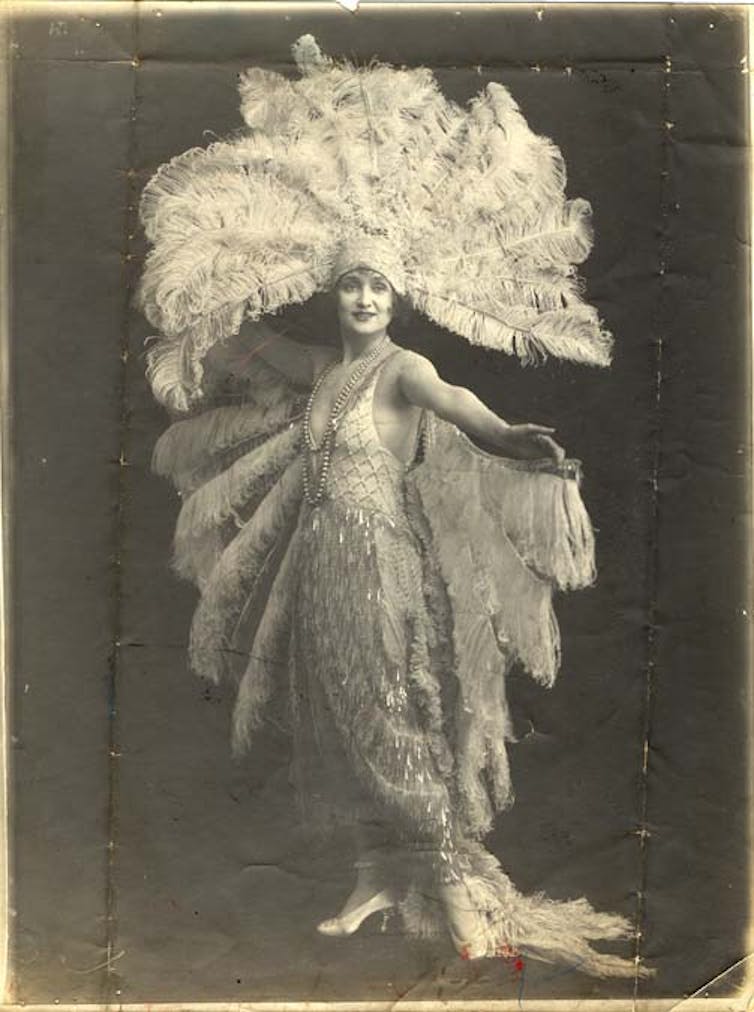
The iconic feathered showgirl was born amid the chaos of the first world war, when the wealthy, global French superstar Gaby Deslys entertained Parisians and Allied soldiers in a 1917 show called Laissez-les tombe! (Let Them Fall), a dazzling spectacle of ostrich feathers, rhinestones and beauty.

Although showgirls first appeared in late-19th century music halls, the red, white and blue feathered costumes in Deslys’ revue offered Paris something new and triumphal. The massed plumes, wild dancing and bodily displays celebrated French aesthetics and extravagance and communicated that France and her allies would not bow to Germany.

Gaby Deslys, resplendent in ostrich plumes and jewels, photographed in 1919 by Henri Manuel. Wikimedia 

Prior to 1914 Deslys’s expensive jewellery, haute couture and expansive feathered hats – along with her affairs with powerful men such as department store magnate Harry Selfridge and King Manuel II of Portugal – created countless headlines.

But she was also outspoken about a woman’s right to support herself financially and worked tirelessly during the war raising funds for the Allies. Deslys was so passionate about aiding the devastated Parisian nightlife that she paid for all the costumes in Laissez-les tombe! herself.

Deslys’s cultural impact has inextricably linked feathers, high fashion, celebrity and showgirls ever since.

From France to Broadway

Feathered showgirl revues were so popular that they quickly went global. In 1920s New York, impresarios such as Florenz Ziegfeld staged luxurious Broadway productions that glorified the American showgirl.

But he made exceptions to American women. One of Ziegfeld’s most famous showgirls, Dolores, was born into poverty in London’s East End as Kathleen Mary Rose. She rose to become a supermodel who walked for the couturier Lady Duff-Gordon, known professionally as Lucile.

Ziegfeld considered Dolores one of the world’s most beautiful women. Tall, slender and graceful, she drove audiences wild when she glided across Ziegfeld’s stage and posed in opulent costumes.

The famous haute couture model and showgirl known as ‘Dolores’ posing as the White Peacock in Ziegfeld’s Midnight Frolics (1919). Wikimedia Commons

On becoming a showgirl, Dolores used her modelling ability to make her fortune, earning today’s equivalent of US$10,000 a week by 1923.

Other performers harnessed the feathered showgirl aesthetic, including the celebrated twins Jenny and Rosie Dolly, who came from humble origins and used their beauty, talent and hard work to dominate American and European stages in the 1910s and 1920s.

Ziegfeld paid the Dollys the equivalent of US$64,000 weekly in 1915. Like Deslys, they became notorious for their consumption of fashion and affairs with famous men.

Two women wearing sequinned, feathered headdresses.
The Dolly Sisters, famous performers in the Ziegfeld Follies of the 1910s and 1920s. The Metropolitan Museum of Art

However, stage revues became unpopular around 1930 due to their vast expense and the rise of cinema – so the showgirl travelled to Hollywood.

There, she was celebrated in biopics such as The Great Ziegfeld (1936) with its glittering, feathered costumes by the designer Adrian.

In the second world war, showgirls boosted troop morale, like Deslys did in 1917.

Hollywood made feel-good films including the biopic The Dolly Sisters (1945), which reimagined the brunette twins as all-American blondes by casting 1940s pinup stars Betty Grable and June Haver.

From Hollywood to Vegas

From there, the American showgirl arrived in Las Vegas, performing in every hotel and casino on the strip during the 1950s and 1960s.

Like the showgirls of yore, these performers’ allure was their grace, beauty, and extravagant, expensive costumes, produced by the world’s leading designers.

Showgirls remained a fixture of Las Vegas entertainment throughout the 1970s and 1980s. Choreographers including Donn Arden and Madame Bluebell (who also worked in the Parisian revues) created hallmark, visual spectacles featuring costumes by Bob Mackie.

Jubilee!, which opened at the old MGM Grand casino in 1981, was one such revue. In addition to the vast volume of plumes, it was claimed the show had caused a global shortage of Swarovski crystals because the costumes had used them all.

In 1986 the old MGM Grand became Bally’s Casino, but Jubilee! stayed. The costumes, some of which cost more than US$7,000 each (roughly US$25,000 today), were used six nights a year for 35 years and maintained by 18 wardrobe staffers.

Jubilee! closed in 2016, but its costumes live on as valuable cultural artefacts that celebrities borrow to reinterpret the American showgirl for 21st-century audiences.

This includes demonstrating that showgirls are independent, hardworking and talented women.

From Vegas to Taylor Swift

Burlesque performer Dita Von Teese draws on the American showgirls’ legacy by wearing costumes from Jubilee! in her Las Vegas cabaret, and called the 1945 Dolly Sisters film one of her inspirations.

Pamela Anderson wore Jubilee! costumes in The Last Showgirl (2024), a film that highlights the sacrifices female performers often have to make to pursue their dreams.

Taylor Swift is the latest superstar to harness showgirl iconography. Photographs from her new album show Swift wearing the Jubilee! “Diamond” and “Disco” costumes by Mackie.

Another photograph shows Swift in a cloud of ostrich plumes and rhinestones wearing a dark, bobbed wig: a direct reference to 1920s American showgirls and performers such as the Dolly Sisters.

Swift’s stage costumes are by the world’s leading fashion designers, while her songs often reference historical celebrities to critique how the entertainment and media industry treat female performers.

Choosing Mackie’s Jubilee! costumes allows Swift to become the American showgirl (Taylor’s Version), by tapping into a century of glamour and signalling that she too has worked hard and made sacrifices to reach the top.The Conversation

Emily Brayshaw, Honorary Research Fellow, School of Design, University of Technology Sydney

Subscribe to support our independent and original journalism, photography, artwork and film.

Sunday, 5 October 2025

Paris Fashion Week: Form Follows Function, and Feeling ~ Inside Niccolò Pasqualetti’s Modular Modernism

Backstage in Paris before the Niccolo Pasqualetti SS26 show in Paris. Photograph (above) and cover picture by Jay Zoo for DAM. 

Niccolò Pasqualetti’s Spring/Summer 2026 collection in Paris consolidated his reputation as one of the most intelligent new voices in contemporary design. Merging fine tailoring with an experimental approach to form, the Tuscan-born designer explored modularity, material innovation, and sustainability with quiet authority. Story by Jeanne-Marie Cilento. Photographs by Jay Zoo

Shoulder pads became sculptural
accessories in the new collection. 
AT Paris Fashion Week, Niccolò Pasqualetti presented a new collection that combined conceptual rigor with functional adaptability. 

Shown in the stripped-down concrete halls of the Palais de Tokyo, the collection examined how precision tailoring and modular construction can serve as tools for contemporary living rather than symbols of status or gender. It was a collection that spoke less about identity and more about adaptability, the ability of clothing to move, shift, and respond to the person who wears it.

Pasqualetti has developed a design language that sits between sculpture and pragmatism. This season, structured forms softened into rounded edges, while convertible silhouettes blurred distinctions between categories. 

The Italian designer presented work built on transformation, garments that reconfigure, adapt, and endure. The focus on structure, craft, and clarity felt strikingly modern, proving that evolution in fashion can be as much about construction as concept.

"The collection is a mix of my different inspirations, as I always like to work with lots of contrasting aspects in the process," Niccolo Pasqualetti explained backstage to DAM before the Paris show. "Also, I worked with simple geometric shapes to create new constructions and asymmetries. These ideas were mixed together with the Italian wardrobe that is always there: you will find trenchcoats, suits, jackets and white shirts, but everything is twisted a bit, like there is an element of wrongness."

"The collection is a mix of different inspirations; I always like to work with contrasting aspects and I used simple geometric shapes to create new constructions and asymmetries"

A leather bomber jacket
has removable sleeves. 
A leather bomber with removable sleeves, tunics made from geometric cotton panels, and shoulder pads that could be detached or repositioned illustrated the designer’s ongoing pursuit of flexibility in construction. The use of recycled lyocell furthered this sense of intelligent functionality, aligning craft with sustainability rather than treating it as an external concern. 

"My sculpted shapes are inspired from Richard Serra’s works which are very big but kind of bent," Pasqualetti comments. "My work has sculptural elements like the shoulder pads that are normally internal elements of garments, but I use them as external details, like accessories. Some have sequins or are elastic and others become objects on their own."

A neutral palette of whites, creams, and blacks reinforced the clarity of the forms. Sequined sarong-style skirts layered over asymmetric swimsuits introduced texture without excess. Oversized safety pins, a recurring motif, acted as both fastening and ornament, suggesting that the smallest detail could redefine structure. These gestures reflected a designer intent on reducing fashion to its most elemental components and then rebuilding it on his own terms.

"My sculpted shapes are inspired from Richard Serra’s work with sculptures that are very big but kind of bent"

The sequined shoulder and geometric 
shapes are highlights of Pasqualetti's 
designs this season in Paris. 
"There are some garments that look like objects, like squares or big triangles and there is this idea of combining lots of textiles with beading and leather," the designer describes. "There are a lot of details that are not apparent at first glance but are in all of the garments."

Pasqualetti’s approach stands out precisely because it resists grand gestures. His work is not theatrical but investigative, exploring how garments behave when simplified, deconstructed, and reassembled. In an era when modularity is often treated as a novelty, Pasqualetti’s insistence on adaptability feels genuinely relevant. His clothes are designed to evolve, not through seasonal reinvention but through structural intelligence.

Born near Florence in 1994, Pasqualetti trained at IUAV in Venice and later at Central Saint Martins in London, where he was awarded the Stella McCartney scholarship. Before launching his own brand in 2021, he worked for The Row in New York and Loewe in Paris, experiences that sharpened his sense of proportion and fabrication. 

His trajectory since has been steady and strategic: recipient of the Franca Sozzani Award in 2021, winner of the Camera Moda Fashion Trust in 2023 and 2024, and a finalist for the LVMH Prize last year.That recognition is not accidental. Pasqualetti represents a strand of Italian design that fuses craftsmanship with conceptual clarity — where tailoring is not merely a heritage code but a structural discipline. His work embodies a shift from spectacle toward thoughtfulness, from seasonal novelty toward sustainable evolution.

For Spring/Summer 2026, Pasqualetti did not attempt to redefine fashion’s future; instead, he offered a precise study in how garments can reflect the complexity of the present. In his hands, construction becomes conversation, between wearer and maker, tradition and change, permanence and fluidity.

Scroll down or tap pictures to see more highlights and backstage at the SS26 collection in Paris.


Backstage in Paris before the Niccolo Pasqualetti SS26 Show at the Palais de Tokyo 


Subscribe to support our independent and original journalism, photography, artwork and film.