Wednesday, 7 January 2026

What’s on Your Holiday Reading List? We Asked Six Dedicated Readers

Holiday books are about page-turners as well as catching up on those that have been left on the bedside table during the year. Cover picture of Robert Redford on the beach in Malibu by Annie Leibovitz. 

By Jo Case

When I think about holiday reading, I think about relaxing with an easy page-turner … but I also think about finally having the headspace for the more complex, challenging books that have haunted my bedside table during the busy year.

Summer reading is often characterised as paperback romance or detective fiction. And it is that. But it’s also anything your tired, finally well-rested brain wants to apply itself to in the sunnier months: on a beach, by a pool or splayed on a couch under an air conditioner.

We asked six avid readers what they plan to read this holiday – and their answers reflected all of the above and more. I’ve already stolen a few ideas to add to my own hopeful pile. (So far, it includes Susie Boyt’s much-raved-about novel Loved and Missed, a biography of her father Lucian Freud, Dominic Amerena’s literary satire, I Want Everything … and Anna Karenina.)


The Summer Book and Belgian crime

What better time to revisit The Summer Book, by Tove Jansson? It helps that there is a film adaptation on the way (starring Glenn Close), though I wonder how this bittersweet, funny and pitch perfect story of a girl, her grandmother and her father spending a summer on a tiny island in the Gulf of Finland can be rendered in filmic form.

Talking of adaptation, the latest TV adaptation of the chief inspector Maigret detective novels has recently dropped – and that encourages me to read more of the short novels by the Belgian writer, Georges Simenon. I read half a dozen Maigret novels last summer, but that’s fine – there are 75 books in the series. Good times.

David McCooey is professor of writing and literature, Deakin University.


Page-turning rural noir

As a former managing editor of television and video for ABC News, Tim Ayliffe has always had a keen eye for the hot button issues of the day. That’s reflected in his John Bailey series of tense political thrillers. But Dark Desert Road promises to be something different.

Here, Ayliffe heads west into the New South Wales Riverina and the territory of the rural noir. His usual burnt-out journalist in the eye of the storm is replaced by a burnt-out cop. Kit McCarthy hasn’t seen her twin sister Billie in years. This is quite understandable as Billie seems to have got herself involved in a survivalist cult hell bent on blowing things, and people, up. So now she needs help.

That’s the premise – and it promises to be just the right kind of energetic page-turner for a lazy holiday read.

Sue Turnbull is honorary professor of communication and media studies, University of Wollongong – and a crime fiction expert.


Patricia Lockwood

Last summer I read Patricia Lockwood’s No One is Talking About This, a novel that’s up-to-the-minute smart about contemporary life on social media until halfway through when it takes you by the throat and leaves you gasping.

I went quickly to her 2017 memoir, Priestdaddy, where she recounts life as the child of a married Catholic priest. More lately, I read her viral poem, Rape Joke, a remarkable reshaping of thought and talk around women’s experiences of rape. You have to love a writer who can come up with (in a London Review of Books column):

Perhaps for the bug reason, she could only ever picture Kafka lying on his back. Perhaps because of his surviving photos, she had the idea that he medically could not blink.

This summer, I hope to read her new post-COVID novel, Will There Ever Be Another You, hoping for more writing that identifies and breaks our taboos – like the best jokes do.

Kevin Brophy is emeritus professor of creative writing at University of Melbourne.


Novels about academia

To some, summertime means spontaneity. To me, an adorer of a syllabus if there ever was one, it means a carefully curated reading list. This year, the plan is to spend as much time as possible reading novels about the idiosyncrasies and hypocrisies of academia.

I’ll start by revisiting three classics – Mary McCarthy’s The Groves of Academe, Vladimir Nabokov’s inimitable Pnin, David Lodge’s Changing Places – before I move on to books I haven’t read before.

At the top of my list is Alison Lurie’s The War Between the Tates, a portrait of infidelity and pomposity at Corinth University (a fictional reimagining of Cornell). Next are two darkly comic novels from the nineties: Javier Marías’ Oxford novel All Souls and Ishmael Reed’s Japanese by Spring. Then, I intend to round out the summer with My Education by Susan Choi (shortlisted for this year’s Booker for Flashlight) and Elif Batuman’s The Idiot.

If there’s any summer left at the end of all this, I’ll devote it to rereading some old favourites: JM Coetzee’s Disgrace, Philip Roth’s The Human Stain, and Zadie Smith’s On Beauty.

Joseph Steinberg is Forrest Foundation postdoctoral fellow, English & Literary Studies, The University of Western Australia.


Book & film: The Virgin Suicides

Every summer, I return to the same perfect pairing: Jeffrey Eugenides’s elegiac novel The Virgin Suicides and Sofia Coppola’s fever-dream adaptation. The story – a meditation on loss and longing – follows the tragic fates of the Lisbon sisters (Cecilia, Lux, Bonnie, Mary and Therese) who are withdrawn from school by their stifling mother and imprisoned at home – before eventually dying by suicide.

Set in 1970s Michigan, in the heart of the Rust Belt, the story brushes against some big themes: the horror of the mundane, the decay of memory, the failure of the American Dream. But the novel’s thematic complexity is not as powerful as its aesthetic imagination. I revisit the girls’ world obsessively because its hazy, dreamlike quality captures, with unnerving accuracy, how it felt to be a teenage girl. Simply put, the summer was long and languorous, and the house was always too small.

Eugenides’s novel, like Coppola’s film, skilfully blends the magic and misery of adolescence: the sacred rituals and secret pacts, the constant scrutiny and creeping sense of entrapment. Like adolescence, summer too is defined by its inevitable ending.

Kate Cantrell is a senior lecturer in writing, editing, and publishing at the University of Southern Queensland.


Australian romantic comedies

A couple of years ago, I nominated Abra Pressler’s Love and Other Scores as my beach book and noted that it was part of an increased investment from major Australian publishers in local romantic comedies. As someone who both writes and studies romance fiction, I’m delighted that this trend has continued.

There has been a spate of excellent Australian rom-coms released this year: Steph Vizard’s A Smart Girl’s Guide to Second Chances, Patrick Lenton’s In Spite of You, Emma Mugglestone’s In the Long Run, Darcy Green’s After the Siren, Karina May’s That Island Feeling, and Holly Brunnbauer’s What did I Miss?, just to name a few.

My beach read this summer is also a local rom-com: Brooke Crawford’s Better Than the Real Thing. This is a story about a Melbourne teacher in the midst of a series of life crises who unexpectedly finds a reclusive rock star’s childhood diary. When he offers to pay her a lot of money to travel in London and return it to him – how can she refuse?

Jodi McAlister is a senior lecturer in writing, literature and culture, Deakin University.The Conversation

Subscribe to support our independent and original journalism, photography, artwork and film.

Thursday, 1 January 2026

Why Does it Feel So Hard to Work Out in the Morning? Here are Some Scientific Reasons Why

You are not imagining it, there are good reasons why it feels so difficult to workout in the morning. 

By Hunter Bennett, University of South Australia

Your alarm goes off. Somehow you manage to get dressed, drag yourself to the gym, and start squatting.But why does it feel so hard? Your legs are heavy and the weight you lifted only a couple of days ago – in the afternoon – feels almost impossible.

No, you’re not imagining it. There’s a large body of evidence to suggest most of us are stronger, more powerful, and have better endurance later in the day.

There are several reasons exercising can feel much harder first thing in the morning. Here’s why, and how you can adjust to morning exercise if you need to.

Your circadian rhythm affects your workout

Your body has a natural 24-hour clock that regulates hormones, body temperature and when you feel most awake or ready for sleep.

This clock is called your circadian rhythm. It is controlled by the brain but can also be influenced by external factors such as sunlight. This might explain why exercising in the morning in winter can be especially hard for some of us.

Research shows your circadian rhythm is clearly linked to exercise performance, which tends to follow a daily pattern.

Most people reach their peak between 4 and 7pm. This means we tend to be stronger, faster and more powerful in the afternoon and early evening.

We don’t know exactly why. But there are a few potential explanations.

Matt Garrow/The Conversation. Adapted from Delos, CC BY

Body temperature

Your core body temperature is at its lowest around 5am, and steadily increases across the day. When your body temperature rises, your muscles contract more efficiently. We think this is part of the reason people are typically stronger and more powerful later in the day.

Hormonal fluctuations

Insulin – the hormone that regulates blood sugar (glucose) levels – tends to be highest in the morning. This leads to a decrease in blood sugar, meaning less glucose your body can use as fuel, likely affecting how hard you can push.

Nervous system function

While we don’t know exactly why, there is some evidence to suggest your nervous system is better at sending signals to your muscles throughout the day. This allows you to use more of your muscle fibres during exercise, essentially making you stronger.

But what if I’m a morning person?

Your sleep chronotype can also affect exercise performance.

This describes your natural inclination for sleep and wakefulness at certain parts of the day – basically whether you’re a “morning person” (an “early bird”), or feel more productive and alert in the evening (a “night owl”).

Research shows night owls with a late chronotype do notably worse when exercising in the morning, compared to people with an early chronotype.

While we don’t know why this is the case, it might be that night owls experience smaller fluctuations in hormones and temperature throughout the day – although this is just speculation.

Interestingly, being sleep deprived seems to affect physical performance in the afternoon more than in the morning. So if you’re staying up late and not getting much sleep, you may actually find it easier to exercise the next morning than the next afternoon.

So, does timing matter?

Whatever time of day, if you can feel yourself working you will make progress – for example, increasing muscle strength and improving aerobic fitness and heart health.

So if you’re exercising to get bigger, stronger and fitter, the timing doesn’t actually matter.

Besides, when we exercise often comes down to motivation and convenience. If you like to exercise earlier in the day and that suits you best, there’s no reason to change.

But you can adapt if you need

If you have a sporting event coming up in the morning – and you usually train in the afternoon – you might want to prepare by doing some early exercise so you’re at your peak.

There is evidence to suggest that repeatedly training in the morning can close the gap between your afternoon and morning performance.

Basically, your body can get used to exercising at a particular time, although it will likely take a few weeks to adapt.

Finally, if you find exercising close to bedtime makes you feel too alert and is disrupting your sleep, you may want to try doing something more gentle at night and/or exercising earlier in the day.The Conversation

Hunter Bennett, Lecturer in Exercise Science, University of South Australia

Subscribe to support our independent and original journalism, photography, artwork and film.

Tuesday, 30 December 2025

Planning Your Next Holiday? Here’s How to Spot and Avoid Greenwashing

The Bawah Reserve hotel has villas built around ancient trees or above gleaming waters, set in the pristine Anambas archipelago in a far flung corner of Indonesia, one of the country's first marine conservation areas. 

By Rawan Nimri, Liz Simmons and Salman Majeed

More of us than ever are trying to make environmentally responsible travel choices. Sustainable travel is now less niche and more mainstream, with 93% of travellers in one survey saying they would consider sustainable choices. Accordingly, an increasing number of hotels have become certified. This means they have been officially checked and approved to meet sustainability standards by an independent organisation.

Secret Bay, Dominica, treehouse villas have 
views from a secluded clifftop perch to the sea. 
The World Sustainable Hospitality Alliance says hotels need to reduce waste and emissions by as much as 66% by 2030 to deliver meaningful change. The World Travel and Tourism Council reports that more than 5,000 hotels worldwide have adopted its independent verification program.

Major chains, including Hilton, Marriott and Accor, have also set measurable sustainability targets. These commitments are shared with guests through hotel websites, signs in lobbies and cards placed in rooms.

So when it comes to booking accommodation, navigating the sheer volume of buzzwords and promises – “eco”, “sustainable”, “green”, “responsible” – can feel overwhelming.

When you’re planning your next trip, how can you check whether the sustainability claims live up to the promises?

Don’t believe all the claims

When hotels present themselves as environmentally friendly or sustainable through marketing, but don’t live up to those claims, it’s called greenwashing.

In our study, just published in the Journal of Vacation Marketing, we conducted focus groups with Australian travellers and asked them how well they understood hotel sustainability messages.

We learned that guests don’t always believe claims. They viewed simple actions, like skipping daily room cleaning or turning off the air-conditioning, as too small to really count. One traveller said:

They only mention towel reuse, but nothing else, but what about food waste or cleaning chemicals?

Motivations of hotels were often questioned, too. Guests felt that hotels expected them to do most of the “green” work, such as reusing towels or using the in-room recycling bin.

That made them feel the responsibility was being pushed onto them. It also created suspicion that sustainability is disguised as cost-cutting, so trust in the hotels’ initiatives suffered. Other travellers noted:

They had signs all over the place, and for me, it felt like they were trying too hard and making it seem better than it actually was.

Hotels talk a lot about being green, but to me, it feels more like branding than real action.

When the promises are backed by action

But when hotels explain exactly what they’re doing, show proof of their actions, and admit where they’re improving, guests feel more confident. They may even pay more for their stay.

What we found supports a growing consensus among travellers.

Nobody wants to fall for greenwashing, and consumers want to feel empowered to make the right choice for the environment. Guests want to know if they’re at risk of supporting greenwashing, so they can choose hotels whose efforts are verifiable.

Information matters. So when hotels get their messages wrong, they can undermine the trust of their customers.

Waterfall gardens forest
Hotels can get certified with independent registers. Riley Jackson/unsplash, FAL

In recent years, a number of registers have been established that certify sustainability actions taken by hotels. External registers are financially independent of the tourism industry, and have minimum standards required for registration.

Here’s what to watch for

Not everybody can become an expert in sustainability, so we have put together a list of things you can look out for when you’re booking accommodation, as well as what you can do to help other travellers.

  • Look for independent proof. Book with hotels with recognised third-party certifications, such as EarthCheck or Green Key. If there is no certifier named and no explanation of what was checked, treat the claim as marketing, not evidence.

  • Check for details. Trustworthy green claims use concrete details such as percentages, dates and clear actions. Phrases like “eco-friendly,” “sustainable”, or “planet positive” without statistics or examples are too vague to trust.

  • Compare the claims against what you see. Test promises against reality. Reviews, guest photos and what you notice on arrival should show real changes, such as refillable toiletries, recycling and less waste, not just posters.

  • Ask: who is really doing the work? Many “eco” messages ask guests to reuse towels or skip cleaning, which are actually cost-cutting initiatives. Better signs are investments in efficient systems, using solar power, water-saving fixtures and proper recycling. If the towel card is all you see, the balance is wrong.

  • Look for honesty about limits. No hotel is perfect, and honest ones admit it. Brief explanations of current limitations with future goals are more believable than claims of being fully sustainable.

  • Watch out for suspicious language and pressure. Be cautious of absolute claims like “zero impact” or “100% sustainable” without proof. Also be wary of messages that make you feel guilty for wanting normal comfort.

  • Use your power as a consumer. Ask simple questions before you book and notice how clearly the hotel replies. Check independent review sites, too. After your stay, mention specific practices, good or bad, in your review to deter hotels from greenwashing behaviour.

Not just a green label

Travel is changing, and so are travellers. More people want holidays that feel good for them and for the planet.

When you know what to look for, you can spot shaky green claims and choose hotels that match your values. That pressure matters. It nudges the industry to be authentic, cuts down on greenwashing, and supports the hotels that are actually doing the work, not just putting a green label on the door.


We would like to acknowledge Dr Farah Shishan from the University of Jordan who contributed to this research.The Conversation

Rawan Nimri, Lecturer in Tourism and Hospitality, Griffith University; Liz Simmons, Assistant researcher, Griffith University, and Salman Majeed, Associate Professor, University of Technology Sydney

Subscribe to support our independent and original journalism, photography, artwork and film.

Sunday, 28 December 2025

How Tom Stoppard Made Us All Philosophers: ‘It’s Wanting to Know that Makes Us Matter’

British playwright Tom Stoppard assumed his audience was as well read and inquisitive as he was. Photograph/ALAMY


By Fergus Edwards

Tom Stoppard was one of the most critically acclaimed and commercially successful playwrights of our age. He won his first Tony Award for Rosencrantz and Guildenstern Are Dead in 1968, and his last for Leopoldstadt in 2023.

Stoppard directing the film adaptation of his play
Rosencrantz and Guildenstern are Dead in 1990. 
His life was extraordinary. Born Tomáš Straussler in Zlín, Czechoslovakia, in 1937, his Jewish family fled Nazi occupation to India and then England. 

He chose to become a journalist rather than go to university, and became close friends with Nobel Prize winners, presidents – and Mick Jagger.

The wit and intellectual curiosity of Stoppard’s plays was so distinctive that “Stoppardian” entered the Oxford English Dictionary in 1978. Hermione Lee’s biography of him contains a cartoon with annoyed audience members hissing: “Look at the Jones’s pretending to get all the jokes in a Stoppard play.”

Stoppard just assumed his audience was as well read and inquisitive as he was.

Philosophy is the foundation

As Stoppard said to American theatre critic Mel Gussow in 1974,

most of the propositions I’m interested in have been kidnapped and dressed up by academic philosophy, but they are in fact the kind of proposition that would occur to any intelligent person in his bath.

Philosophy is the foundation of Stoppard’s plays. They cite Aquinas, Aristotle, Ayer, Bentham, Kant, Moore, Plato, Ramsey, Russell, Ryle and Zeno. One philosopher in Stoppard’s radio play Darkside (2013) is never sure if he is spelling Nietzsche correctly.

In 2003, the actor Simon Russell-Beale recalled to a National Theatre audience Stoppard introducing a cast to

2,000 years of philosophy in an hour – it was rather brilliant – just to explain what the debate was and why it was dramatically exciting.

Philosophy – but not before life

Stoppard’s interest in philosophy began in 1968. He wrote to a friend that he was

in a ridiculous philosophy\logic\math kick. I don’t know how I got into it, but you should see me […] following Wittgenstein through Tractatus Logico-Philosophicus.

The Austro-British philosopher Ludwig Wittgenstein (1889–1951) had a philosophy of philosophy. He argued lots of academic philosophy was literal nonsense. Some things we think are important are beyond words.

Stoppard saw theatre similarly, saying in a lecture to Canadian students in 1988 that “theatre is a curious equation in which language is merely one of the components”.

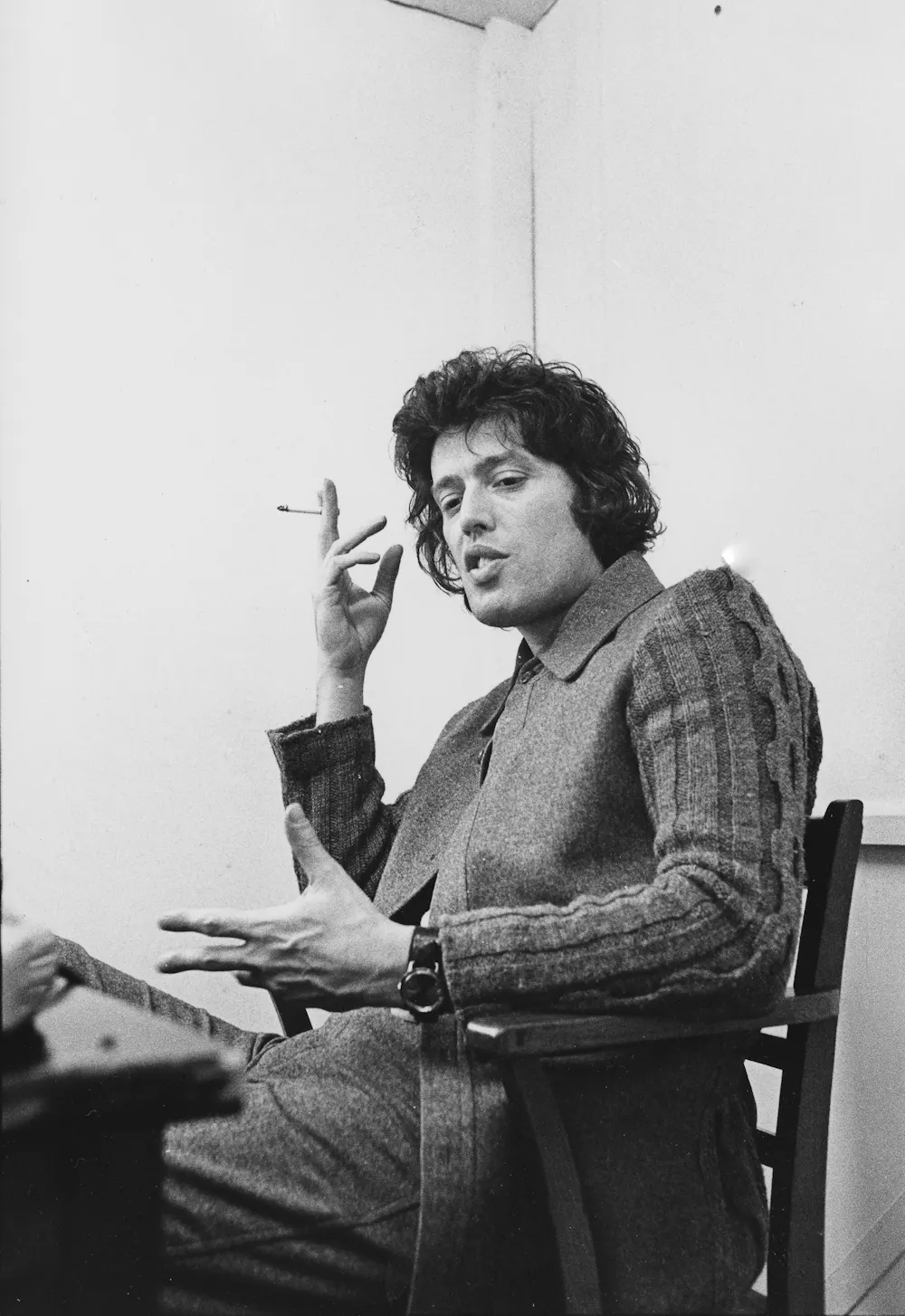
Stoppard  sitting at a table and smoking a cigarette.
Stoppard as a young playwright in 1972. Clive Barda/Radio Times/Getty Images

Stoppard wrote philosophers who tie themselves into cerebral knots failing to prove what they want to believe about God, morals or consciousness in plays such as Jumpers (1972), Rock ‘n’ Roll (2006) and The Hard Problem (2015).

One of Stoppard’s philosophers dictates a lecture in Jumpers, saying “to begin at the beginning: is God? (To SECRETARY). Leave a space”.

Stoppard’s plays sympathise with this forlorn desire to know until it leads characters to ignore other people. Action in the world is more important than the search for knowledge if there is a marriage to be saved, a dying wife to be cared for, or an adopted child to be found. Wittgenstein’s Lecture on Ethics is complex – but Stoppard’s plays show it in effect.

What we know, and how

In his TV play Professional Foul (1977), Stoppard sent philosophers to a conference in Prague. Scholarly debate was contained by totalitarian censorship. The professor of ethics at Cambridge University makes his call for action by riffing on Wittgenstein’s Tractatus: “Whereof we cannot speak, thereof we are by no means silent.”

Stoppard also staged lines from Wittgenstein’s Philosophical Investigations in Dogg’s Hamlet, Cahoot’s Macbeth (1979). Some characters speak English, others use the same words but with different meanings. The audience observes and learns this new nonsense language, laughing at its jokes. They understand the philosophy of language as Wittgenstein did: social conventions between people, not words pinned on things.

What we can know, and how, is crucial to Stoppard’s plays even when the immediate subject matter isn’t philosophy.

It might be quantum physics in Hapgood (1988) or chaos theory in Arcadia (1993); European history in The Coast of Utopia (2002) or contemporary politics in Rock ‘n’ Roll; individual consciousness in The Hard Problem or even whatever we might mean by “love” in The Real Thing (1982). The characters really do want to know. They debate and interrogate but never find definite answers.

As Hannah suggests in Arcadia:

It’s all trivial […] Comparing what we’re looking for misses the point. It’s wanting to know that makes us matter. Otherwise we’re going out the way we came in.

But there are jokes too. Arcadia opens in 1809 with a precocious 13-year-old girl asking her dashing 22-year-old tutor: “Septimus, what is carnal embrace?” before the tutor (originally played by a smoldering Rufus Sewell) pauses, and cautiously replies “Carnal embrace is the practice of throwing one’s arms around a side of beef”.

The audience erupted in laughter. I was one of them.

And as the play draws to a close, a waltz in 1809 happens in the same room as a waltz in the present. As the two dancing couples circle each other, Stoppard’s play suggests that what one person can share with another is more meaningful than justified true belief.

It is a beautiful, theatrical moment. And it is beyond words.The Conversation

Fergus Edwards, Lecturer in English, University of Tasmania

Subscribe to support our independent and original journalism, photography, artwork and film.

Thursday, 25 December 2025

To Feel Loneliness is to be Human: Here’s How to Handle it at Christmas

The Christmas season is like a golden thread, spanning our lives, pulling us back to the past. We often us it as a time to reflect on what we've lost, what we've become and what didn't happen. It can cut deeply. Cover picture of Juana Martin Haute Couture AW25 in Paris by Andrea Heinsohn for DAM


By Paul Jones  

Christmas is often considered a time of connection, warmth and belonging. That’s the script, anyway. But for many people, the reality feels different; isolating, emotionally weighted and filled with comparisons that sting.

Whether you’re spending Christmas alone, navigating grief, or simply don’t feel “festive,” it can feel like you’ve slipped out of sync with the rest of the world. However, that feeling isn’t the same as being alone. Loneliness, isn’t about the number of people around you. It’s about connection, and the absence of it.

This time of year intensifies emotional experience. Rituals such as decorating a tree or watching a favourite film may bring up memories. These could be of people, or they could be of former versions of ourselves.

We measure time differently in December, a phenomenon psychologists refer to as “temporal anchoring”. The season acts as a golden thread spanning our lives, pulling us back to the past. We often use it to reflect on what we’ve lost, who we’ve become, and what didn’t happen. It can cut deeply.

It is a sharp counterpoint to the cultural messaging: people coming together, the push to be joyful and the idea that gratitude must prevail. It’s not just tinsel that is expected to sparkle. We are, too.

Some people are more vulnerable at this time of year, particularly those in flux or transitioning. A recent breakup, moving house, a medical diagnosis or redundancy can often lead to feeling emotionally unanchored. Others carry complex feelings about family, grief or past trauma, which make forced joy or cheerfulness jarring.

Personality plays a role too. People high in traits such as neuroticism or socially prescribed perfectionism can be more vulnerable to distress and loneliness when life does not live up to their expectations.

Your brain on loneliness

Studies have shown that chronic loneliness can increase stress hormones such as cortisol, impair immune function and even affect cardiovascular health. Social neuroscientist John Cacioppo described loneliness as “a biological warning system” that our need for connection isn’t being met.

Loneliness, though, is a normal human response. It is a reaction to a mismatch between our desired social experience and our reality. Self-discrepancy theory helps explain why this mismatch causes emotional pain. When there’s a gap between who we are and who we feel we should be, whether it is socially, emotionally or even seasonally, discomfort follows. Christmas, with all its trimmings, amplifies that gap.

Close up of person sitting on floor with mug of tea surrounded by Christmas-y things.
Do Christmas your own way. Bogdan Sonjachnyj/Shutterstock

Solitude isn’t the enemy

That said, being alone at Christmas doesn’t automatically mean something’s wrong. In fact, it might be exactly what you need.

For many, this time can be a rare opportunity for space, stillness and healing. It might be the only time of year when you get the space to hear your own thoughts, reflect or reset. Choosing solitude purposefully can be deeply restorative.

Connecting with yourself can be just as important as connecting with others. Research into self-determination theory also highlights autonomy, competence and relatedness as core psychological needs.

Autonomy, in particular, means honouring your own choices, not other people’s expectations. For example, choosing to spend the day quietly reading, cooking for yourself, or creating a personal ritual supports both autonomy and competence. These acts reinforce your ability to care for yourself and reduce the pressure to seek validation from others.

Philosophers such as 19th-century Danish thinker Søren Kierkegaard and ancient stoic Epictetus emphasised the importance of tuning into your own inner life rather than being governed by external forces. They remind us that authenticity doesn’t come from performing joy for others, but from noticing what we need and choosing to honour it.

The key is alignment. Do what nourishes you, not what performs well on Instagram, and let the societal pressures wash over you rather than be driven by them.

So what can help?

Trying to “fix” loneliness with a to-do list isn’t the answer. It’s about tuning into what you need. These approaches are rooted in psychological and philosophical insight. They are not quick fixes.

1. Let yourself feel it

Loneliness hurts. It’s okay to name it. Pushing it away rarely works. Accepting and sitting with it can be the first step toward softening its grip.

2. Create micro-rituals

Small routines bring meaning and structure. Brew a particular tea. Rewatch a film that resonates. Light a candle for someone you miss. Rituals connect you to something larger but also connect you to yourself.

3. Reframe connection

Closeness doesn’t have to mean crowds. It might mean sending a message, joining a quiet online space or simply being present with yourself. Journaling, voice notes or reflective walks can all be forms of inward connection.

4. Celebrate your uniqueness

You are not a statistic. You don’t need to aim for the “average” mental health baseline. Your emotional life is yours alone. A little variation, a little eccentricity, these are signs of being alive.

5. Find what works for you

There’s no one right way to do Christmas. Whether it’s a solo walk, a day in pyjamas, or calling one person you trust, the point is to honour your individuality.

If you’re feeling out of step this Christmas, that doesn’t make you broken. It makes you aware. You’re noticing what’s missing; you are listening. That’s not weakness, it’s one of the greatest sources of wisdom.

In The Book of Disquiet, Portuguese poet and philosopher Fernando Pessoa wrote: “To feel today what one felt yesterday isn’t to feel – it’s to remember today what was felt yesterday, to be today’s living corpse of what yesterday was lived and lost.”

It’s a stark image, but a truthful one. At Christmas, we often try to summon old feelings, those of joy, warmth, and belonging, as if they can be reactivated on command. But what if we didn’t force it? Christmas doesn’t have to be remembered joy. It can be present truth.

Loneliness isn’t something to be solved or suppressed. It’s a companion on the journey inward.

And sometimes, the most meaningful connection we can make is with ourselves.

Paul Jones, Associate Dean for Education and Student Experience, Aston University, UK.

Subscribe to support our independent and original journalism, photography, artwork and film.

Wednesday, 24 December 2025

A Brief History of Mulled Wine: From Health Tonic to Festive Treat

    Artsiom Lebedzeu/Alamy
By Sara Read

When frost sparkles in the morning and our breath is visible as we venture outside, thoughts turn to winter warming treats like mulled wine – a drink full of ingredients that have become synonymous with Christmas.

Mulled wine is made by adding spices such as cinnamon, cloves, ginger, mace and nutmeg to sweetened red wine, which is then warmed gently. Across Europe and Scandinavia, it can be purchased in many pubs, bars and festive markets – while supermarket shelves groan with bottles of readymade mulled wines for you to heat at home.

There are many different English recipes out there, including some dating back to the 14th century – from a collection of manuscripts that later became known as The Forme of Cury. The beverage made by following this recipe would certainly have packed a punch, as it contains several spices from the ginger family including galangal, in addition to the more familiar ones.

And before wine was known as mulled, drinking wine flavoured with spices has a long history. There is a mention of drinking spiced wine in the biblical poem the Song of Solomon, which states: “I would give you spiced wine to drink.”

It is thought that spice-infused wine was introduced to Britain by the Romans. An older name for it was “hippocras”, although this was mainly taken as a health tonic – made from spice-infused red or white wine and taken hot or cold.

A man drinking wine.
An illustration from a medieval manuscript showing ‘ypocras’ being made. Wikimedia

In The Merchant’s Tale from Geoffrey Chaucer’s Canterbury Tales (1392), the wealthy, elderly knight January takes “ypocras, clarre, and vernage / Of spices hote, to encrese his corrage” (hypocras, clary, and vernage / of spices hot to increase his courage). January sups these three types of spiced wine to boost his virility on his wedding night for his young bride, May.

Diarist and civil servant Samuel Pepys also mentions taking “half-a-pint of mulled sack” – a sweetened Spanish wine – in an almost medicinal way to comfort himself in the middle of a working morning in March 1668, when things had been going wrong for him.

The name mulled wine comes from the Old English mulse – an archaic name for any drink made of honey mixed with water or wine, derived from the Latin word for honey (mel) and still used in modern Welsh as mêl. From mulse we get “musled”, which was used to describe anything that has been “mingled with honey”.

Before the growth of the global sugar trade, honey was the main way that food and drink was sweetened. Vin chaud, the French equivalent of mulled wine, is traditionally sweetened with honey. England imported spiced wine from Montpellier in large quantities from the 13th century, but only those of social status, like Chaucer’s knight January, would have been able to indulge in those days.

Warm sweet and spiced wine continued to be drunk for health and enjoyment throughout the centuries. But in the 18th century, mulled wine evolved again, as reflected in a recipe in Elizabeth Raffald’s The Experienced English House-keeper (1769) for a warm drink thickened with egg yolks:

Grate half a nutmeg into a pint of wine and sweeten to your taste with loaf sugar. Set it over the fire. When it boils, take it off to cool.

Beat the yolks of four eggs exceeding well, add to them a little cold wine, then mix them carefully with your hot wine a little at a time. Pour this backwards and forwards several times till it looks fine and bright.

Set it on the fire and heat a little at a time till it is quite hot and pretty thick, and pour it backwards and forwards several times.

Send it in chocolate cups and serve it up with dry toast, cut in long narrow pieces.

The result of this method is a frothy, velvety smooth confection, enjoyed with dipping toast or biscuits.

Our ancestors didn’t associate mulled wines with Christmas, so it seems likely that the pairing was popularised by Charles Dicken’s 1843 novella A Christmas Carol – like so much of what we now regard as a traditional Christmas.

After Mr Scrooge has seen the error of his miserly ways, he says to Bob Cratchit: “We will discuss your affairs this very afternoon, over a Christmas bowl of Smoking Bishop, Bob!” Smoking Bishop is a recipe for mulled wine that combines port in the wine and uses dried oranges for an added flavour note. The smoke refers to the steam rising from this hot drink.

So this year, as you cup your hands around the warm mug and inhale the fragrant steam coming off your mulled wine, think of the long history you are a part of.

The ConversationSara Read, Lecturer in English, Loughborough University

Subscribe to support our independent and original journalism, photography, artwork and film.

Friday, 5 December 2025

How a Medieval Oxford Friar Used Light and Colour to Find Out What Stars and Planets are Made Of

Fishacre would have been delighted to know that nearly 800 years after his discoveries, contemporary astronomy is using light and colour to show far flung stars and planets are all made from the same elements.


By William Crozier, Durham University

During the 1240s, Richard Fishacre, a Dominican friar at Oxford University, used his knowledge of light and colour to show that the stars and planets are made of the same elements found here on Earth. In so doing he challenged the scientific orthodoxy of his day and pre-empted the methods and discoveries of the 21st-century James Webb space telescope.

Following the Ancient Greek philosopher Aristotle, medieval physics affirmed that the stars and planets were made from a special celestial element – the famous “fifth element” (quinta essentia) or “quintessence”. Unlike the four elements found here on Earth (fire, water, earth and air), this “fifth element” is perfect and unchanging.

Fully transparent, it formed the basis of what were believed to be the nine concentric celestial “spheres” surrounding the Earth, as well as the various stars and planets attached to them. These, it was argued, were merely condensed versions of the “fifth element”, with each of the first seven spheres having its own planet, and the outermost eighth and ninth spheres containing the stars and heaven itself, respectively.

A Medieval chart of the nine 
concentric celestial 'spheres’ 
surrounding the earth. 
Oxford University

Colour, light and the stars

Lacking access to telescopes and rock samples, Fishacre – the first Dominican friar to teach theology at Oxford University – openly rejected the idea that the stars and planets were made from some special “fifth element”. In his opinion, they consisted of the same four elements found here.

His reason for asserting this position was his understanding of how colour and light behave.

Colour, Fishacre noted, is typically associated with opaque bodies. These, however, are always composite, meaning made up of two or more of the four terrestrial elements. When we look up at the stars and planets, however, we see that the light they emit often has a faint colour. Mars appears red, and Venus yellow, for example. This suggests, of course, that they are composite and thus made “ex quattuor elementis” – “out of the four elements”.

In Fishacre’s opinion the surest proof that the stars and planets were not made of some special “fifth element” came from the Moon. It has a very definite colour, and, crucially, every so often it eclipses the Sun. Were it made from the transparent fifth element – even a highly condensed version of it – then surely the Sun’s light would pass through it, just as it does a pane of glass. This, however, is not the case.

The Moon, Fishacre reasoned, must therefore be made of the same elements found on Earth. And if this was true of the Moon, which is the lowest celestial body, then it must also be true of all the other stars and planets.

The James Webb space 
telescope confirmed 
what Richard Fishacre 
claimed about the 
composition of stars.

A brave move

In arguing this, Fishacre knew that he was risking criticism. “If we posit this position,” he wrote, “then they, that crowd of Aristotelian know-it-alls (scioli aristoteli), will cry out and stone us”.

Sure enough, stones were thrown at Fishacre – and from high places. In 1250, his teaching was denounced at the University of Paris by St Bonaventure of Bagnoregio, a Franciscan friar who ridiculed in his lectures those “moderns” like Fishacre who foolishly questioned Aristotle’s teaching on the celestial fifth element.

Contemporary astrophysics has, of course, vindicated Fishacre’s position. The stars and planets are not made of some special fifth element, but rather from many of the same metals and elements found here on our home planet. The James Webb space telescope, for example, recently established that the atmosphere of the Neptune-like exoplanet TOI-421 b, some 244 light years away, contains high quantities of water and sulphur dioxide.

Remarkably, how the James Webb space telescope established this – a process known as transmission spectroscopy – is very similar, at least in principle, to the method which Fishacre employed. It detected subtle variations in the brightness and colour of the light emitted by TOI-421 b which could only be caused by water and sulphur dioxide.

Given how much criticism his claims received, Fishacre would no doubt have been delighted to know that nearly 800 years after his death, contemporary astronomy, just like him, is using light and colour to show that far flung stars and planets are all made from the same elements.

The ConversationWilliam Crozier, Duns Scotus Assistant Professor of Franciscan Studies, Durham University

Subscribe to support our independent and original journalism, photography, artwork and film.